
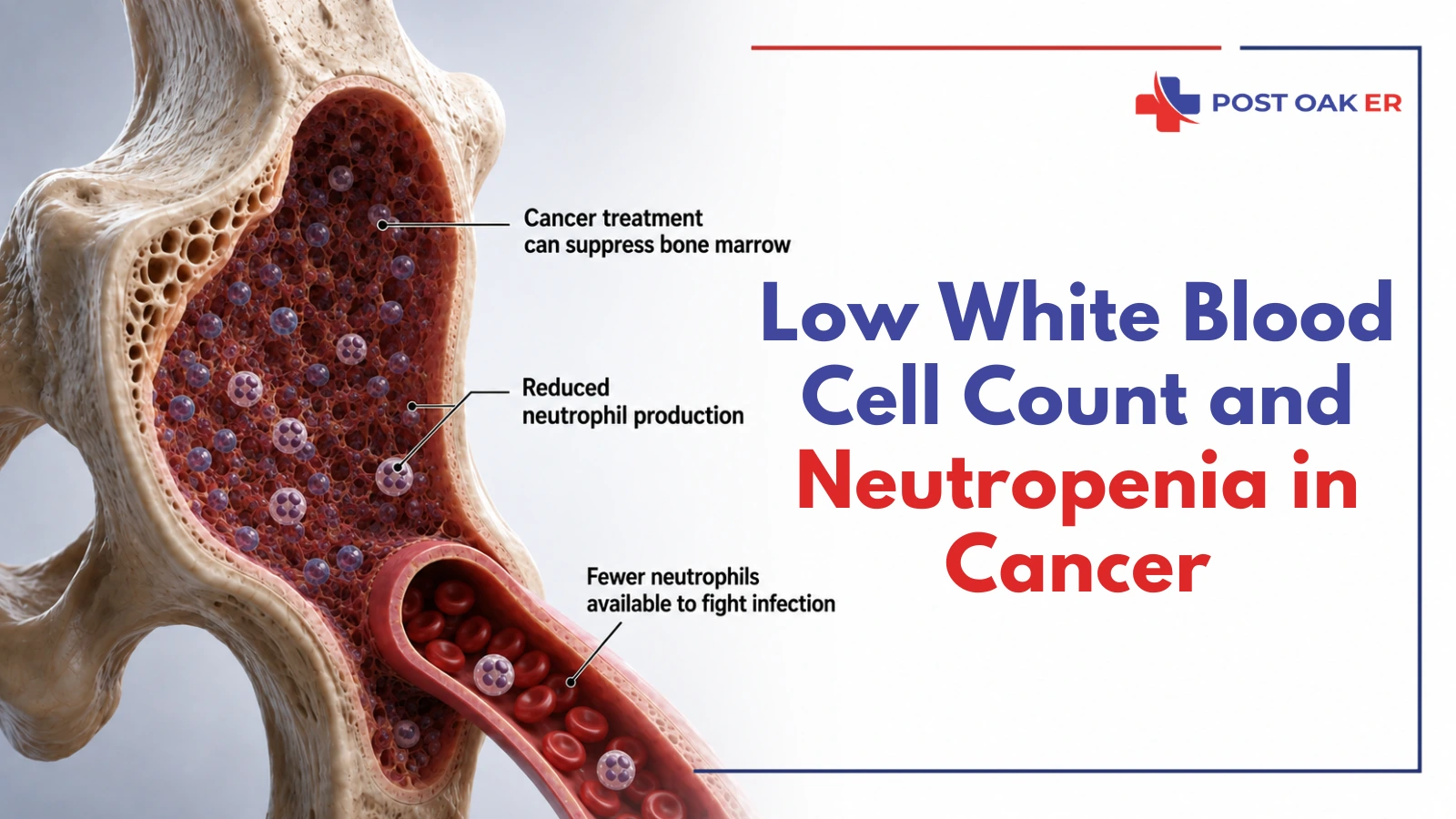
A low white blood cell count on a cancer lab report can be concerning, but the number alone does not show whether you are in immediate danger. What matters is which cells are low, the neutrophil count or ANC, the trend, recent treatment, and your current symptoms.
For cancer patients, neutropenia matters because it can reduce the body’s ability to contain infection. A stable abnormal result may need oncology guidance; a low count with fever or serious illness can require emergency evaluation.
Low WBC, Neutrophils, and ANC Are Related – but Not the Same Thing
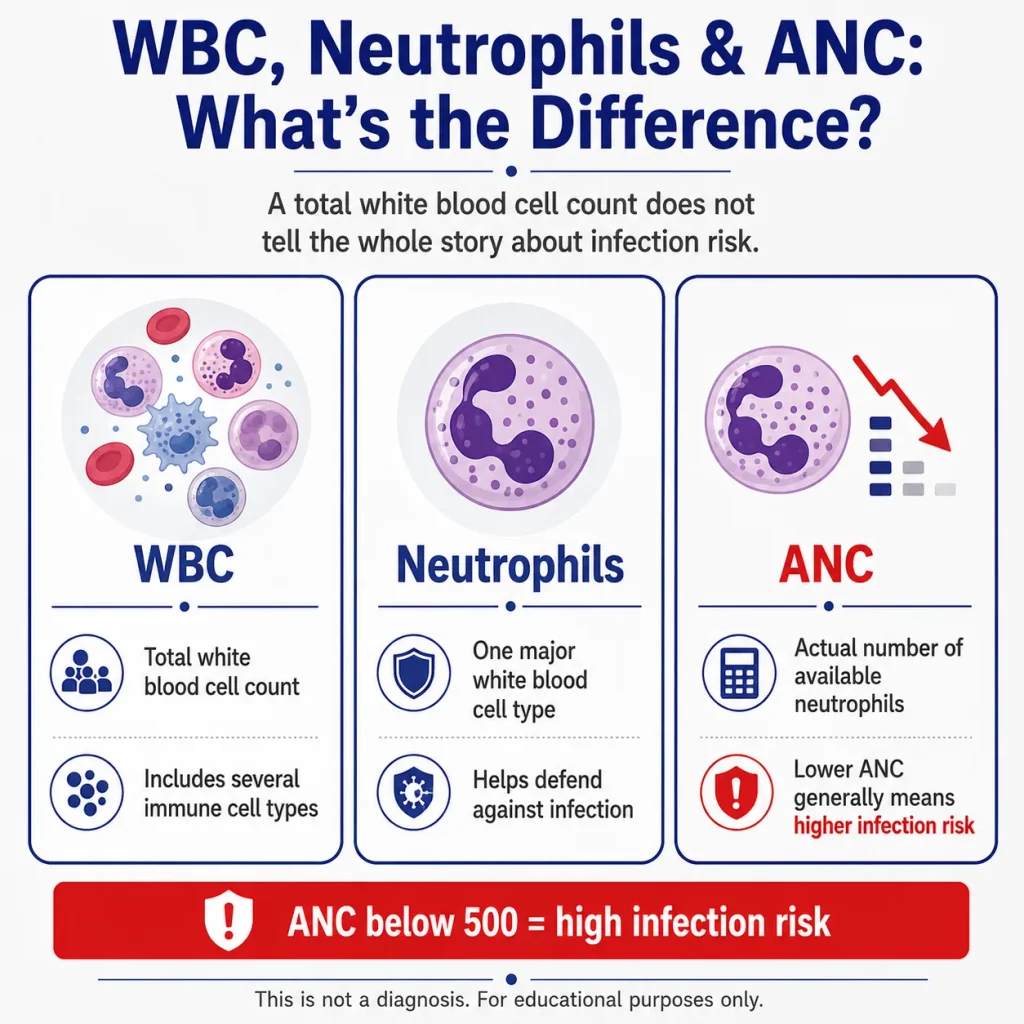
A white blood cell count (WBC) is the total number of several types of infection- and immune-related cells in the blood. The MedlinePlus overview of white blood cell counts explains that a WBC count combines five major cell types, including neutrophils, lymphocytes, monocytes, eosinophils, and basophils.
A CBC with differential goes a step further by showing how much of each white-cell type is present. MedlinePlus explains the blood differential separately from the total WBC. Neutrophils are especially important in this article because they are a major part of the body’s defense against infection.
The ANC is the actual number of neutrophils available in a given volume of blood. The National Cancer Institute definition of ANC emphasizes a practical point: as ANC falls, infection risk rises. This is why a total WBC can be low without telling the whole story. Clinicians usually interpret the WBC, differential, ANC, recent treatment, and symptoms together.
Why a Low Count Matters More During Cancer Care
Cancer and cancer treatment can lower blood counts in several ways. Some cancers affect bone marrow function, while chemotherapy and certain other cancer treatments can suppress production of neutrophils. The American Cancer Society guidance on neutropenia describes cancer and cancer treatments among the causes and notes that neutropenia itself often causes no symptoms.
The practical concern is infection risk. When neutrophils are reduced, an illness that starts mildly can become serious more quickly. Counts also rise and fall during treatment, so the same ANC can mean different things depending on whether it is dropping, at its expected low point, or recovering.
Is There a “Dangerously Low” WBC or ANC Number?
There is no single WBC number that defines an emergency for every cancer patient. Total WBC includes several cell types, laboratory ranges differ, and ANC is more specific for neutrophil-related infection risk.
For context, American Cancer Society blood-test guidance describes ANC below 1,500 cells per microliter as neutropenia and notes that infection risk becomes much higher when ANC falls below 500. NCI likewise identifies an ANC below 500 as a high-risk level for infection. Those thresholds are clinically useful, but they are not a home safety test.
Clinicians also consider whether the count is falling or recovering, recent cancer treatment, how long severe neutropenia may last, other medical factors, and current symptoms. An ANC of 450 with fever is not the same situation as a similar value in a well patient who has a defined oncology monitoring plan.
Fever Changes the Situation When You Have Neutropenia
Fever with significant neutropenia can represent febrile neutropenia, an oncologic emergency because infection can progress quickly. The National Cancer Institute guidance on infection and neutropenia advises cancer patients to contact their health care team for signs of infection and notes that infections during treatment can be life-threatening and require urgent medical attention.
The American Cancer Society guidance on fever during cancer care notes that fever may be the first and sometimes the only sign of infection in a patient with neutropenia. That is why a fever should not be dismissed simply because the patient otherwise feels relatively normal.
Do Not Rely on How Sick You “Look”
Severe neutropenia can blunt the usual inflammatory response to infection. Redness, swelling, pus, cough, or other familiar signs may be less obvious. A patient who looks reasonably well can still have a serious infection when fever and neutropenia occur together.
Follow Your Oncology Team’s Fever Instructions
Cancer programs often give patients a specific temperature threshold, thermometer method, after-hours number, or instruction to go directly to an ER. Follow that plan rather than waiting for a higher fever. Tell the clinician if you took acetaminophen, ibuprofen, or another fever-reducing medicine because it can lower the measured temperature.
Other Signs of Infection or Serious Illness That Should Raise Concern
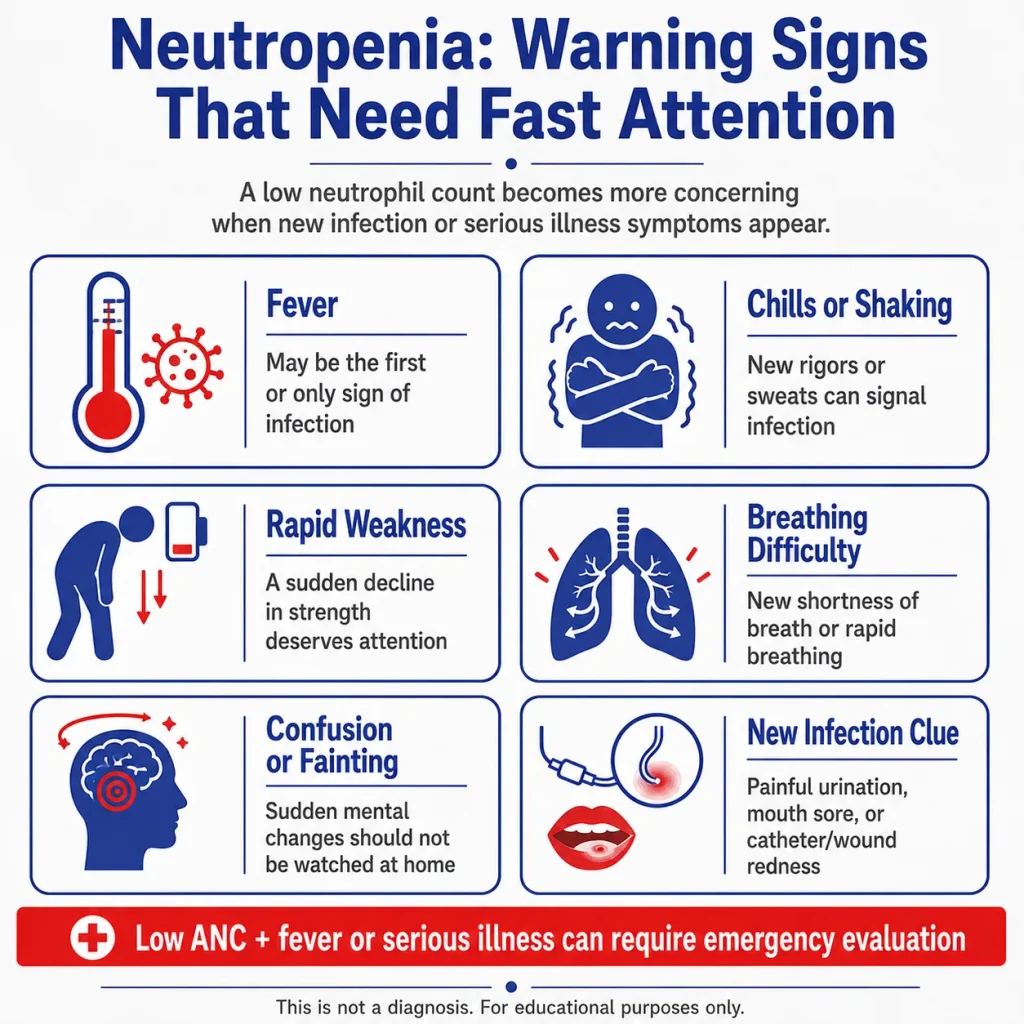
Fever is central, but it is not the only reason a neutropenic cancer patient may need urgent care. A low ANC plus a major change in how you feel can change the decision.
Chills or shaking: especially new rigors or sweats, can accompany infection before other signs are obvious.
Rapidly worsening weakness: a sudden decline in strength or ability to manage normal activities can signal systemic illness.
Breathing difficulty: new shortness of breath, rapid breathing, or worsening cough needs urgent attention.
Confusion, unusual drowsiness, or fainting: these are concerning signs that should not be watched at home.
A new infection clue: painful urination, a mouth sore, redness or drainage around a catheter or wound, or new localized pain may point to an infection source.
When symptoms are severe or changing quickly, do not wait for a scheduled lab recheck.
Stable Abnormal Result or Emergency? How to Decide
Low Count but Otherwise Stable
If you have a low WBC or ANC but feel well, have no fever, and have no new concerning symptoms, the next step may be prompt oncology guidance rather than an automatic ER visit. Your team may recommend repeat labs, precautions, treatment adjustments, or other instructions based on your treatment cycle.
Do not decide safety from one flagged portal result. Your oncology team can judge whether the value fits the expected treatment pattern or needs faster assessment.
Low Count Plus Fever or Significant Illness
Emergency evaluation becomes more likely when a low neutrophil count is paired with fever, shaking chills, severe weakness, trouble breathing, confusion, fainting, or rapid deterioration. Urgency comes from the blood-count abnormality plus the patient’s current condition.
Call 911 for life-threatening symptoms, severe breathing difficulty, collapse, inability to wake normally, or when private transport is unsafe.
What the ER May Evaluate When Neutropenia and Infection Are a Concern
The ER’s job is to identify and treat an acute infection or another dangerous complication, not to manage long-term cancer treatment. The workup depends on symptoms, recent therapy, vital signs, and clinical stability.
Evaluation commonly includes vital signs, a focused examination, and repeat blood testing such as a CBC with differential to confirm the neutrophil count or ANC. Clinicians may add chemistry tests, blood cultures, urine testing, or imaging when symptoms suggest a particular infection or complication.
When febrile neutropenia is identified, time matters. The joint ASCO/IDSA guideline on fever and neutropenia recommends initial empiric antibacterial therapy within one hour of triage, while also using clinical judgment and risk assessment to determine whether outpatient management is appropriate. That disposition decision should be made by the treating clinical team, not by the patient based on a lab result alone.
At Post Oak ER, on-site laboratory services are available to support emergency assessment when blood counts or infection are part of the concern. Testing is selected according to the patient’s presentation rather than as routine cancer monitoring.
When Emergency Symptoms Cannot Wait in Houston
For Houston cancer patients with known or suspected neutropenia, Post Oak ER provides 24/7 emergency care for sudden or serious symptoms. Fever with neutropenia, shaking chills, severe weakness, breathing problems, confusion, fainting, or rapidly worsening illness may need emergency evaluation instead of waiting for routine oncology follow-up. Bring your most recent blood counts and treatment information if they are readily available, and follow any emergency instructions already provided by your cancer-care team.
Frequently Asked Questions
What is considered a dangerously low white blood cell count in someone with cancer?
There is no universal WBC cutoff that defines an emergency by itself. Clinicians weigh ANC, the trend, recent treatment, and symptoms. An ANC below 500 cells per microliter is associated with high infection risk, but serious symptoms can be urgent at other values too.
What does a low neutrophil or ANC count mean?
It means fewer neutrophils are available to fight infection. Lower ANC generally means greater infection risk, especially when the reduction is severe or prolonged. Your oncology team interprets the number in the context of treatment and symptoms.
Can you have a low WBC without being neutropenic?
Yes. Total WBC includes several white-cell types, so the total can be low while the neutrophil count is not in the neutropenic range. A CBC with differential and ANC show which cells are actually reduced.
Why is fever dangerous when your neutrophils are low?
Neutrophils are central to the infection response. When they are very low, infection can become serious quickly and may produce fewer obvious signs. Fever may be the first or only warning sign.
Can neutropenia cause symptoms even when there is no infection?
Neutropenia itself usually does not cause a distinctive symptom pattern. Symptoms may come from infection, cancer, treatment effects, anemia, dehydration, or another problem, so they should be interpreted with the blood counts and treatment history.
Should I go to the ER for a low WBC or ANC if I do not have a fever?
Not every low result requires an ER visit. If you feel well and have no fever or concerning symptoms, contact your oncology team promptly. Seek emergency evaluation when the low count is paired with severe weakness, breathing difficulty, confusion, fainting, rapid deterioration, or another significant sign of infection or illness.