
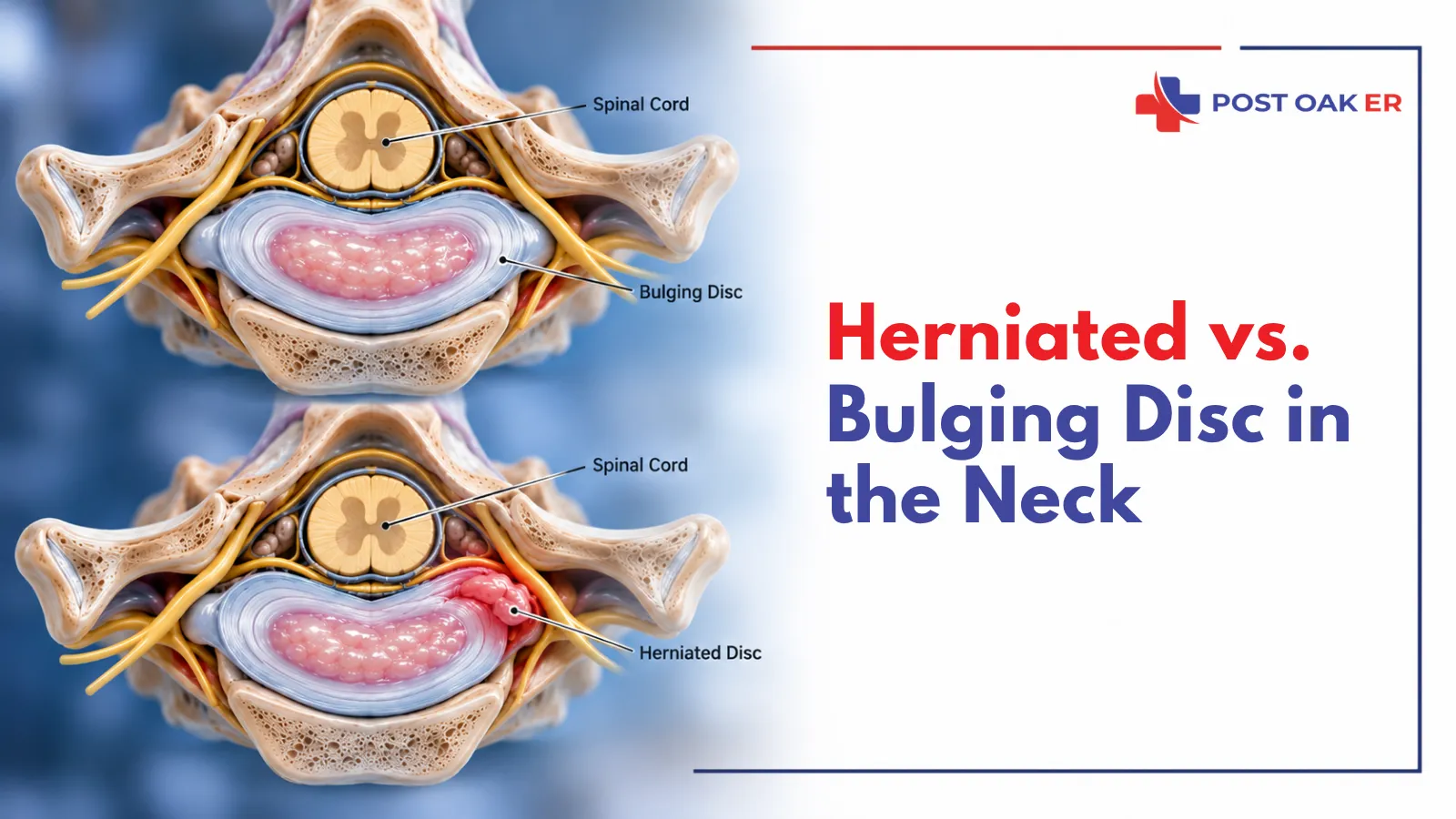
A cervical MRI may report a “disc bulge” at one level and a “disc herniation” at another. Which is worse—and which explains your pain? These labels describe disc shape, not nerve damage or emergency risk. What matters more is the finding’s location, its effect on nerves or the spinal cord, and any changes in your symptoms or abilities.
What Is the Difference Between a Bulging and Herniated Disc in the Neck?
What Is a Bulging Disc in the Cervical Spine?
Discs cushion the neck vertebrae. Each has a tough outer ring around a softer center. With age and wear, a disc can flatten and extend beyond the vertebrae across a broad area. This is called a bulging disc.
A bulge does not necessarily pinch a nerve. Mayo Clinic’s comparison of bulging and herniated discs notes that a bulge can exist without symptoms.
What Is a Herniated Disc in the Neck?
A herniated disc has more localized displacement: material from the softer center may push through a weakened outer ring. Its position determines whether it irritates a nerve root or affects the spinal-cord space.
A small herniation in a tight space can cause symptoms; another may cause none. The American Association of Neurological Surgeons’ overview of herniated discs explains how symptoms relate to disc position and nearby nerves.
Is a Herniated Disc Always More Serious Than a Bulging Disc?
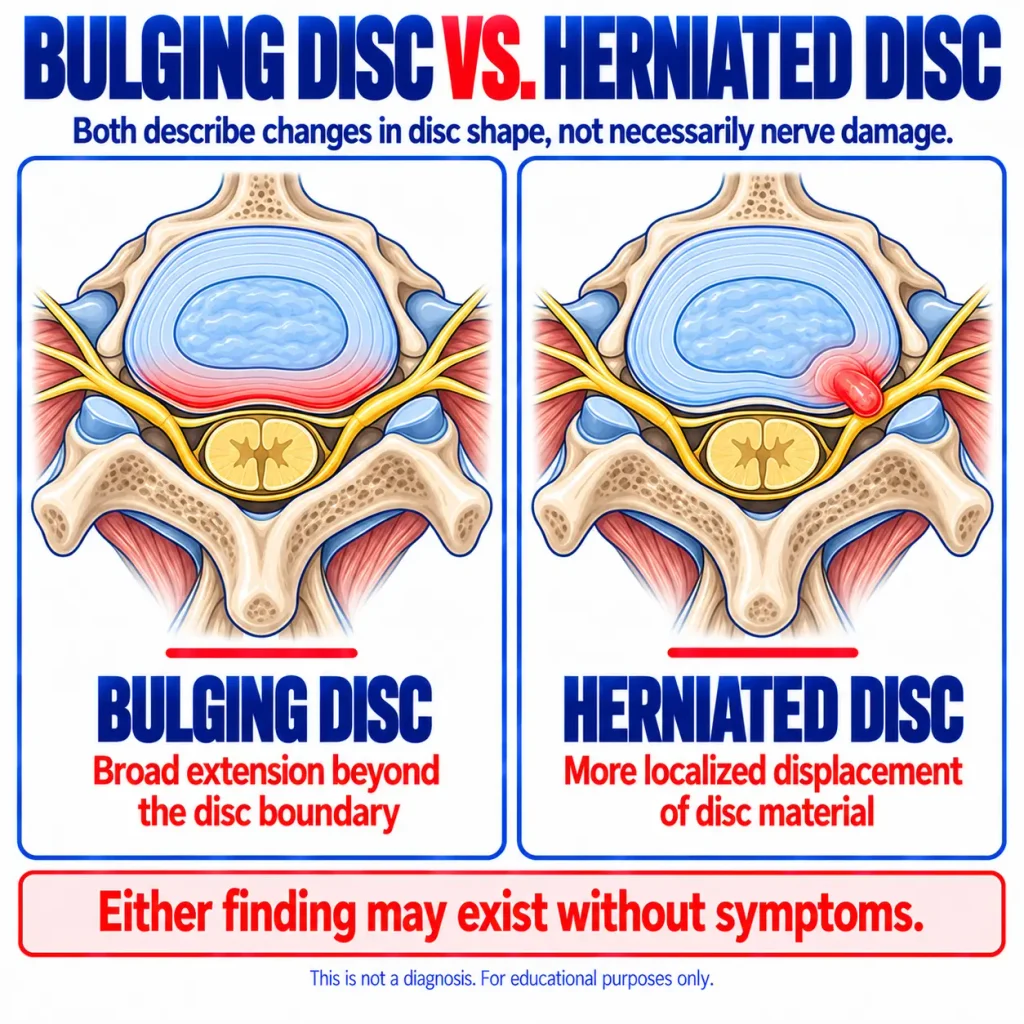
No. A herniation may be more likely to irritate a nerve, but a broad bulge narrowing a nerve passage may matter more than a small herniation that affects nothing nearby. Examination findings and changes in function are more useful for judging severity.
Why Can an MRI Show a Disc Problem Without Causing Symptoms?
Disc Changes Can Appear in People Without Neck Pain
MRI can reveal changes that cause no symptoms. In a study of cervical MRI scans in 1,211 people without related symptoms, researchers found abnormalities in some participants and stressed clinical correlation. Disc changes also increase with age.
Incidental findings are not automatically dangerous or irrelevant. Clinicians consider the location, possible nerve pressure, and whether symptoms fit.
Why MRI Findings and Symptoms Do Not Always Match
MRI shows anatomy, not pain, strength, reflexes, or balance. A prominent disc may leave a nerve unaffected, while a smaller change in a narrow space causes symptoms. Terms such as “mild,” “broad-based,” and “focal” cannot establish clinical severity alone.
What Symptoms Can a Bulging or Herniated Disc in the Neck Cause?
Neck Pain or Discomfort Around the Shoulders
A symptomatic disc may cause neck stiffness, shoulder-blade aching, or pain with neck movement. Muscles, joints, and other structures can cause similar symptoms. Pain intensity or location alone cannot identify the responsible disc.
Pain, Tingling, or Numbness Traveling Into the Arm
A disc irritating a cervical nerve root may cause shooting pain, tingling, or numbness into the shoulder, arm, or hand. The American Academy of Orthopaedic Surgeons’ guidance on cervical nerve-root symptoms explains how symptom patterns and examination help assess nerve involvement.
Weakness or Difficulty Using the Arm or Hand
Nerve involvement can affect strength, not just sensation. Dropping objects, difficulty lifting, or a newly unreliable grip may be clues. Pain can also limit movement without true weakness; clinicians test muscle power instead of guessing from the report.
What Are the Signs That a Bulging or Herniated Disc in the Neck Is Getting Worse?
Increasing Pain or Changes in Sensation
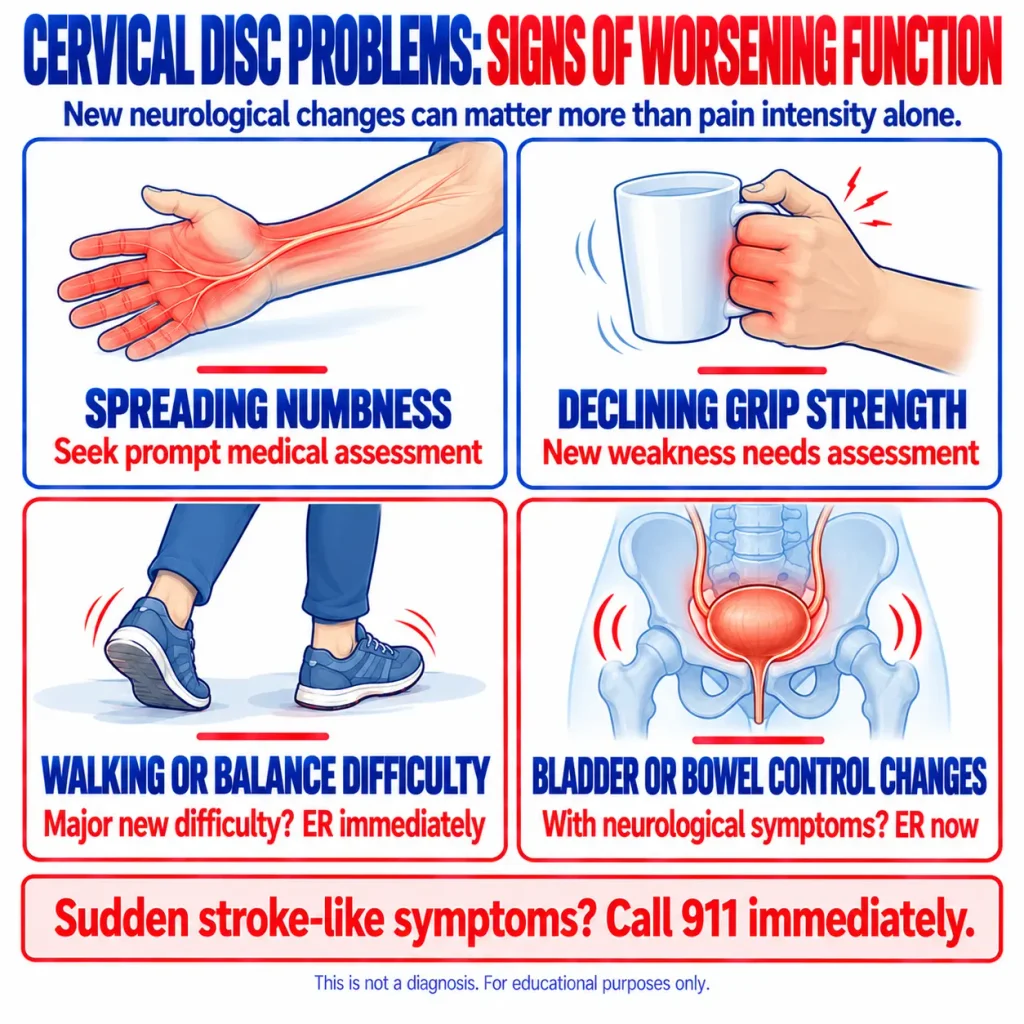
More frequent pain, spreading discomfort, or new tingling can justify reassessment. But worse pain does not prove the disc has enlarged or torn further; symptoms and scan changes do not always track together.
New or Progressively Worsening Arm Weakness
Loss of function is more concerning than pain alone: a newly weak grip, difficulty lifting the arm, or declining use over days. New or progressive weakness needs prompt assessment; severe or rapidly worsening weakness needs emergency evaluation. MedlinePlus describes weakness and changes in arm or hand function among the possible effects of a herniated cervical disc.
Walking Problems or Loss of Coordination
A cervical disc can sometimes affect the spinal cord. New hand clumsiness, balance loss, or walking difficulty may suggest cord involvement. NHS guidance on cervical spinal-cord dysfunction flags changes in walking, hand use, strength, or bladder and bowel function. Rapid deterioration or major neurological loss calls for emergency care.
When Should You Seek Medical Care for a Cervical Disc Problem?
When Emergency Evaluation Is Necessary
Emergency evaluation is needed for severe or rapidly worsening limb weakness, major walking or balance difficulty, sudden loss of function, or bladder or bowel control changes with neurological symptoms. Serious neck injury with neurological symptoms also requires emergency assessment. Avoid moving the neck unnecessarily and call 911 if a major spinal injury is suspected. Post Oak ER’s trauma and injury care information explains its role in urgent injury evaluation.
Never attribute sudden one-sided weakness to an old MRI. Face drooping, speech problems, abrupt weakness, vision changes, or sudden loss of balance may mean stroke. CDC stroke warning-sign guidance advises calling 911 immediately rather than driving yourself.
When Prompt Medical Assessment Is Appropriate
Seek prompt assessment for spreading numbness, disabling arm pain, developing weakness, or changed hand function. Even with a known disc problem, new symptoms can alter testing needs. Do not delay if weakness is progressing.
When an MRI Finding May Be Managed Through Routine Follow-Up
A stable disc finding without neurological warning signs usually does not require emergency care. Outpatient follow-up can compare the scan with symptoms and function. New problems should not automatically be blamed on an earlier report.
How Do Doctors Determine Whether the MRI Finding Is Causing Symptoms?
Comparing Symptoms With the Location of the Disc Abnormality
Clinicians examine the disc level, its side and position, and any narrowing around nerves or the cord. They compare this with the pattern of symptoms. A mismatch may require considering another cause.
Checking Strength, Sensation, and Neurological Function
Examination can include arm and hand strength, sensation, reflexes, and coordination. Walking and balance matter if cord involvement is suspected. The goal is to assess actual function, not merely confirm MRI wording.
When Additional Imaging or Evaluation May Be Needed
Doctors review prior MRI findings alongside current symptoms and examination. New deficits may prompt imaging or specialist assessment, but repeating MRI for every pain flare is unnecessary. The American College of Radiology’s cervical-imaging guidance bases imaging decisions on the presentation and warning signs. Post Oak ER describes its on-site emergency imaging services; on-site cervical MRI is not advertised.
What Happens After a Bulging or Herniated Cervical Disc Is Evaluated?
Next steps reflect how imaging matches symptoms, neurological function, and progression. Stable patients without major deficits may be managed as outpatients. Persistent arm symptoms may need specialist review; significant nerve or cord involvement can require urgent coordinated care. Neither label means surgery is inevitable.
Emergency Evaluation for Changing Neck and Arm Symptoms in Houston
Post Oak ER provides 24/7 emergency medical care for concerning neurological changes in patients near Houston’s Post Oak and Galleria area. Emergency physicians can assess neurological function and injury history, review available imaging reports, and decide whether urgent testing, specialist involvement, or hospital transfer is needed.
Frequently Asked Questions
What is the difference between a bulging disc and a herniated disc in the neck?
A bulging disc extends beyond its usual boundary over a broader area. A herniated disc involves a more localized extension of disc material. Both are descriptions of anatomy, not automatic measures of severity.
Is a herniated disc in the neck more serious than a bulging disc?
Not necessarily. Location, contact with a nerve or the spinal cord, symptoms, and neurological examination determine clinical concern more reliably than either label.
Can an MRI show a bulging disc even if you have no symptoms?
Yes. Cervical disc changes can appear on MRI in people who feel well. A clinician considers whether the finding fits the patient’s symptoms and examination.
Can a bulging or herniated cervical disc cause arm numbness or tingling?
Yes, if disc material irritates or compresses a cervical nerve root. Arm sensations have other possible causes, so the pattern and examination matter.
What are the signs that a bulging disc in the neck is getting worse?
New spreading numbness, reduced grip or arm strength, or changes in balance and coordination may indicate a more concerning clinical problem. Increased pain alone does not prove the disc has structurally worsened.
Can a cervical disc problem cause weakness in the hands or arms?
It can when a nerve root or the spinal cord is affected. New weakness warrants prompt assessment, while sudden severe or rapidly progressing weakness requires emergency evaluation.
Does a herniated disc in the neck always require surgery?
No. Surgery is not an automatic consequence of an MRI finding. Treatment decisions depend on symptoms, neurological findings, progression, and specialist assessment when indicated.
When should you go to the ER for a bulging or herniated disc in the neck?
Seek emergency evaluation for severe or rapidly worsening weakness, major walking difficulty, sudden loss of function, or new bladder or bowel dysfunction with neurological symptoms. For sudden stroke-like symptoms, call 911 immediately.