
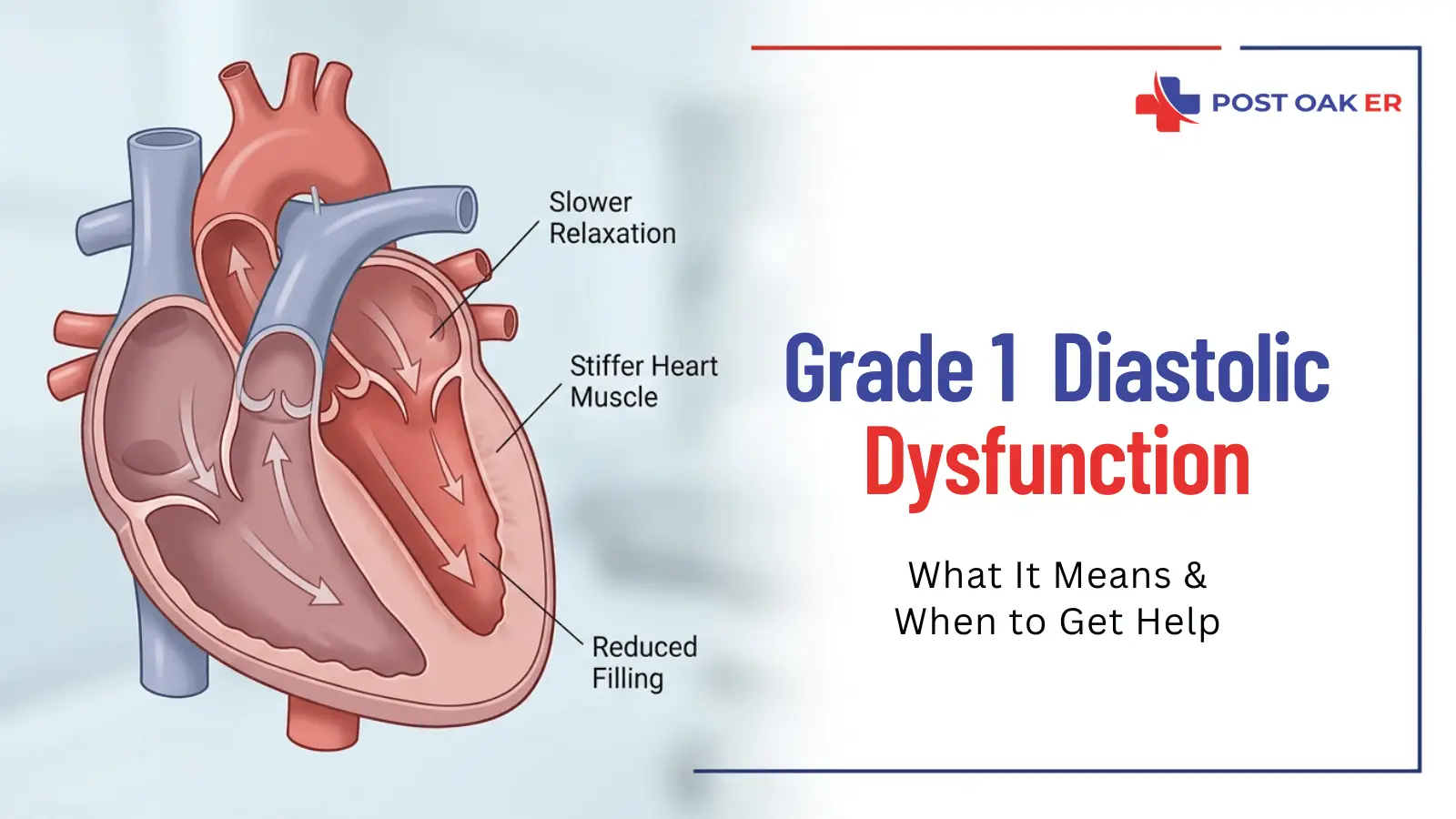
If your echo report says Grade 1 diastolic dysfunction, it usually means the heart’s main pumping chamber is not relaxing as well as it should during the filling phase. In many people, this is an early echo finding rather than proof of severe heart failure. The American Society of Echocardiography’s 2025 update describes Grade 1 diastolic dysfunction as a pattern with reduced relaxation and normal mean left atrial pressure at rest, and Cleveland Clinic describes diastolic dysfunction more broadly as a problem where the lower chambers do not relax and fill properly.
For many patients in Houston, the scary part is seeing the phrase on a report before anyone has explained it. That is why the bigger question is not just “What does this term mean?” but also “Do I have symptoms, and is this something urgent?” In most cases, the answer depends on the whole clinical picture, not the wording alone. Echocardiography is the key test because it helps show how the heart contracts, relaxes, fills, and how the valves are working.
Key Takeaways
- Grade 1 diastolic dysfunction usually means the heart is relaxing more slowly during filling, often with normal filling pressure at rest on the echo pattern.
- It is not automatically the same thing as heart failure.
- Some people have no symptoms at all. Others may notice shortness of breath, lower exercise tolerance, fatigue, or swelling if the problem is affecting the heart more meaningfully.
- High blood pressure, aging, diabetes, obesity, and other heart-related strain can contribute.
- An echocardiogram is the main test that helps identify this pattern.
- Severe shortness of breath, chest pain, fainting, blue lips, or sudden worsening symptoms still need emergency care.
What Does Grade 1 Diastolic Dysfunction Mean?
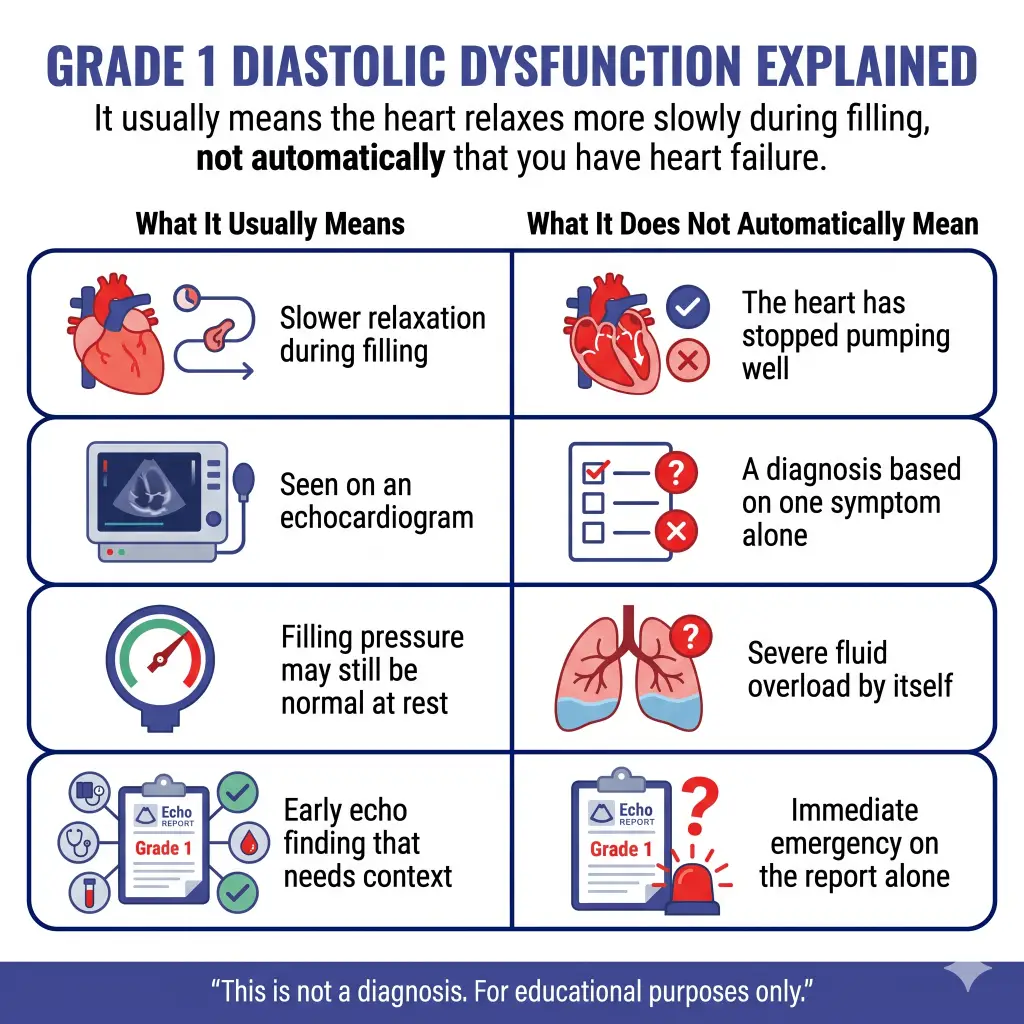
Your heartbeat has two main phases: one when the heart squeezes blood forward, and one when it relaxes and fills again. Diastolic dysfunction refers to a problem in that filling phase. Cleveland Clinic describes it as a situation where the lower chambers do not relax and fill properly.
When a report says Grade 1, it usually points to an impaired relaxation pattern rather than severe filling pressure problems at rest. The ASE update describes Grade 1 diastolic dysfunction as reduced e′ velocity with a normal E/e′ ratio, normal pulmonary artery systolic pressure, and an E/A ratio at or below 0.8, which in plain language means the heart’s relaxation pattern looks abnormal even though resting filling pressure may still be normal.
Is Grade 1 Diastolic Dysfunction the Same as Heart Failure?
No. It is better to think of this as an echo finding than a diagnosis of symptomatic heart failure by itself. Heart failure is a clinical syndrome built from symptoms, physical findings, and test results together, not from one line on a report alone. MedlinePlus notes that echocardiography helps identify the type of heart failure and shows how well the heart contracts and relaxes, but diagnosis still depends on the broader picture.
That said, the two ideas can overlap. The American Heart Association explains that in heart failure with preserved ejection fraction (HFpEF), the heart muscle may contract normally while the ventricles do not relax as they should during filling. So Grade 1 diastolic dysfunction does not automatically mean heart failure, but it can be part of the story in the right patient.
Does Grade 1 Diastolic Dysfunction Cause Symptoms?
Sometimes yes, sometimes no. Some people only learn about it because it shows up on an echocardiogram done for another reason. Others may have symptoms such as shortness of breath, reduced exercise tolerance, fatigue, or swelling if the filling problem is contributing to higher pressures or a broader heart issue. Cleveland Clinic notes that when diastolic dysfunction progresses, symptoms can include fatigue, shortness of breath, swelling, nausea, and weight gain.
This is why symptoms matter more than the phrase alone. A person with no shortness of breath, no swelling, and normal daily function may need follow-up, blood pressure control, and monitoring. A person with clear breathing trouble or worsening stamina needs a closer clinical look.
Why Does This Show Up on an Echocardiogram?
An echocardiogram is the main test used to look at how the heart moves, fills, and pumps. MedlinePlus says an echo shows the heart while it is beating, and heart-failure testing guidance notes it is the best test to help identify the type of heart failure because it shows how well the heart contracts and relaxes.
That is why many people first hear this term after an ultrasound of the heart. The echo is not just looking at ejection fraction. It also looks at filling patterns, valve function, chamber size, and other clues that help a clinician interpret whether the report finding is mild, significant, or mostly something to watch over time.
What Can Cause or Contribute to Grade 1 Diastolic Dysfunction?
Several common conditions can contribute to this pattern. Aging changes how the heart relaxes, and long-standing high blood pressure can make the heart muscle stiffer over time. Diabetes, obesity, coronary artery disease, kidney dysfunction, and metabolic strain are also part of the bigger HFpEF and diastolic dysfunction picture.
That does not mean every person with one of these risk factors will develop symptoms. It does mean the finding makes more sense when placed next to blood pressure history, weight, blood sugar, exercise tolerance, and the reason the echo was ordered in the first place.
What Doctors Usually Focus On After This Finding
Doctors usually focus less on the wording alone and more on what is driving it and whether you actually have symptoms. That often means looking closely at blood pressure, diabetes, weight, kidney health, sleep apnea risk, and whether you are having shortness of breath, swelling, or declining stamina.
They may also review your ejection fraction, compare this study with older echoes if available, and decide whether you need medication changes, cardiology follow-up, or more testing. The goal is not to react to the phrase in isolation. The goal is to understand whether it is an early structural clue, part of symptomatic HFpEF, or a mild finding that mainly needs risk-factor control.
When to Go to the ER or Call 911
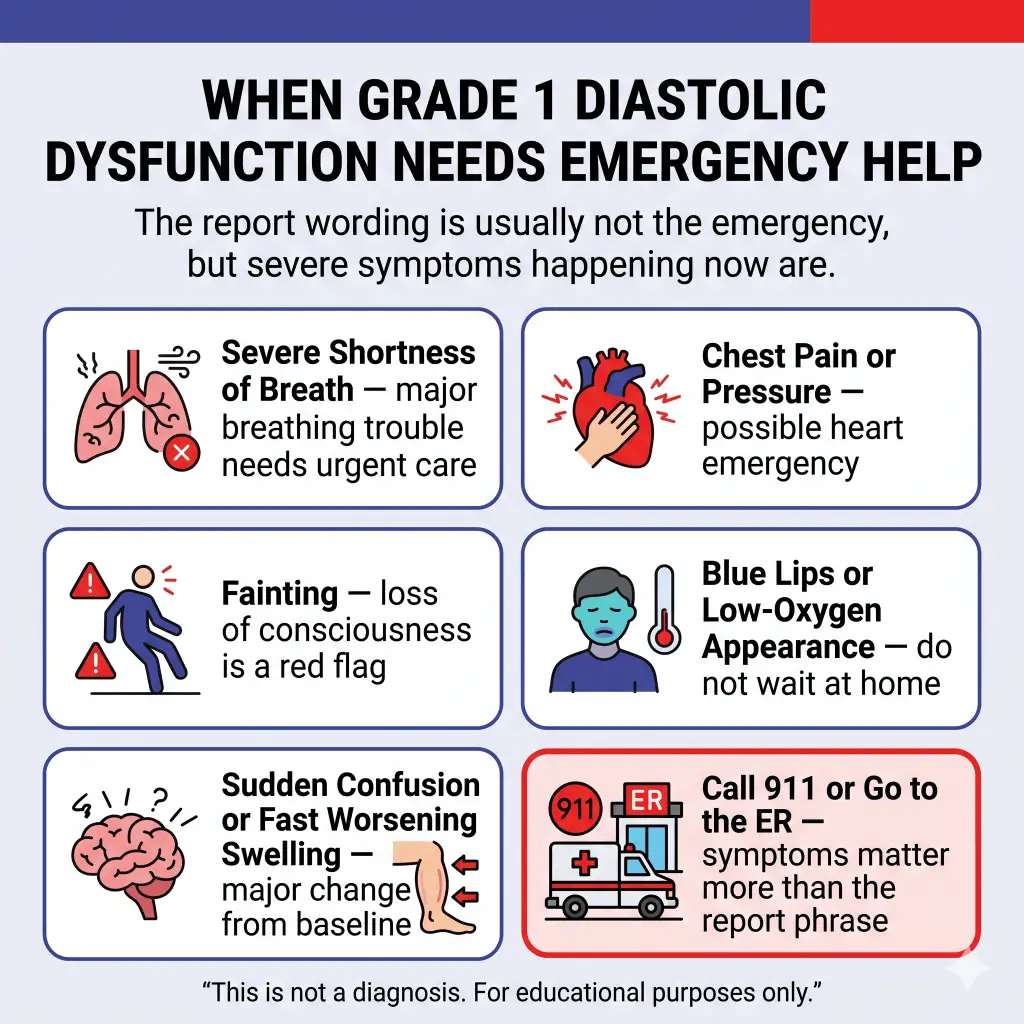
Do not wait for a routine follow-up if you have major breathing trouble, chest pain or pressure, fainting, blue lips, sudden confusion, or a fast worsening of swelling or shortness of breath. Those symptoms can point to heart failure, low oxygen, a heart attack, or another urgent problem. Mayo Clinic and MedlinePlus both describe severe shortness of breath, chest pain, fainting, and rapid worsening as symptoms that need prompt medical attention.
If you are in Houston and you develop chest pain, major breathing trouble, fainting, or other serious heart warning signs, Post Oak ER is open 24/7 for prompt emergency evaluation. Grade 1 diastolic dysfunction on a report is usually not the emergency by itself. Symptoms happening now are what matter most.
What Questions to Ask After You See This on Your Echo Report
A good next step is to ask practical questions, not just scary ones. Ask:
- Do I have symptoms that match this finding?
- Is my ejection fraction normal?
- Is high blood pressure part of the reason this showed up?
- Do I need medication changes?
- Do I need cardiology follow-up?
- Should this be watched over time with repeat imaging?
Those questions help shift the conversation from “I saw a scary phrase online” to “What does this mean in my case?” That is a much more useful way to understand the report.
Grade 1 diastolic dysfunction is often an early echo finding, not a reason to panic by itself. The phrase matters, but your symptoms, blood pressure, risk factors, and overall heart function matter more. The right response is usually follow-up and context, not fear.
Frequently Asked Questions
Is Grade 1 diastolic dysfunction serious?
It can be important, but it is not automatically severe. It usually reflects an early impaired-relaxation pattern on echo, and its real meaning depends on symptoms, filling pressures, and the rest of the heart evaluation.
Can Grade 1 diastolic dysfunction cause shortness of breath?
It can, especially if the filling problem is part of a broader heart issue or progresses over time. But some people with Grade 1 findings have no symptoms at all.
Does Grade 1 diastolic dysfunction mean heart failure?
No, not by itself. It is an echo finding, while heart failure is a clinical diagnosis based on symptoms, exam findings, and testing together.
Can you have a normal ejection fraction with diastolic dysfunction?
Yes. The American Heart Association notes that in HFpEF, the heart may contract normally while relaxing abnormally during filling.
What causes Grade 1 diastolic dysfunction?
Common contributors include aging, high blood pressure, obesity, diabetes, kidney dysfunction, and other forms of heart strain.
Can Grade 1 diastolic dysfunction improve?
What often improves is the overall heart-risk picture and symptom control when blood pressure and other contributors are managed well. The exact echo finding may or may not change, but good follow-up still matters.
What should I ask my doctor about my echo report?
Ask whether you have symptoms related to the finding, whether your ejection fraction is normal, whether blood pressure is part of the cause, and whether you need treatment changes or cardiology follow-up.
When should I go to the ER if I have this diagnosis?
Go right away if you have chest pain, severe shortness of breath, fainting, blue lips, sudden confusion, or fast worsening swelling or breathing trouble.