
A CT angiogram is an imaging test that uses CT imaging and contrast dye to look at blood vessels. When the test is focused on the heart, it is often called a coronary CT angiogram or CCTA, and it helps doctors look at the arteries that supply blood to the heart.
For patients in Houston, this test may come up during a conversation about chest pain, possible coronary artery disease, unclear heart-test results, or future heart-risk evaluation. A CT angiogram can provide useful information, but it is still a test, not a treatment. If symptoms are happening right now and feel severe, sudden, or frightening, emergency care should come before waiting for scheduled imaging.
Key Takeaways
- A CT angiogram uses CT pictures and contrast dye to look at blood vessels.
- A coronary CT angiogram focuses on the coronary arteries, which supply blood to the heart.
- It can help show plaque, narrowing, or blockage in the coronary arteries.
- It is noninvasive, but it still involves radiation exposure and iodine-based contrast dye.
- It is different from a calcium score because a calcium score looks for calcified plaque and gives a risk-related number.
- It is different from a traditional coronary angiogram because no catheter is threaded into the heart arteries during a CT angiogram.
- Chest pain, major breathing trouble, fainting, sudden weakness, or stroke-like symptoms should not wait for a scheduled outpatient test.
What Is a CT Angiogram?
A CT angiogram is a CT scan designed to show blood vessels more clearly. During the test, contrast dye is injected into a vein so the blood vessels are easier to see on the scan. A coronary CT angiogram focuses on the heart’s blood vessels, especially the coronary arteries.
The main idea is simple: CT pictures plus contrast dye help doctors see the shape and condition of blood vessels. For the heart, the test can help evaluate whether the coronary arteries look open, narrowed, or blocked. It does not open an artery, place a stent, or treat a blockage by itself.
What a Coronary CT Angiogram Shows
A coronary CT angiogram looks at the arteries that supply blood to the heart. It can help doctors see whether there is plaque buildup, narrowing, or blockage that may affect blood flow to the heart muscle.
The test may also give information about the structure of the coronary arteries and sometimes other nearby findings, depending on why the scan was ordered. It can be helpful when doctors need a clearer picture of possible coronary artery disease, especially in selected patients where the clinical question fits the test.
When Doctors May Use a CT Angiogram
Doctors may consider a coronary CT angiogram when they need more information about possible coronary artery disease, chest discomfort, unclear heart-test results, or suspected narrowing in the heart arteries. It may also be used when a clinician wants to better understand the pattern of plaque or artery narrowing.
This does not mean every person with chest pain needs this test. The decision depends on the symptoms, age, risk factors, kidney function, heart rhythm, contrast allergy history, and the exact medical question. In other words, CCTA is useful in the right setting, but it is not a one-size-fits-all heart test.
CT Angiogram vs. Calcium Score
A CT angiogram and a calcium score are both CT-based heart tests, but they answer different questions. A calcium score looks for calcified plaque and gives a risk-related number. A coronary CT angiogram uses contrast dye to look more directly at the coronary arteries and may show whether arteries are narrowed.
This is important because a calcium score is mainly a risk-assessment tool. A CT angiogram gives more detail about the artery itself. One is not automatically “better” than the other. The right test depends on the reason your doctor is ordering it.
CT Angiogram vs. Traditional Coronary Angiogram
A CT coronary angiogram is noninvasive. It uses a CT scanner and contrast dye through an IV, but it does not require a catheter to be inserted into the heart arteries. A traditional coronary angiogram is invasive and involves placing a catheter through the wrist or groin and guiding it toward the heart.
That difference matters because the tests are used differently. A CT angiogram can help evaluate arteries, but it does not treat a blockage. A traditional angiogram may be used when doctors need a more direct look or may need to perform treatment, such as angioplasty or stent placement, during the same procedure.
What Happens During the Test
For a coronary CT angiogram, an IV is placed so contrast dye can be injected. Sticky ECG patches may be placed on the chest to help monitor the heart’s electrical activity during the scan. You lie on the CT table, and the scanner takes images while you may be asked to hold your breath briefly.
Some people may receive medicine to slow the heart rate or help widen blood vessels, depending on the test plan and facility protocol. The scan itself is usually brief, but the full appointment can take longer because of check-in, preparation, heart-rate control, imaging, and observation afterward if needed.
What a CT Angiogram Does Not Do
A CT angiogram does not open a blocked artery. It does not place a stent, remove plaque, or replace emergency care when symptoms are active and severe. It also does not answer every possible cause of chest pain by itself.
This test is one piece of the medical decision. A result may lead to reassurance, follow-up, medication changes, more testing, or referral to a specialist. What happens next depends on the findings and the patient’s full medical picture.
Risks and Reasons It May Not Be Right for Everyone
A coronary CT angiogram involves radiation exposure and iodine-based contrast dye. For many people, the test is safe when ordered appropriately, but some patients need extra caution. That can include people with kidney disease, contrast allergy, pregnancy, certain heart rhythm problems, or a very fast heart rate that makes imaging harder.
This does not mean the test is dangerous for most patients. It means doctors weigh the benefit of the information against the risks and limitations. If you have kidney problems, allergies to contrast dye, or any chance of pregnancy, tell the ordering clinician and imaging team before the scan.
When Chest Symptoms Should Not Wait for a Scheduled CT Angiogram
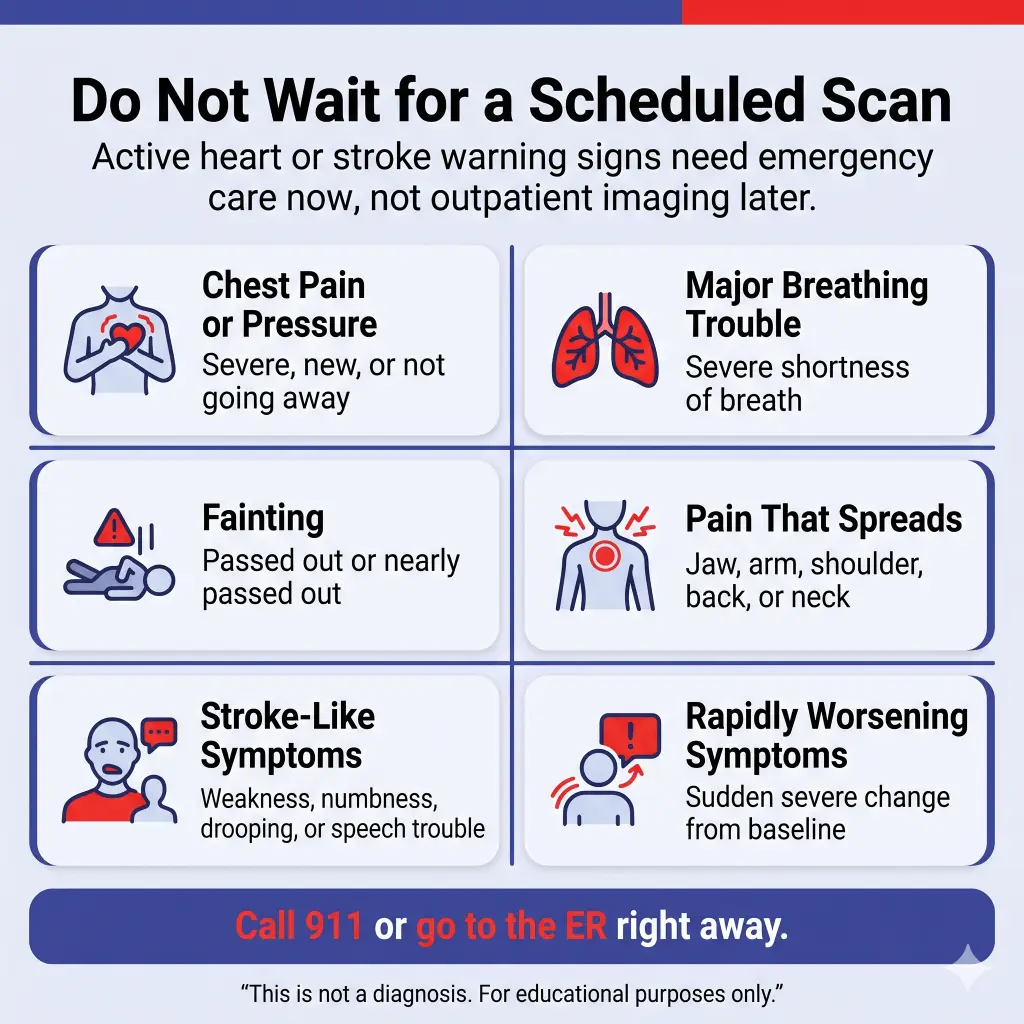
A scheduled CT angiogram can be useful for planned evaluation, but it should not delay emergency care when symptoms are happening now. Chest pain or pressure, severe shortness of breath, fainting, pain spreading to the jaw or arm, heavy sweating, nausea with chest symptoms, or sudden weakness should be treated seriously.
This is especially important if the symptoms are new, severe, not going away, or similar to a previous heart-related episode. A scheduled test is not the right plan for active symptoms that could represent a heart attack, stroke, or another urgent condition.
When to Go to the ER or Call 911
Go to the ER or call 911 right away for chest pain or pressure that is severe, new, or not going away; major breathing trouble; fainting; sudden weakness or numbness; confusion; trouble speaking; facial drooping; severe dizziness with chest symptoms; or symptoms that rapidly worsen. These are not routine imaging questions. They are possible emergency warning signs.
If you are in Houston and you develop chest pain, major breathing trouble, fainting, sudden weakness, or other possible heart or stroke warning signs, Post Oak ER is open 24/7 for prompt emergency evaluation. A CT angiogram may be part of some heart evaluations, but active emergency symptoms should be checked urgently.
What to Ask Before or After a CT Angiogram
Before the test, it is reasonable to ask why the CT angiogram is being recommended and whether it is a coronary CT angiogram or another type of CTA. You can also ask whether contrast dye will be used, whether kidney function blood work is needed first, and whether you should avoid caffeine or certain medicines before the scan.
After the test, ask what the results show, whether the findings are reassuring, and whether any follow-up is needed. Also ask what symptoms should send you to the ER instead of waiting for a future appointment. That final question is important because imaging plans and emergency symptoms should not be treated the same way.
CT Angiogram at a Glance
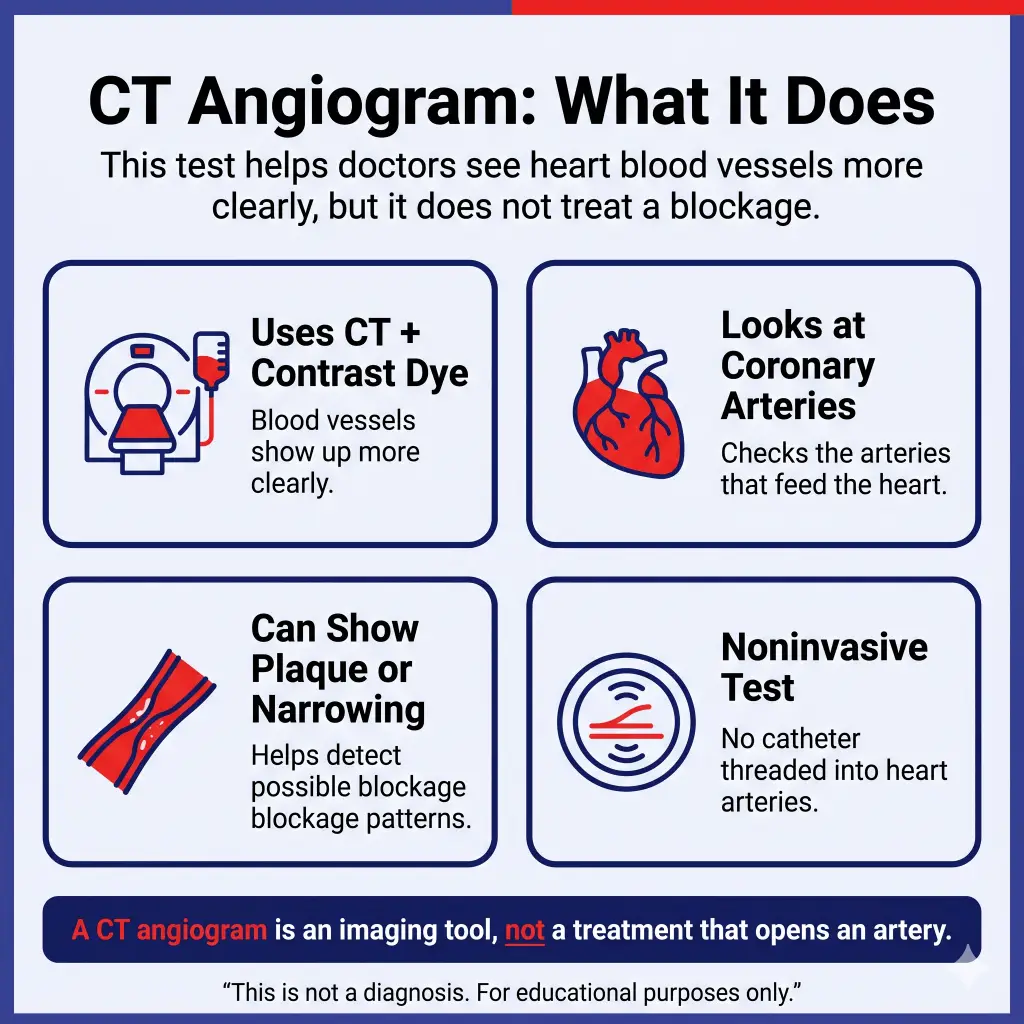
- What it is: A CT test that uses contrast dye to look at blood vessels.
- For the heart: It can show coronary artery plaque, narrowing, or blockage.
- What it is not: A treatment that opens an artery.
- Why it is used: To help doctors evaluate possible artery disease in selected patients.
- When not to wait: Chest pain, severe breathing trouble, fainting, or stroke-like symptoms need emergency care.
A CT angiogram can be a helpful test when the clinical question fits. The best way to think about it is as a detailed imaging tool that helps doctors see blood vessels more clearly. But if heart or stroke warning signs are happening now, the safer choice is urgent evaluation rather than waiting for an outpatient scan.
Frequently Asked Questions
What does a CT angiogram show?
A CT angiogram shows blood vessels. A coronary CT angiogram focuses on the arteries that supply blood to the heart and can help show plaque, narrowing, or blockage.
Is a CT angiogram the same as a coronary calcium score?
No. A calcium score looks for calcified plaque and gives a risk-related score. A coronary CT angiogram uses contrast dye and gives more detail about the coronary arteries and whether they may be narrowed.
Can a CT angiogram show blocked arteries?
Yes, it can help show whether arteries are narrowed or blocked, especially when the scan is focused on the coronary arteries.
Is a CT angiogram painful?
The scan itself is not usually painful. You may feel the IV placement, and some people notice a warm feeling when contrast dye is injected.
Do you need contrast dye for a CT angiogram?
Yes, CT angiography usually uses contrast material injected into a vein so the blood vessels are easier to see.
Is a CT angiogram safer than a heart catheterization?
A CT coronary angiogram is noninvasive, while a traditional coronary angiogram uses a catheter inserted through the wrist or groin. That does not mean one is always the right test over the other; the best choice depends on the medical situation.
Can I wait for a scheduled CT angiogram if I have chest pain?
Do not wait for scheduled imaging if chest pain is severe, new, not going away, or comes with shortness of breath, sweating, fainting, weakness, or pain spreading to the jaw, arm, shoulder, back, or neck.
When should I go to the ER instead of waiting for heart imaging?
Go to the ER or call 911 for chest pain, major breathing trouble, fainting, sudden weakness or numbness, confusion, trouble speaking, facial drooping, or symptoms that feel severe, sudden, or rapidly worse.