

Seeing blood in your urine can be alarming. Sometimes it turns the urine pink, red, or cola-colored, and sometimes the blood is so small you only find out because of a urine test. The medical term for this is hematuria.
Here is the most important takeaway first: blood in urine should not be ignored. Mayo Clinic advises seeing a healthcare professional whenever urine looks like it may contain blood, and the National Kidney Foundation notes that hematuria can happen for many reasons—from infection and kidney stones to more serious causes—and that testing and follow-up matter.
Educational only. This is not medical advice or a diagnosis.
What blood in urine actually means
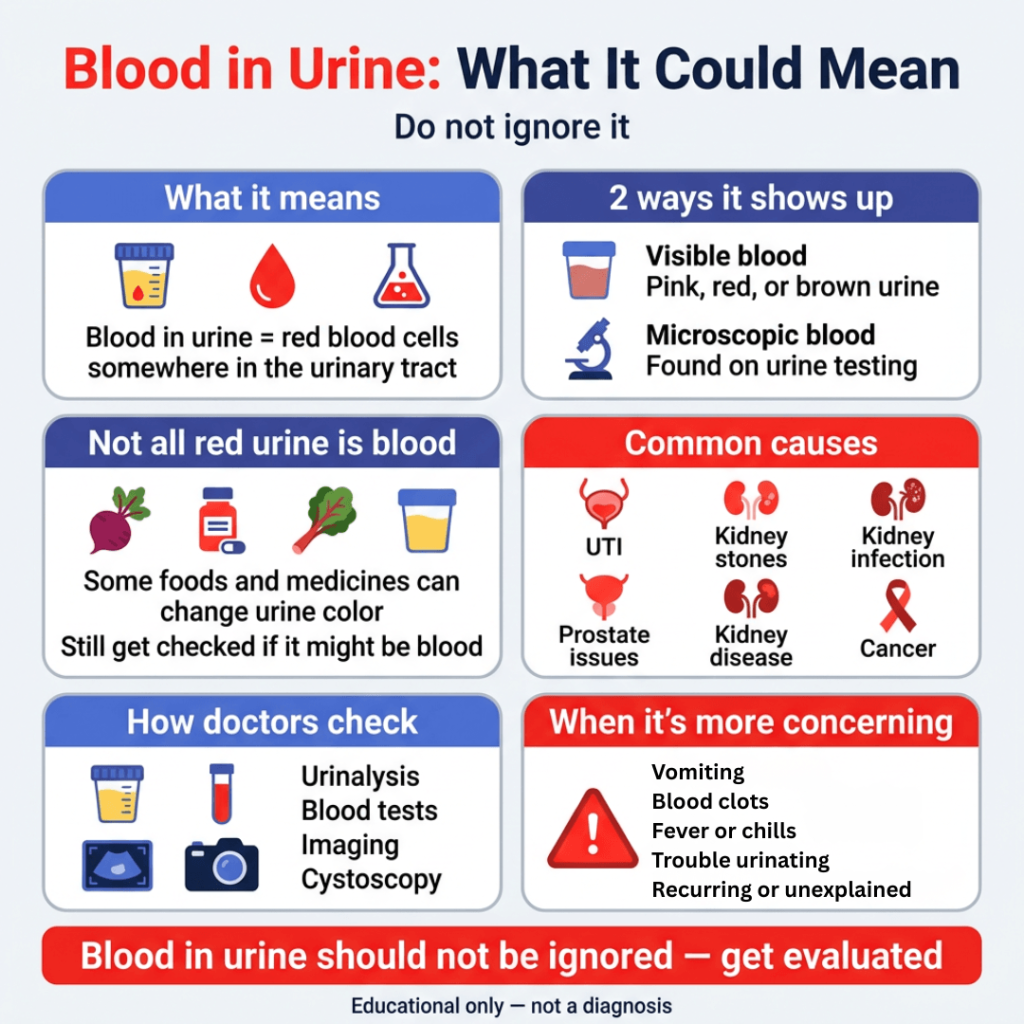
Blood in urine means red blood cells are present somewhere along the urinary tract. That can involve the kidneys, ureters, bladder, prostate, or urethra.
There are two main ways this shows up:
Visible blood in urine (gross hematuria)
This is when the urine visibly looks pink, red, or brown. It can happen with only a small amount of blood, and it is often not painful—although blood clots can hurt when they pass.
Microscopic blood in urine
This is when blood is present but too small to see without a microscope or urine testing. Urology Care Foundation explains that microscopic hematuria can be found during routine testing, even when you do not notice a color change.
Not all red urine is blood
Before assuming the worst, it helps to know that red urine is not always caused by blood. Mayo Clinic notes that some medicines and foods—such as phenazopyridine, beets, and rhubarb—can make urine look red.
That said, you should not self-diagnose. If it might be blood, it deserves evaluation.
Common causes of blood in urine
There are many possible causes, and the right interpretation depends on the rest of your symptoms.
Urinary tract infection (UTI)
A UTI can irritate the lining of the urinary tract and cause blood in the urine. It often comes with burning when you pee, frequency, urgency, or lower abdominal discomfort. MedlinePlus and NKF both list infection as a common cause of hematuria.
Kidney stones or other urinary stones
Stones can scrape the urinary tract and trigger bleeding, often with sharp side/back pain, waves of pain, nausea, or urinary difficulty. Cleveland Clinic and MedlinePlus list urinary stone disease and kidney/bladder stones among important causes.
Kidney infection
If the infection reaches the kidney, symptoms may become more systemic—fever, chills, flank pain, nausea, vomiting—and blood in urine may be part of the picture. Cleveland Clinic lists those associated symptoms with hematuria.
Enlarged prostate or prostate-related irritation
In adults—especially men—prostate issues can cause blood in the urine. MedlinePlus lists prostate infection/inflammation among possible urinary sources.
Kidney disease or inflammation
Kidney inflammation and other kidney diseases can also cause hematuria. MedlinePlus includes kidney inflammation and kidney disease among the possible causes.
Cancer
Blood in urine can sometimes be linked to bladder or kidney cancer, especially in adults and particularly if there are risk factors such as smoking. NKF, MedlinePlus, and Mayo Clinic all note cancer as one of the possible causes that must be considered.
When blood in urine is more concerning
Any blood in urine deserves attention, but certain combinations raise the urgency.
Be more concerned if blood in urine comes with:
- fever or chills
- back or flank pain
- painful urination
- nausea or vomiting
- blood clots
- difficulty urinating or a feeling of blockage
- unexplained weight loss or persistent recurrence
Cleveland Clinic notes hematuria may occur with symptoms such as frequent urination, burning, urgency, nausea/vomiting, fever, chills, abdominal pain, or flank pain. Mayo Clinic adds that passing clots can hurt, and when the cause cannot be found, follow-up may be needed—especially in people with bladder-cancer risk factors such as smoking, pelvic radiation, or certain chemical exposures.
What doctors usually do to find the cause
The main goal is not just to “confirm blood.” It is to figure out why it is there.
Urinalysis
A urine test is usually one of the first steps. MedlinePlus notes that a blood-in-urine test is part of a urinalysis, which measures different cells and substances in urine.
Blood tests
Depending on the situation, bloodwork may be used to look at kidney function and other clues. NHS notes providers may ask for a urine sample and arrange blood tests when evaluating blood in urine.
Imaging
Mayo Clinic says an imaging test is often needed to help find the cause of blood in urine. This may include CT, MRI, or ultrasound, depending on the clinical picture.
Cystoscopy
Mayo Clinic also notes that some patients need cystoscopy, where a tiny camera is used to look inside the bladder for signs of disease.
Warning symptoms that shouldn’t wait

If you have blood in your urine plus any of the following, it is reasonable to seek same-day urgent evaluation:
- Severe side, back, or abdominal pain
- Fever or chills
- Persistent vomiting or inability to keep fluids down
- Blood clots with worsening pain or urinary blockage
- Trouble urinating or very low urine output
- Feeling weak, lightheaded, confused, or rapidly worse
These patterns can point to infection, obstruction, dehydration, or another urgent cause that should not be monitored at home.
If you’re in Houston and you’re seeing blood in your urine with pain, fever, vomiting, or trouble urinating, it’s reasonable to get evaluated promptly instead of waiting to see what happens.
Post Oak ER states it is a 24/7 emergency room in Houston’s Post Oak & Galleria area with board-certified ER physicians, plus on-site CT, ultrasound, X-ray, and labs. Their Houston location page also notes the facility is easy to reach from areas such as Uptown, Westchase, Midtown, the Heights, and the Energy Corridor.
Frequently Asked Questions
Is blood in urine always serious?
Not always—but it should still be evaluated. Some causes are temporary or less serious, while others need prompt treatment or follow-up. Mayo Clinic and NKF both recommend not ignoring it.
Can a UTI cause blood in urine?
Yes. Infection is a recognized cause of hematuria and often comes with burning, urgency, or frequency.
Can kidney stones cause blood in urine?
Yes. Stones are one of the classic causes of blood in urine, especially when paired with severe flank pain or nausea.
If I only see blood once, should I still get checked?
Yes. Even a one-time episode can matter, especially in adults. Mayo Clinic advises evaluation whenever urine looks like it contains blood.
What test is usually done first?
Usually a urinalysis, and then additional testing depending on symptoms and risk factors.