
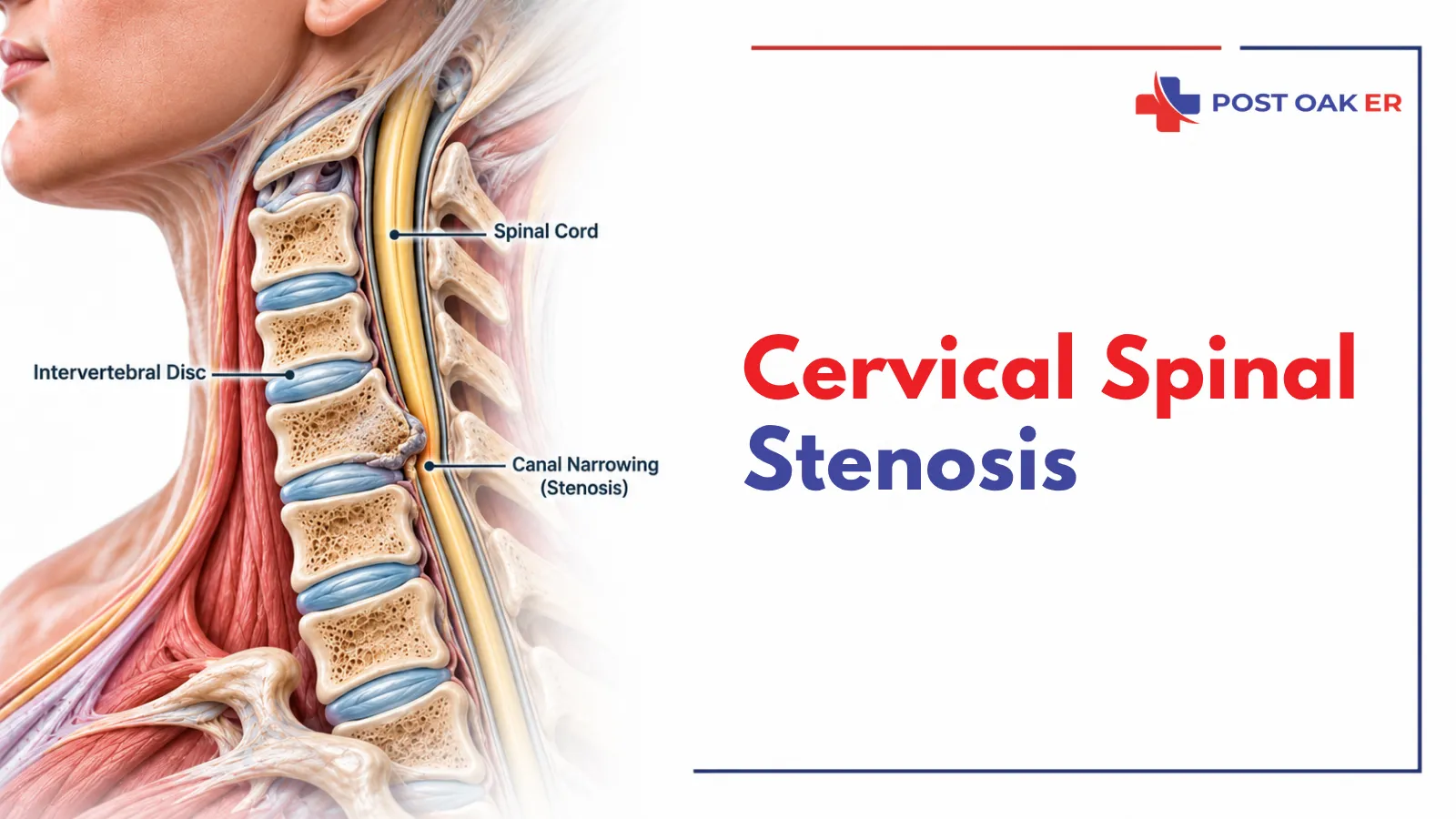
Your MRI report mentions cervical spinal stenosis. You may feel fine, have occasional neck discomfort, or be noticing changes in your hands or balance. Those are very different situations, even if the scan uses the same diagnosis.
Cervical stenosis describes a narrowed space in the neck. It does not automatically mean spinal cord damage, and the wording of the report cannot tell you by itself whether you need emergency treatment. What matters is how the imaging finding relates to your neurological examination, your symptoms, and what you can do today compared with before.
What Does Cervical Spinal Stenosis Mean on an Imaging Report?
The cervical spine is the part of your backbone in your neck. Its central canal contains the spinal cord, which carries signals between the brain and much of the body. Cervical spinal stenosis means this canal has become narrower than usual. If the space becomes tight enough, nearby neurological structures may be compressed.
Often the narrowing develops over years as discs lose height, joints change with age, ligaments thicken, or bone spurs grow. Some people naturally have a narrower canal. The National Institute of Arthritis and Musculoskeletal and Skin Diseases (NIAMS) overview of spinal stenosis explains these changes and the range of symptoms they may produce.
An imaging report describes anatomy. A phrase such as “canal narrowing at C5-C6” locates a finding; it does not establish that the finding explains every ache, that nerves have been injured, or that a procedure is inevitable.
Does Cervical Spinal Stenosis Always Cause Symptoms?
Why Some People Have Cervical Stenosis Without Symptoms
No. A person may learn about cervical narrowing after imaging done for another reason and have no noticeable difficulty using their arms, hands, or legs. Degenerative findings can be present without a corresponding neurological problem. Even an image that appears concerning must be interpreted in the context of the person being examined.
Research on cervical cord compression without clinical symptoms describes this gap between scan findings and how a person functions. Narrowing of the canal and actual spinal cord dysfunction are related concepts, but they are not interchangeable diagnoses.
Why the Severity of Narrowing Does Not Tell the Whole Story
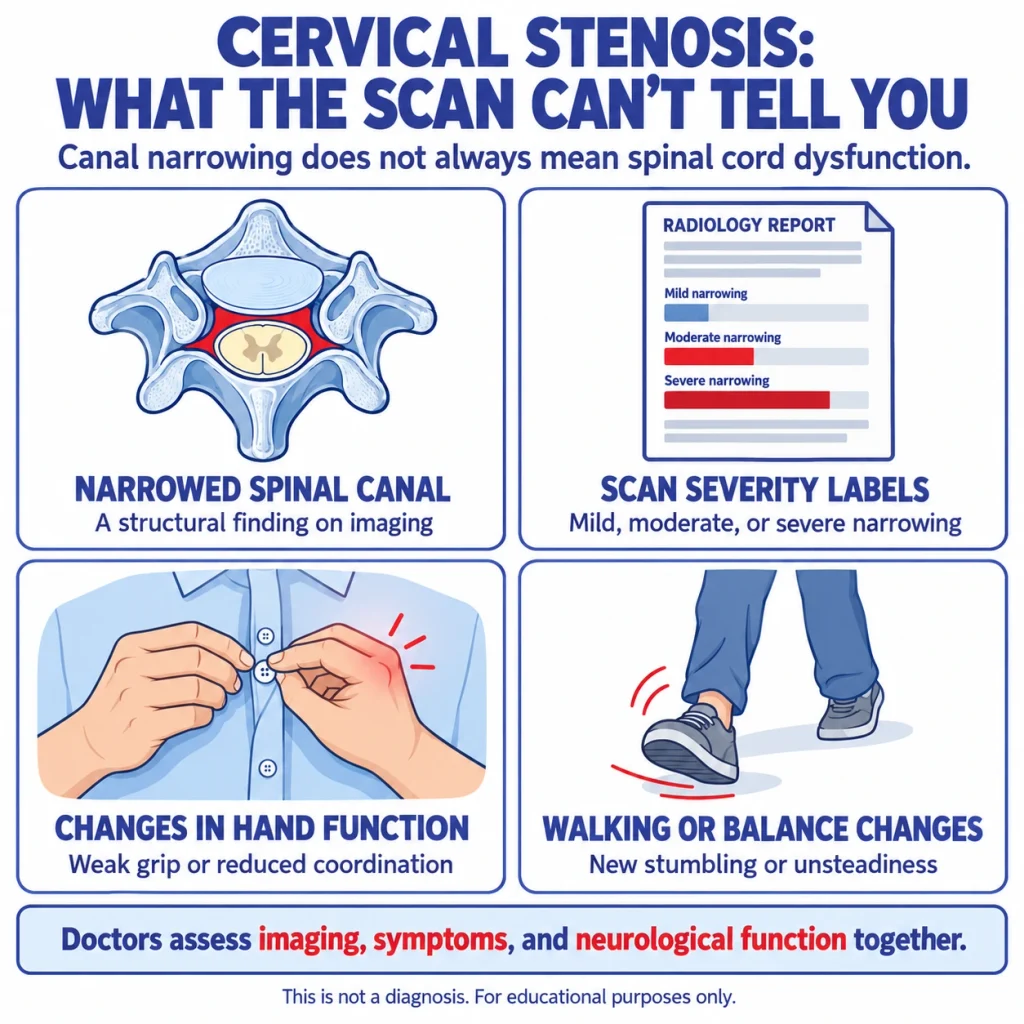
Radiologists may describe stenosis as mild, moderate, or severe. Those words matter, particularly when the canal is very narrow, but they are only part of the assessment. Two people with similar scans can have different examinations, symptoms, and ability to manage daily tasks.
A report of significant narrowing deserves review even if you have few symptoms; it is not a reason to dismiss follow-up. Equally, a relatively modest description does not cancel out new weakness or unsteadiness. The clinician looks for a credible connection between the imaging and the changes you are experiencing.
What Symptoms Can Make Cervical Spinal Stenosis Clinically Significant?
Neck Discomfort, Arm Pain, or Tingling
Some people with cervical narrowing report neck stiffness, pain extending into a shoulder or arm, or tingling in a hand. Narrowing near an exiting nerve root can contribute to radiating symptoms. But arm discomfort has other possible causes, so the scan alone cannot identify the source.
If your main concern is neck pain rather than a new scan finding, Post Oak ER’s guide to when neck pain needs emergency assessment addresses broader symptom and injury warning signs.
Weakness or Changes in Hand Function
Changes in strength or coordination deserve closer attention than pain intensity alone. You might notice a newly unreliable grip, greater difficulty fastening a button, or trouble controlling objects that you previously handled easily. These are examples of altered function, not proof of a particular diagnosis.
The American Academy of Orthopaedic Surgeons’ explanation of cervical spinal cord involvement describes how neurological problems can affect hand strength and dexterity. What matters clinically is whether these problems are new, worsening, or supported by an abnormal neurological examination.
Walking Difficulties or Changes in Balance
The spinal cord also carries signals involved in leg movement and coordination. New unsteadiness, stumbling on familiar ground, or needing unusual support on stairs may prompt an assessment for spinal cord dysfunction, even without severe neck pain.
A clinician must also consider other explanations for balance problems. The aim is not to assume that the scan caused the change, but to identify whether the nervous system is being affected and how quickly evaluation is needed.
How Do Doctors Determine Whether Cervical Stenosis Is Causing Symptoms?
Reviewing Symptoms and Changes in Daily Activities
The conversation begins with timing. When did the numbness, weakness, or walking problem begin? Has it stayed the same, gradually progressed, or changed abruptly? Is one hand affected or both? Can you still do ordinary tasks such as carrying a bag, writing, or walking across a room?
A previous examination or scan can help establish a baseline. A patient who has been stable for years needs a different decision from someone whose ability to walk has deteriorated since yesterday.
Neurological and Physical Examination
An examination may check strength in the arms and legs, light-touch sensation, reflexes, coordination, and gait. The American Association of Neurological Surgeons’ cervical-spine guidance explains why clinicians compare these findings with symptoms and imaging rather than interpreting one test in isolation.
The pattern helps the clinician decide whether a nerve root, the spinal cord, or another condition may be involved. For readers whose principal symptom is reduced arm strength, Post Oak ER has a separate guide to arm weakness and when it is an emergency.
How MRI, CT, and Clinical Findings Fit Together
MRI provides detailed views of the spinal cord, discs, and other soft tissues. CT can be useful for assessing bony narrowing or certain injuries. As the NIAMS guidance on spinal stenosis diagnosis notes, imaging findings alone do not establish whether treatment is necessary.
When meaningful neurological changes appear, a clinician may recommend updated imaging or urgent specialist assessment. The test is selected for the clinical question; it is not automatically the same for everyone with cervical stenosis.
When Does Cervical Spinal Stenosis Need Urgent Medical Attention?
When a Stable Imaging Finding May Not Be an Emergency
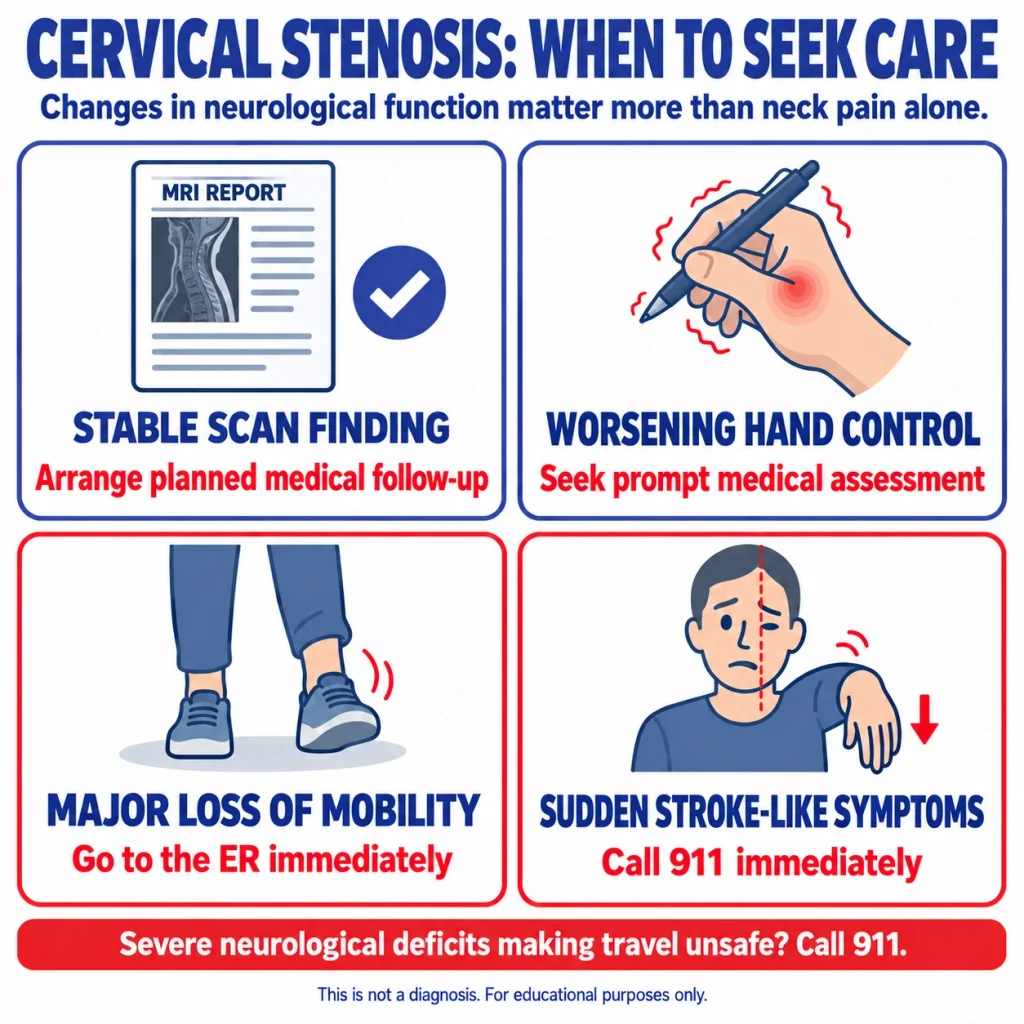
If stenosis was found incidentally, you have no concerning neurological deficits, and daily function is unchanged, a planned visit with your treating clinician may be appropriate rather than an ER visit. The degree of narrowing, the radiologist’s observations, and your medical history still determine what follow-up is needed.
When New or Progressively Worsening Symptoms Need Prompt Assessment
Contact a clinician promptly if you are developing increasing arm or leg weakness, spreading or worsening numbness, deteriorating hand coordination, or a change in walking or balance. Do not wait for pain to become severe. Gradual loss of function can matter even when each individual change seems small.
The MedlinePlus guidance on serious spinal stenosis symptoms identifies worsening weakness, walking difficulties, and urinary or bowel changes as reasons for prompt medical attention. A clinician can decide whether assessment must occur immediately or through an expedited specialist pathway.
When Sudden or Significant Loss of Function Becomes an Emergency
Go to the nearest emergency department immediately for marked or rapidly worsening weakness in an arm or leg, inability or major new difficulty walking, or new loss of bladder or bowel control occurring with neurological symptoms. These changes can raise concern about serious spinal cord involvement or another neurological emergency. If the person cannot move safely or has profound deficits, call 911 instead of attempting to drive.
Sudden facial drooping, one-sided weakness, trouble speaking, loss of vision, or abrupt loss of balance may signal a stroke rather than a neck condition. CDC stroke warning-sign guidance calls for dialing 911 immediately, even if symptoms begin to improve.
What Happens After Cervical Spinal Stenosis Is Diagnosed?
Next steps depend on the symptoms, examination, rate of change, and imaging together. Someone with a stable finding and no neurological impairment may be monitored or referred for routine outpatient review. Progressive symptoms can lead to specialist consultation and additional investigation.
When the spinal cord is significantly affected, a spine specialist may discuss treatment intended to reduce pressure. That decision is individualized; “severe” on a report does not automatically mean surgery, and mild pain does not exclude an important functional problem. The AAOS discussion of treatment decisions in cervical cord compression describes the role of worsening neurological changes in specialist decision-making.
Emergency Evaluation for New Neurological Changes in Houston
For Houston patients with a recent cervical stenosis finding, Post Oak ER provides 24/7 emergency care when symptoms such as significant new weakness, rapidly worsening mobility, or sudden loss of function need assessment. Emergency clinicians can examine neurological function, determine whether available emergency imaging services are appropriate, and arrange additional hospital-level or specialist care when indicated. An ER assessment addresses the urgent problem; it does not replace longitudinal spine follow-up.
Frequently Asked Questions
What does cervical spinal stenosis mean on an MRI report?
It means the central spinal canal in your neck is narrowed. The report describes an anatomical finding; your clinician must decide what it means in light of your symptoms and examination.
Can you have cervical spinal stenosis without symptoms?
Yes. Some people have narrowing on imaging but no noticeable neurological symptoms. A clinician should still review significant findings and advise on follow-up.
Does severe cervical stenosis on an MRI always mean you need surgery?
No. Imaging severity alone does not determine treatment. Symptoms, examination findings, evidence of spinal cord dysfunction, and individual risks guide a specialist’s recommendation.
Can cervical spinal stenosis cause numbness or weakness in the arms?
Yes, particularly when nearby nerves or the spinal cord are affected. Because other conditions can produce similar symptoms, new or worsening weakness needs clinical assessment rather than an assumption based on the scan.
Can cervical spinal stenosis affect walking and balance?
It can if the spinal cord is involved. New stumbling, unsteadiness, or difficulty walking warrants prompt assessment, especially if it is worsening.
What is the difference between cervical spinal stenosis and cervical myelopathy?
Stenosis refers to narrowing of the canal. Cervical myelopathy refers to clinical dysfunction of the spinal cord; it may develop when narrowing compresses the cord, but not everyone with stenosis has myelopathy.
When should I go to the ER for cervical spinal stenosis?
Go immediately for significant or rapidly worsening limb weakness, major new walking difficulty, or new bladder or bowel dysfunction with neurological symptoms. Call 911 for stroke-like symptoms or if severe deficits make travel unsafe.
Can cervical spinal stenosis symptoms worsen even if neck pain is mild?
Yes. Hand coordination, strength, and walking can change without much neck pain. A change in function may be more urgent than the pain score suggests.