

A shirt that suddenly takes longer to button or a walk that feels less steady may seem unrelated. But when hand coordination and walking begin to change together, the problem can sometimes involve the spinal cord in the neck. Recognizing that pattern matters more than measuring how much the neck hurts.
Cervical myelopathy describes a change in spinal cord function, not a diagnosis that can be made from symptoms alone. This guide explains which everyday changes deserve assessment, how they differ from a pinched nerve, and when worsening neurological function calls for emergency care.
What Is Cervical Myelopathy, and How Does It Affect the Spinal Cord?
The cervical spinal cord travels through the neck and carries signals between the brain, arms, trunk, and legs. If it is affected, someone may have difficulty coordinating hand movements or controlling their walking—even without severe neck pain. Johns Hopkins Medicine’s overview of cervical myelopathy describes this combination of fine-motor and balance problems.
A common cause is gradual pressure on the cord as discs, joints, or ligaments in the neck change with age and the space around the cord narrows. Other causes exist, but an imaging finding of narrowing is not, by itself, proof of myelopathy. The diagnosis depends on whether the symptoms, examination, and imaging fit together. The distinction is practical: pain can be mild while neurological function is getting worse.
Why Can Cervical Myelopathy Make Your Hands Clumsy?
Difficulty With Buttons, Writing, or Small Objects
Fine-motor tasks require precise signals to several small muscles at once. Early changes may show up while fastening jewelry, turning a key, writing a grocery list, or using cutlery. A person may still have enough strength to lift a bag but find that fingers do not perform familiar tasks as accurately as before.
An occasional slip is common; a new pattern is more informative. Notice whether tasks have become consistently slower or harder over days, weeks, or months. Family members may spot changes in handwriting or the time it takes to get dressed before the person sees them as symptoms. The American Academy of Orthopaedic Surgeons’ patient guidance describes loss of hand dexterity as a characteristic sign of cervical cord involvement.
Dropping Objects and Losing Grip Control
Repeatedly losing hold of a cup, phone, or utensil may reflect poorer coordination, weakness, altered sensation, or more than one of these problems. This is different from avoiding a task because an aching hand hurts. Ask what has actually changed: Does the hand fail to hold an object securely, or is the movement limited mainly by pain?
When Numbness Comes With Reduced Dexterity
Tingling or numb fingertips are not specific to myelopathy; many conditions can produce them. The more concerning combination is altered sensation alongside declining control, such as numb fingers plus difficulty fastening buttons. Both the distribution of symptoms and the progression help a clinician decide where the neurological problem may be.
How Does Cervical Myelopathy Affect Walking and Balance?
Feeling Unsteady While Walking
The spinal cord in the neck also carries signals needed for leg movement and balance. Someone may feel stable while sitting but less confident when turning, taking stairs, or walking across uneven ground. They might widen their steps, reach for furniture, or begin having near-falls despite having little neck discomfort.
Leg Stiffness, Heaviness, or a Different Gait
Legs may feel stiff or hard to position smoothly rather than simply tired after exertion. Steps may become awkward, the feet may catch, or getting up and walking may require more concentration. The American Academy of Physical Medicine and Rehabilitation identifies walking changes and severe loss of mobility among concerns associated with cervical spondylotic myelopathy.
These changes are not a normal consequence of getting older simply because they arise gradually. They are a reason to examine strength, reflexes, sensation, and gait rather than assuming deconditioning or fatigue.
Why Hand and Walking Changes Together Matter
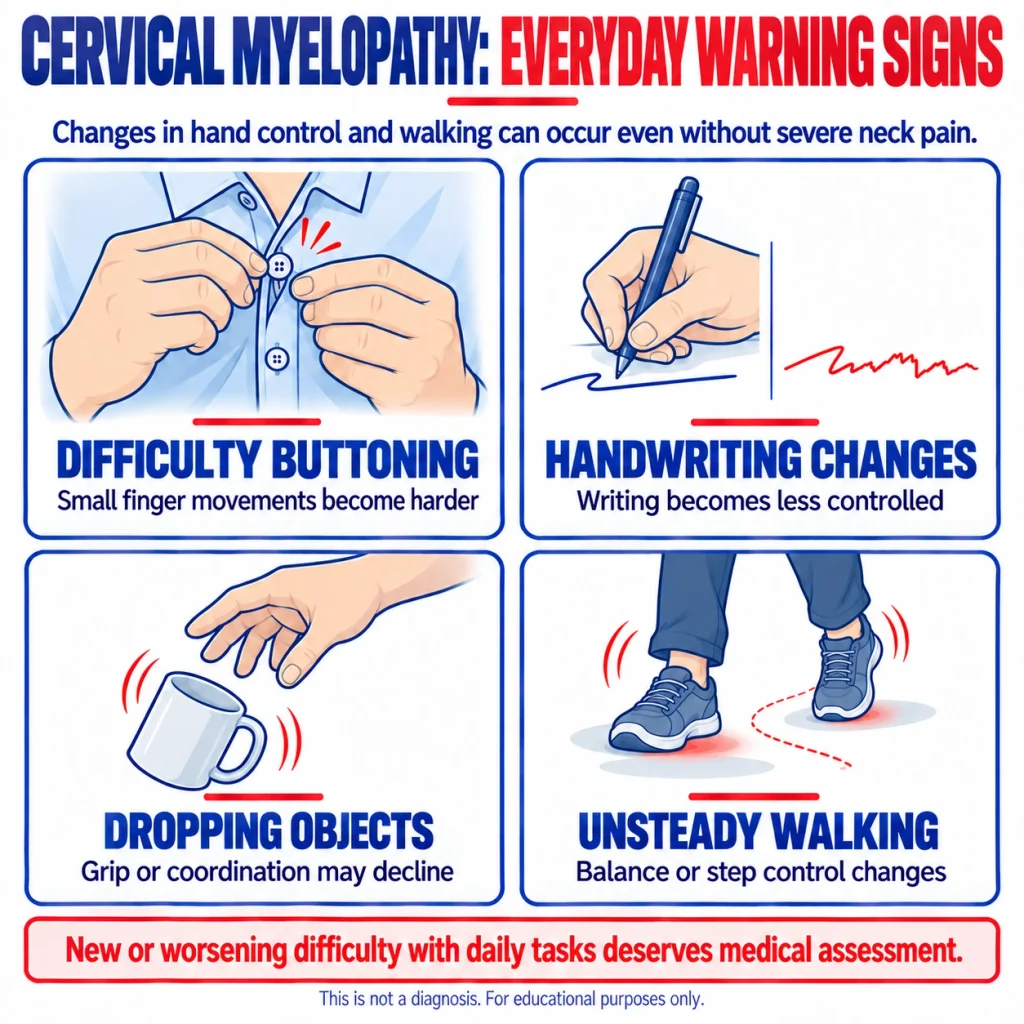
A single sore or numb hand may suggest a localized problem. Difficulty handling small objects accompanied by unsteady walking raises a different question: could nerve signals be disrupted at the spinal cord level? The combination does not prove myelopathy, but it makes a focused neurological assessment especially valuable.
Cervical Myelopathy vs. a Pinched Nerve: What Is the Difference?
A pinched nerve in the neck, or cervical radiculopathy, involves a nerve root leaving the spine. Symptoms more often travel into a particular shoulder, arm, or hand and may follow a relatively localized pattern of pain, tingling, numbness, or muscle weakness. The Cervical Spine Research Society’s explanation of radiculopathy distinguishes that nerve-root pattern from problems affecting the spinal cord.
Cervical myelopathy can disturb control in multiple areas, including the hands and legs. A person may also have radiculopathy and myelopathy at the same time, so arm pain does not rule out cord involvement. Clinicians use the full pattern and examination—not a single symptom—to tell them apart. For a broader discussion of arm symptoms from different causes, see Post Oak ER’s guide to arm weakness.
When Do Cervical Myelopathy Symptoms Need Urgent Medical Attention?
Gradually Worsening Hand or Walking Difficulties
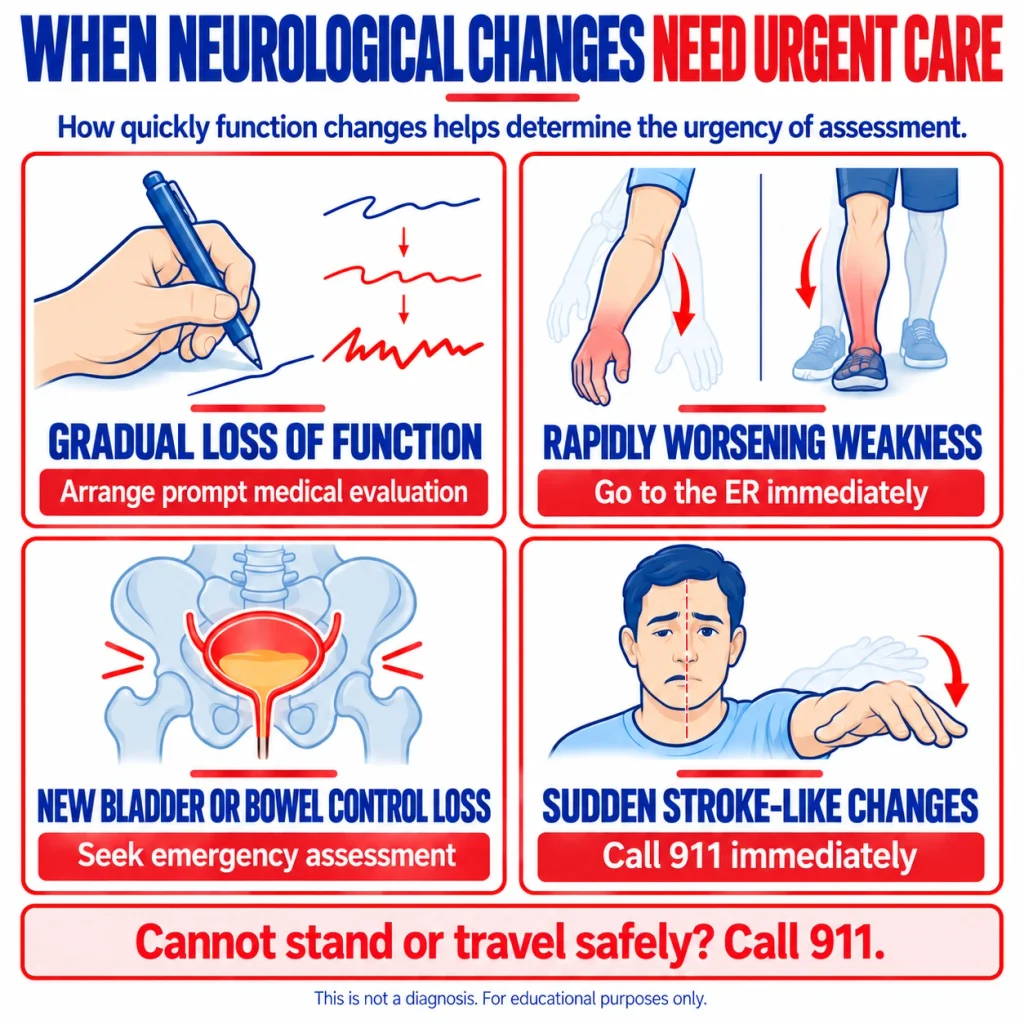
Arrange prompt medical evaluation if your handwriting, grip control, balance, or walking ability is steadily deteriorating. This is true even if the change is slow and the neck barely hurts. A clinician can assess whether the pattern suggests myelopathy and whether urgent MRI or a spine specialist is needed. American Family Physician’s clinical review emphasizes that delayed recognition and referral can worsen outcomes.
It can help to note when changes began, which tasks are harder, and whether there have been falls or new weaknesses. But do not delay assessment just to collect a longer symptom history. If neurological function is noticeably worsening, the need for evaluation increases.
Rapidly Worsening Weakness or Loss of Mobility
Go to an emergency department immediately for substantial or rapidly progressive arm or leg weakness, sudden inability to walk safely, or major loss of coordinated movement. If you cannot stand or travel safely, call 911. Sudden deficits can reflect conditions other than myelopathy, and the cause needs immediate assessment.
Sudden one-sided weakness, facial drooping, changes in speech or vision, or abrupt loss of balance are also possible stroke warnings. The CDC’s stroke warning signs advise calling 911 for these symptoms rather than driving yourself. A new neurological emergency should not be judged by whether neck pain is present.
New Bladder or Bowel Changes Alongside Neurological Symptoms
New difficulty controlling the bladder or bowels, especially with weakness or trouble walking, requires emergency assessment. These symptoms do not establish the diagnosis, but they can signal significant neurological involvement. The NHS guidance on cervical spondylosis identifies loss of bladder or bowel control and new walking or coordination problems as emergency warning signs.
For a broader, symptom-based review of neck-related emergencies, Post Oak ER also explains when neck pain should be evaluated in the ER.
How Do Doctors Evaluate Suspected Cervical Myelopathy?
A History Focused on What Function Has Changed
A medical history often begins with practical questions: Can you still write legibly? Are you dropping items? Is walking on stairs harder? Have you fallen? What changed first, and how quickly? Information from someone who regularly sees the patient may clarify a shift that developed slowly enough to escape notice.
Neurological Examination of Hands, Legs, and Walking
The clinician may test muscle strength, sensation, reflexes, finger coordination, and the way you walk. Certain abnormal reflexes or stiff, uncoordinated movements can suggest cord involvement, while other findings point toward a nerve root or peripheral nerve. No single bedside finding confirms every case; the examination directs what to investigate next.
When Cervical Spine Imaging Is Needed
When the history and examination raise concern for cervical myelopathy, MRI is generally the preferred way to assess the spinal cord and surrounding soft tissues. CT and X-rays can show bone structure or alignment but do not assess the cord as directly. A peer-reviewed clinical review available through the National Library of Medicine explains why MRI findings must be interpreted alongside neurological signs and symptoms.
The urgency of imaging depends on how severe and rapidly progressive the deficits are. Marked deterioration may require emergency imaging, specialist consultation, and access to a hospital with capabilities beyond those of the initial evaluating facility. A scan showing narrowing without compatible clinical findings does not, by itself, establish symptomatic myelopathy.
What Happens When Cervical Myelopathy Is Suspected?
The next step is driven by function—not simply the amount of neck pain or the wording on an old scan. Clinicians weigh symptom progression, examination findings, and appropriate imaging. Progressive deficits warrant timely specialist assessment; major or fast-developing deficits warrant emergency evaluation. Depending on what the examination shows, the patient may need cervical MRI, consultation with a spine or neurological specialist, or transfer for more advanced care.
The central decision for patients is whether everyday ability is changing. Waiting until a hand becomes unusable or walking becomes impossible can mean waiting too long. If you notice a consistent decline, have it assessed while there is still an opportunity to identify the cause and plan the appropriate level of care.
Emergency Evaluation for Neurological Changes in Houston
For patients and families in Houston, Post Oak ER provides 24/7 emergency evaluation for significant or rapidly worsening neurological symptoms. Emergency physicians can assess strength, sensation, coordination, and walking-related concerns, use appropriate on-site emergency testing, and determine whether additional imaging, specialist input, or hospital transfer is needed. The facility describes its available emergency imaging services, including CT and X-ray; an MRI or specialist evaluation may need to be arranged elsewhere when clinically indicated.
Frequently Asked Questions
What are the early signs of cervical myelopathy?
Early signs can include new hand clumsiness, changed handwriting, difficulty with buttons, or an unsteady gait. A pattern of declining function deserves assessment even if neck pain is minimal.
Can cervical myelopathy cause hand clumsiness or difficulty gripping objects?
Yes. Disrupted spinal cord signals can affect finger coordination and hand strength, leading to trouble handling small items or repeated dropping of objects. These symptoms can have other causes, so an examination is needed.
Why does cervical myelopathy affect walking and balance?
Signals between the brain and legs pass through the spinal cord in the neck. Cord dysfunction can interfere with those signals, causing stiffness, imbalance, or difficulty walking smoothly.
Can you have cervical myelopathy without neck pain?
Yes. Some people have hand or walking problems with little or no neck pain. Pain intensity alone cannot determine whether the spinal cord is affected.
What is the difference between cervical myelopathy and cervical radiculopathy?
Myelopathy involves the spinal cord and may affect both hand coordination and walking. Radiculopathy involves a nerve root and more often produces pain, tingling, or weakness in a particular arm distribution. Both can occur together.
Can cervical myelopathy symptoms develop gradually?
Yes. Changes may unfold over weeks or months and can be easy to attribute to other causes. Progressive loss of dexterity or walking ability warrants timely medical evaluation.
When is cervical myelopathy a medical emergency?
Sudden or rapidly worsening weakness, inability to walk safely, or new bladder or bowel dysfunction with neurological symptoms needs emergency assessment. Call 911 for severe sudden deficits or possible stroke symptoms.
Can an MRI help diagnose cervical myelopathy?
Yes. MRI can show the spinal cord and possible compression in the neck. Doctors interpret those images together with symptoms and neurological examination findings.