
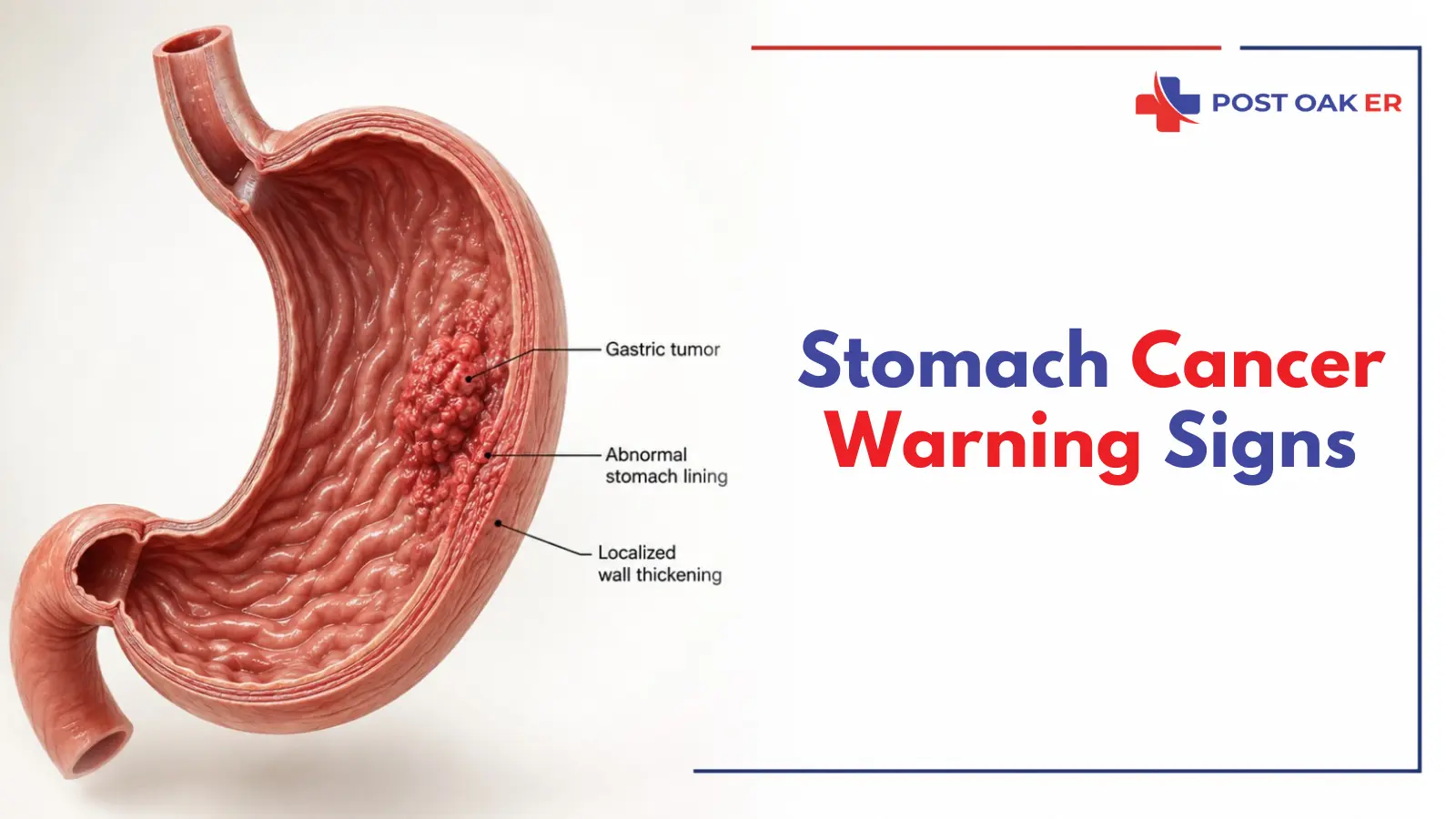
Stomach cancer, also called gastric cancer, often does not announce itself with one unmistakable symptom. Upper-abdominal discomfort, indigestion, nausea, or reduced appetite are common complaints and frequently have non-cancer causes. The pattern becomes more meaningful when symptoms persist, keep returning, progressively worsen, or begin to occur together.
The National Cancer Institute (NCI) lists indigestion, stomach discomfort, bloating after eating, mild nausea, loss of appetite, and heartburn among possible early symptoms, while later symptoms can include stomach pain, vomiting, blood in the stool, and unexplained weight loss. None of these findings can diagnose stomach cancer by themselves.
When Upper-Abdominal Symptoms Should Stop Being Dismissed
Occasional indigestion or stomach discomfort can happen after a heavy meal, during a short-lived stomach illness, or with common digestive conditions. What deserves a closer look is a change from your usual pattern: discomfort that lasts, repeatedly returns without a clear explanation, becomes more intense, or starts interfering with normal eating.
This overlap is one reason symptom duration matters. NIDDK guidance on indigestion (dyspepsia) describes upper-abdominal burning or pain and uncomfortable fullness as common indigestion symptoms, and notes that indigestion can have many causes. A persistent pattern should therefore be evaluated rather than repeatedly assumed to be routine heartburn or an ordinary upset stomach.
Stomach Cancer Warning Signs That May Appear Together
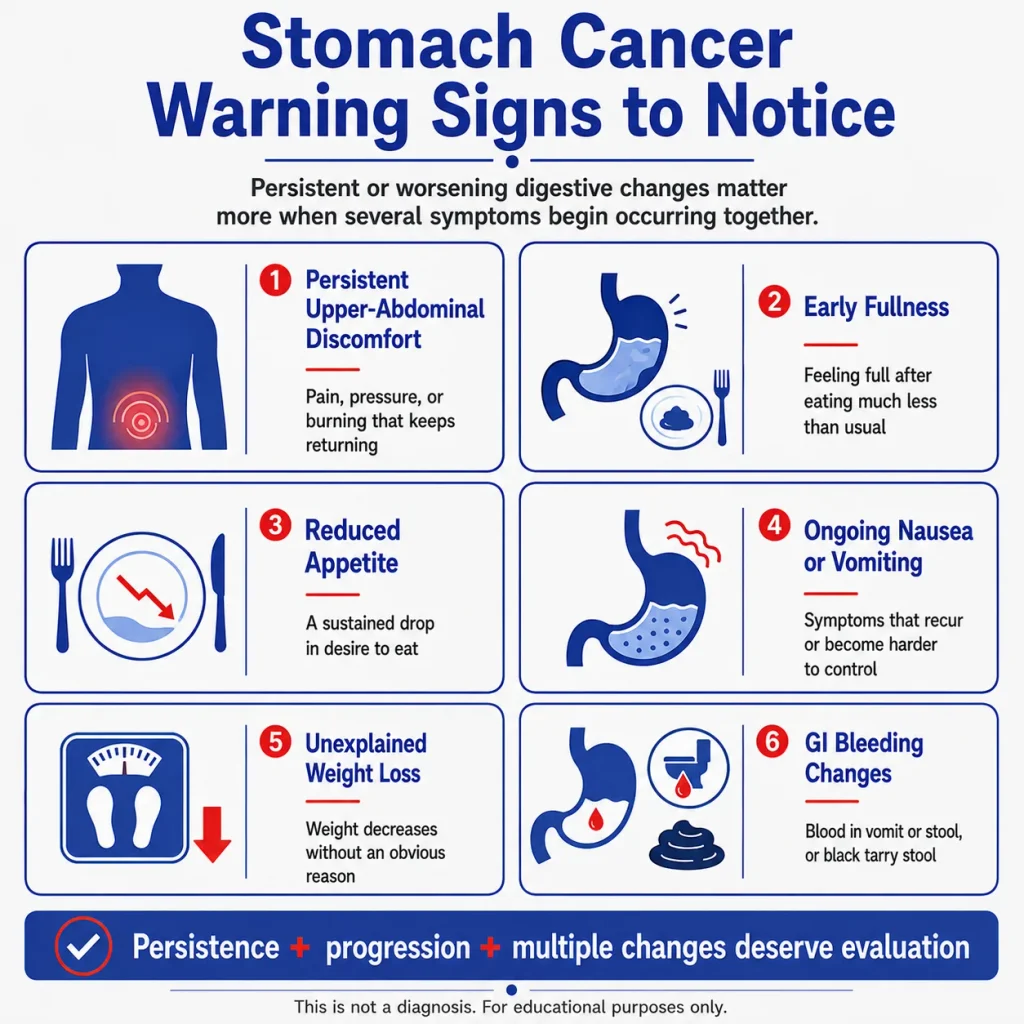
Gastric-cancer symptoms are often nonspecific. The concern is not that every person with these symptoms has cancer, but that a sustained cluster of changes can justify medical evaluation. The American Cancer Society’s stomach-cancer symptom guidance includes poor appetite, upper abdominal discomfort, feeling full after a small meal, heartburn or indigestion, nausea, vomiting, and weakness among recognized possibilities.
Persistent upper-abdominal discomfort or pain
Ongoing pressure, aching, burning, or pain in the upper abdomen deserves attention when it does not resolve as expected or is clearly different from your normal digestive symptoms. Location and sensation alone cannot identify the cause; ulcers, gastritis, reflux, gallbladder problems, pancreatic conditions, and other illnesses can produce overlapping symptoms. The useful signal is persistence, progression, or a new pattern that remains unexplained.
Appetite and eating changes
A sustained drop in appetite, becoming full after eating much less than usual, or repeatedly feeling unusually uncomfortable after meals can be part of the symptom picture. These changes matter more when they are new for you and occur alongside ongoing upper-abdominal discomfort, nausea, unexplained weight loss, or weakness. A few days of reduced appetite during a temporary illness is different from an eating pattern that keeps changing over time.
Ongoing nausea or vomiting
Nausea can accompany many benign GI problems, but recurring or worsening vomiting raises the stakes because it can interfere with hydration and nutrition. MedlinePlus guidance on nausea and vomiting advises medical attention for blood in vomit, severe abdominal pain, or signs of dehydration. If you cannot keep fluids down, are urinating much less than usual, or feel increasingly weak or dizzy, the immediate concern is the complication happening now—not whether cancer is the underlying cause.
Bleeding Symptoms Need Particular Attention
Visible gastrointestinal bleeding should be separated from routine indigestion because it can change the urgency of care. Blood may appear as red blood in vomit, vomit that resembles coffee grounds, red or dark blood mixed with stool, or black, tarry stool. Stomach cancer can cause GI bleeding, but so can ulcers, gastritis, medications, and other conditions; appearance alone cannot tell you the source.
The National Institute of Diabetes and Digestive and Kidney Diseases (NIDDK) advises prompt medical help for acute GI bleeding and notes that severe bleeding can be accompanied by dizziness, fainting, weakness, shortness of breath, or shock. If bleeding is substantial, continuing, or paired with those symptoms, do not treat it as a routine stomach complaint.
Persistent Symptoms vs Symptoms That Need Faster Evaluation
There are two different care decisions. If you are otherwise stable, persistent upper-abdominal discomfort, recurring indigestion-like symptoms, reduced appetite, early fullness, or ongoing nausea should be discussed with a clinician so the cause can be investigated. The fact that symptoms are common does not make repeated or progressive symptoms something to ignore.
Urgency increases when the pattern changes quickly: pain becomes severe, vomiting prevents you from drinking, bleeding appears, weakness becomes pronounced, or you feel faint or significantly dizzy. Severe dehydration can cause very little urination, dizziness or lightheadedness, rapid heart rate, confusion, or shock; MedlinePlus describes severe dehydration as a medical emergency.
When Stomach Symptoms May Require Emergency Care
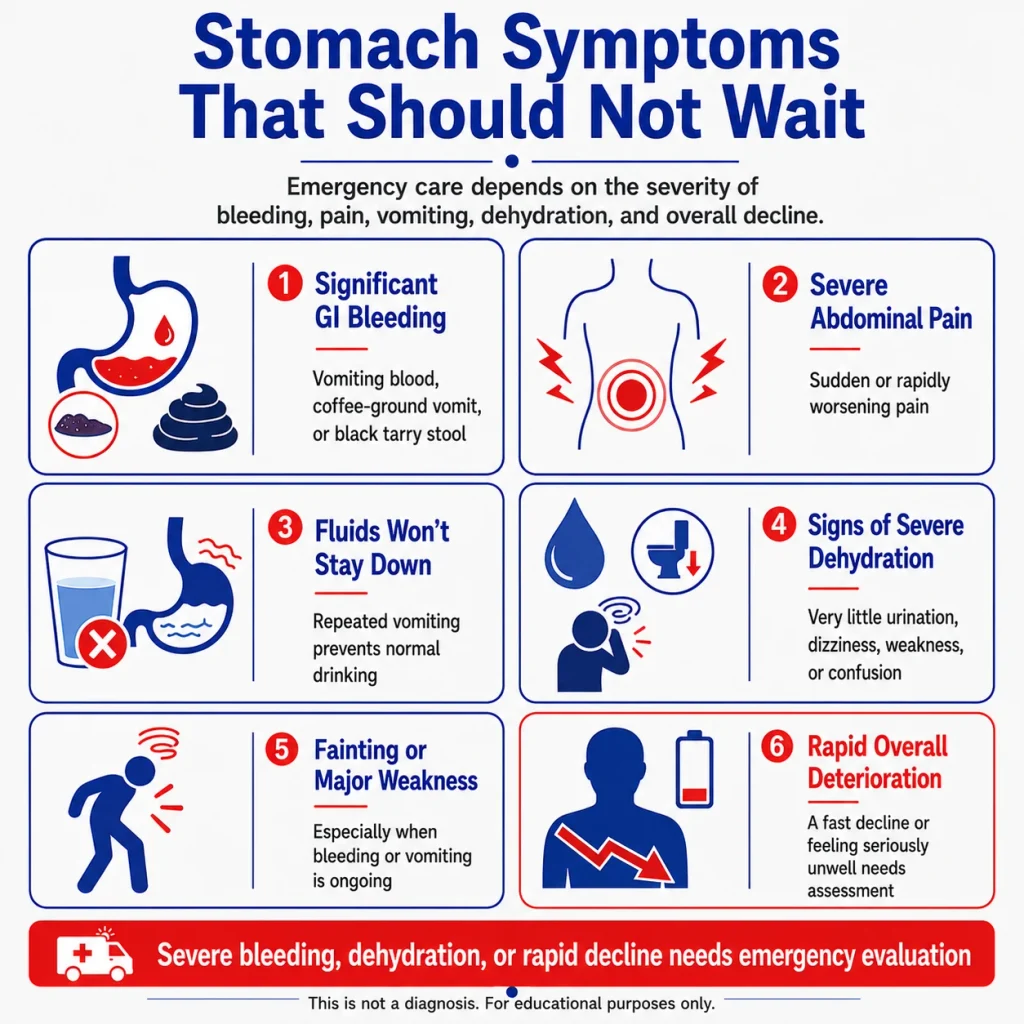
The ER decision should be based on the severity of the current problem, not on whether stomach cancer has already been diagnosed. Emergency assessment becomes more appropriate with:
• Significant or ongoing GI bleeding, including vomiting blood or passing black, tarry stool.
• Severe, sudden, or rapidly worsening abdominal pain.
• Repeated vomiting or an inability to keep fluids down.
• Fainting, marked dizziness, confusion, or significant weakness.
• Rapid overall deterioration or feeling seriously unwell.
For a broader discussion of emergency pain patterns, Post Oak ER’s guide to abdominal pain and when to seek medical care covers red flags such as severe or worsening pain, bleeding, fainting, and dehydration. Its nausea and vomiting emergency guide also explains why repeated vomiting, blood in vomit, severe pain, and dehydration may require ER evaluation.
What Evaluation May Help Determine the Cause
Persistent gastric symptoms need a clinical evaluation because symptoms alone cannot distinguish stomach cancer from more common GI conditions. A clinician may review the symptom timeline, appetite and weight changes, medication use, bleeding symptoms, family and medical history, and findings on a physical exam. Blood or stool testing may be used when bleeding or anemia is a concern.
When stomach cancer is a diagnostic concern, definitive evaluation usually happens through the appropriate outpatient or specialist pathway. The NCI’s stomach-cancer diagnosis guidance describes upper endoscopy with biopsy as a key diagnostic procedure. The American Cancer Society’s overview of tests for stomach cancer similarly notes that diagnosis can involve medical history, physical examination, tests for bleeding, upper endoscopy, biopsy, imaging, and laboratory testing.
Emergency care has a different job. In the setting of severe pain, bleeding, repeated vomiting, dehydration, or instability, the priority is to assess what is dangerous now, support hydration and symptom control when appropriate, and determine whether additional emergency testing or hospital-level care is needed. Stable but persistent stomach symptoms still require follow-up to identify the underlying cause.
Emergency Evaluation in Houston at Post Oak ER
For Houston-area patients with severe abdominal pain, significant bleeding, repeated vomiting, inability to keep fluids down, fainting, or major weakness, Post Oak ER is available 24/7 for emergency evaluation. The facility provides on-site laboratory testing and CT, X-ray, and ultrasound imaging services when these are appropriate to the emergency assessment. Persistent but stable stomach symptoms should still be evaluated through the appropriate medical follow-up rather than repeatedly being treated as routine indigestion without determining the cause.
Frequently Asked Questions
What are the warning signs of stomach or gastric cancer?
Possible warning signs include persistent upper-abdominal discomfort or pain, reduced appetite, feeling full after a small meal, ongoing indigestion or heartburn, nausea, vomiting, unexplained weight loss, blood in the stool, and weakness. These symptoms are not specific to cancer, so a persistent or worsening pattern needs medical evaluation rather than self-diagnosis.
Can persistent upper-abdominal discomfort be a sign of stomach cancer?
Yes, it can be one possible symptom, but it is far more commonly caused by other digestive conditions. The concern rises when discomfort persists, worsens, or occurs with eating changes, vomiting, bleeding, unexplained weight loss, or marked weakness.
Can stomach cancer feel like heartburn or indigestion?
It can. Stomach cancer may cause indigestion or heartburn-like symptoms, especially early on, but those symptoms are also common with non-cancer conditions. A new pattern that keeps returning or does not improve should be assessed rather than assumed to be routine reflux.
Can stomach cancer cause vomiting or difficulty eating normally?
Yes. Nausea, vomiting, poor appetite, and feeling full after a small meal are recognized stomach-cancer symptoms. Repeated vomiting or inability to keep fluids down needs faster assessment because dehydration can become the immediate problem.
What bleeding symptoms can occur with stomach cancer?
Bleeding may appear as blood in vomit, coffee-ground-like vomit, dark or black stool, or blood mixed with stool. These findings do not prove stomach cancer, but acute or significant GI bleeding needs prompt medical evaluation regardless of the cause.
When should stomach pain, vomiting, or bleeding be evaluated in the ER?
Choose emergency evaluation for significant or ongoing bleeding, severe or rapidly worsening abdominal pain, repeated vomiting with inability to keep fluids down, fainting, marked dizziness, confusion, major weakness, or rapid deterioration. The ER decision is based on the severity of the current complication, not on whether cancer has already been diagnosed.