
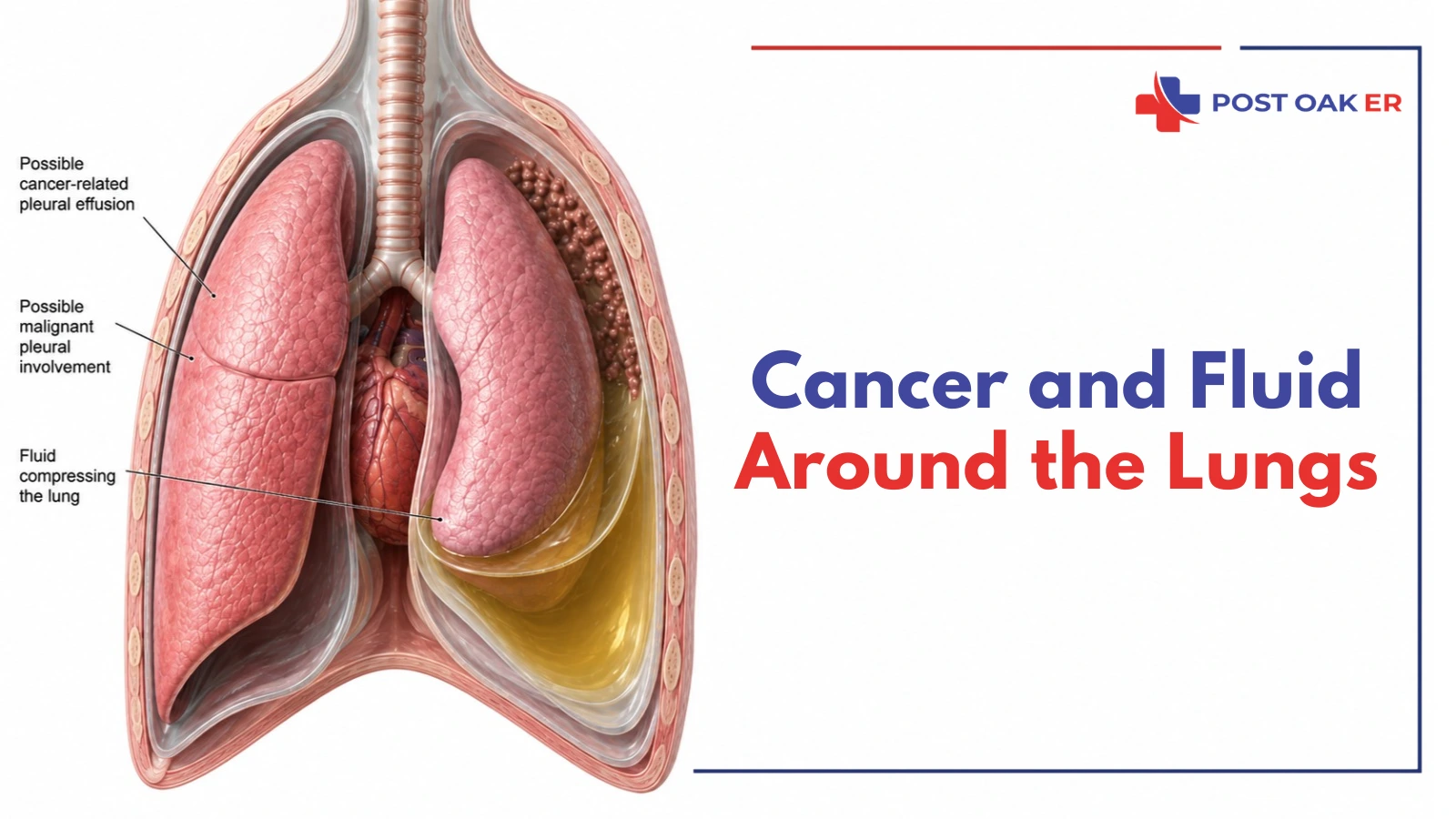
For someone with cancer, new shortness of breath can raise an immediate question: is there fluid around the lungs, and how urgent is it? Pleural effusion is one possible cause, but infection, anemia, blood clots, treatment effects, heart problems, and other conditions can also affect breathing. Urgency depends on how much breathing has changed and how compromised the person is now.
This article focuses on cancer-related pleural effusion – fluid collecting around a lung – and when worsening breathing needs emergency evaluation. It does not cover cancer prognosis or long-term oncology treatment.
What “Fluid Around the Lungs” Means
A pleural effusion is extra fluid in the pleural space, the narrow space between the tissue covering the outside of the lung and the tissue lining the chest wall. The National Cancer Institute explains that when excess fluid collects there, it can press on the lung and make breathing more difficult.
This differs from fluid accumulating inside lung tissue. The NCI distinguishes pleural effusion from pulmonary edema: pleural effusion is fluid around the lungs in the pleural cavity, while pulmonary edema is fluid within the lungs. The distinction matters because the causes, evaluation, and treatment are different.
Cancer can be associated with pleural effusion, but finding pleural fluid does not automatically mean cancer has spread. MedlinePlus notes that pleural effusions have many possible causes, including heart failure, infection, inflammation, lung injury, and tumors. In a person with cancer, clinicians still need to determine what is actually causing the fluid.
How Pleural Effusion Can Affect Breathing
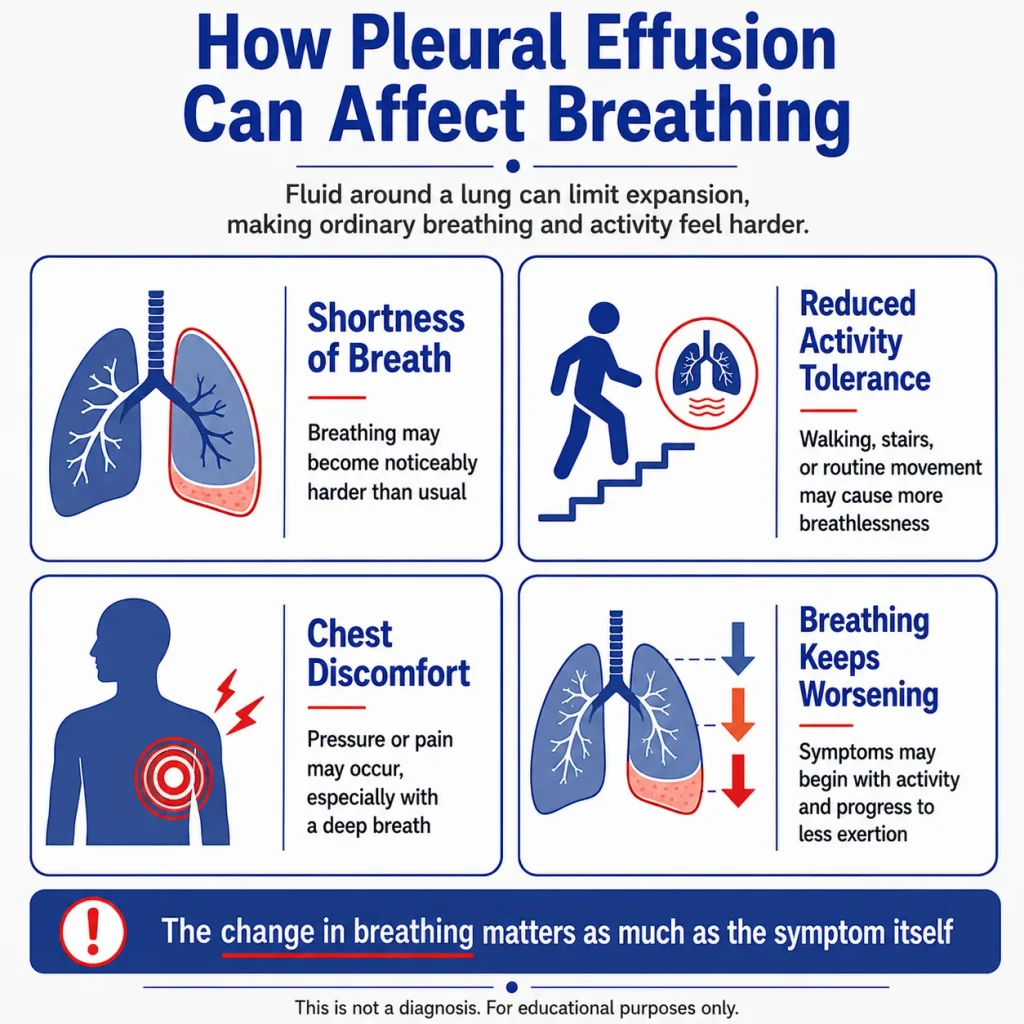
As fluid increases in the pleural space, it can reduce how fully the nearby lung expands. That mechanical effect is why breathlessness is the symptom patients often notice most. The American Cancer Society describes pleural effusion as one cause of shortness of breath in people with cancer because the collection can compress the lung and limit a full breath.
Shortness of Breath
Breathlessness may be new, slowly progressive, or noticeably worse than a person’s usual baseline. It may first appear with walking, climbing stairs, showering, or other ordinary activity and later occur with much less exertion. A larger or more symptomatic effusion can make it difficult to take a satisfying deep breath, but the severity of symptoms does not always match the apparent amount of fluid.
Chest Discomfort and Reduced Breathing Tolerance
Some people develop chest pressure, discomfort, or pain, especially when taking a deep breath. Others mainly notice reduced tolerance for normal activity: a familiar walk feels harder, they need more pauses, or routine movement makes them unusually winded. Cough can occur too, but in this context it is secondary to the change in breathing.
The Change in Breathing Matters as Much as the Symptom
The trajectory matters. If breathing is mildly different but stable, the person is comfortable at rest, can speak and move normally, and is not deteriorating, prompt contact with the oncology or medical team may be appropriate.
A different pattern deserves faster reassessment: breathlessness that is clearly worsening, starts with less and less activity, interferes with basic tasks, or is becoming difficult to recover from. People with cancer should not assume that every breathing change is from the cancer itself. The NCI notes that several cancer-related and non-cancer conditions can cause dyspnea, so a meaningful change needs clinical evaluation rather than self-diagnosis.
When Breathing Symptoms Become an Emergency
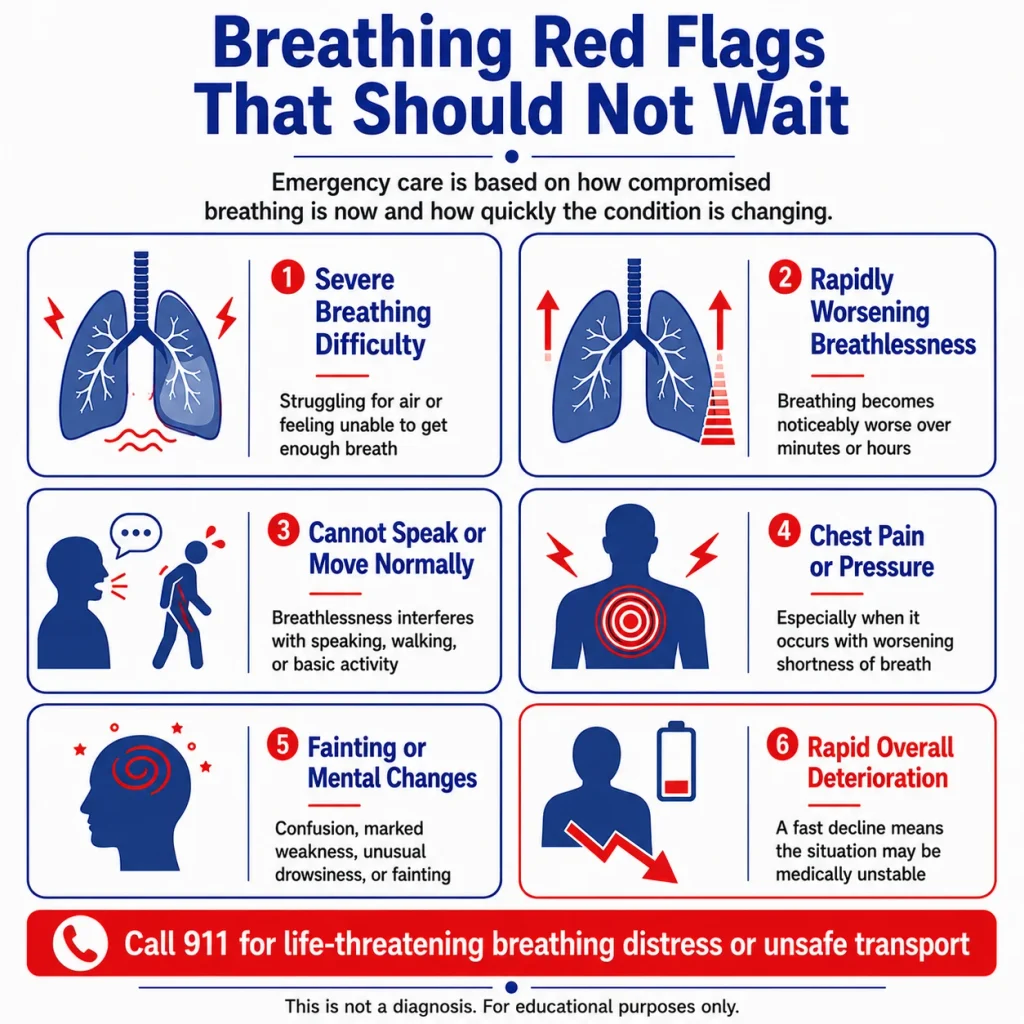
Emergency care is appropriate when breathing is significantly compromised now or is deteriorating quickly. Cancer Research UK specifically advises urgent emergency assessment for sudden or worsening breathlessness in the setting of pleural effusion.
Go to the ER now for:
• Severe difficulty breathing, obvious respiratory distress, or the feeling that you cannot get enough air.
• Breathlessness that is worsening rapidly over minutes or hours.
• Breathing difficulty that prevents normal speaking, walking, or basic movement.
• Significant chest pain or pressure occurring with worsening shortness of breath.
• Fainting, new confusion, marked weakness, unusual drowsiness, or rapid overall deterioration.
The emergency threshold is not simply “cancer plus pleural fluid.” A small or stable effusion can be found without severe symptoms. What changes the care decision is respiratory compromise, rapid worsening, or associated signs that the person may not be medically stable. If breathing is so difficult that safe transport by car is not realistic, or the person is fainting or confused, call 911.
How Doctors May Identify Pleural Fluid
Evaluation starts with symptoms, history, vital signs, and a focused examination. Chest imaging can show whether pleural fluid is present. MedlinePlus lists chest X-ray, ultrasound, and CT as imaging methods used in pleural-effusion evaluation, with the specific test depending on the clinical situation.
Imaging can confirm fluid but does not always establish why it developed. When clinicians need to investigate the cause, testing may include analysis of a fluid sample. MedlinePlus pleural fluid analysis guidance explains that the sample can be evaluated for findings such as infection or cancer cells and that the results may guide additional testing.
What Happens After Pleural Effusion Is Found
Next steps depend on the amount of fluid, breathing difficulty, suspected cause, symptom trajectory, and overall condition. Some small effusions cause no symptoms and may not require an immediate pleural procedure. When a known or suspected malignant pleural effusion is symptomatic, management may include removing fluid to assess symptom relief and lung expansion.
The American Thoracic Society, Society of Thoracic Surgeons, and Society of Thoracic Radiology guideline recommends against therapeutic pleural intervention for asymptomatic malignant pleural effusion and supports symptom-directed approaches when the effusion is causing dyspnea. The exact long-term strategy belongs with the appropriate pulmonary, oncology, or hospital team; this article does not attempt to cover pleurodesis, indwelling catheters, or cancer treatment in detail.
In an emergency setting, the immediate priorities are different: assess how compromised breathing is, identify urgent competing causes of shortness of breath, stabilize serious symptoms, and determine whether hospital-level or specialty care is needed.
When Worsening Breathing Needs 24/7 ER Evaluation in Houston
For Houston-area patients with known or suspected cancer, Post Oak ER provides 24/7 emergency evaluation when shortness of breath becomes severe, worsens rapidly, or occurs with significant chest symptoms, fainting, confusion, or other signs of acute deterioration. The facility also lists on-site CT, X-ray, and ultrasound imaging that may support emergency evaluation when clinically appropriate. Stable breathing changes still deserve timely follow-up with the patient’s clinician or oncology team rather than waiting for them to become an emergency.
Frequently Asked Questions
Can cancer cause fluid around the lungs?
Yes. Cancer can cause a pleural effusion, but cancer is only one possible cause. A person with cancer can also develop pleural fluid from conditions such as infection, heart failure, a blood clot in the lung, or treatment-related problems, so the cause has to be evaluated.
What symptoms can pleural effusion cause in someone with cancer?
Shortness of breath is the main symptom to recognize. Chest discomfort or pain, reduced tolerance for normal activity, and cough can also occur; the urgency depends heavily on severity and whether symptoms are worsening.
Is pleural effusion the same as having fluid inside the lungs?
No. Pleural effusion is fluid in the space around the lungs, between the pleural layers. Pulmonary edema refers to fluid within lung tissue and is a different condition with different causes and management.
Does pleural effusion always mean cancer has spread?
No. Even in someone with cancer, a pleural effusion is not automatically malignant. Imaging can confirm fluid is present, but additional clinical evaluation may be needed to determine why it developed.
Can a small pleural effusion cause no symptoms?
Yes. Small pleural effusions can be asymptomatic and may be found incidentally on imaging. Management depends on the cause, size, symptoms, and overall clinical picture rather than the imaging finding alone.
When should shortness of breath from pleural effusion be evaluated in the ER?
Choose the ER when shortness of breath is severe, rapidly worsening, limiting normal speech or movement, or accompanied by significant chest symptoms, fainting, confusion, marked weakness, or rapid deterioration. Post Oak ER also evaluates urgent breathing and respiratory symptoms 24/7; call 911 for life-threatening respiratory distress or when safe transport is not possible.