

When someone has cancer, a new symptom can make every change feel like evidence that the disease has spread. Symptoms do matter, but they are not a staging test. Pain, shortness of breath, weakness, appetite changes, bleeding, confusion, and fatigue can come from cancer, cancer treatment, infection, medications, dehydration, blood clots, or an unrelated illness. The more useful question is not “Does this prove metastasis?” but “How new, persistent, severe, or function-changing is this symptom, and how quickly should it be assessed?”
Some changes can be reported promptly to the oncology team while the person is otherwise stable. Others – especially sudden neurologic changes, severe breathing difficulty, uncontrolled bleeding, fainting, rapidly escalating pain, or major overall deterioration – may require emergency evaluation. This guide focuses on that decision rather than trying to diagnose cancer progression from symptoms at home.
What Does It Mean When Cancer “Spreads”?
Metastatic cancer means cancer cells from the original, or primary, cancer have established disease in another part of the body. The National Cancer Institute (NCI) explains metastatic cancer as cancer that has spread from where it first formed to a distant part of the body. The cells still keep the identity of the primary cancer – for example, breast cancer that spreads to bone remains metastatic breast cancer rather than becoming bone cancer.
Cancer cells can travel through the blood or lymphatic system and establish new tumors elsewhere, but the process does not follow one predictable pattern or timetable. For patients and families, the practical point is simpler: a new symptom can justify assessment, but it cannot show by itself whether cancer has spread, where it has spread, or how extensive the disease may be.
New or Changing Symptoms Matter More Than Trying to Self-Diagnose Metastasis
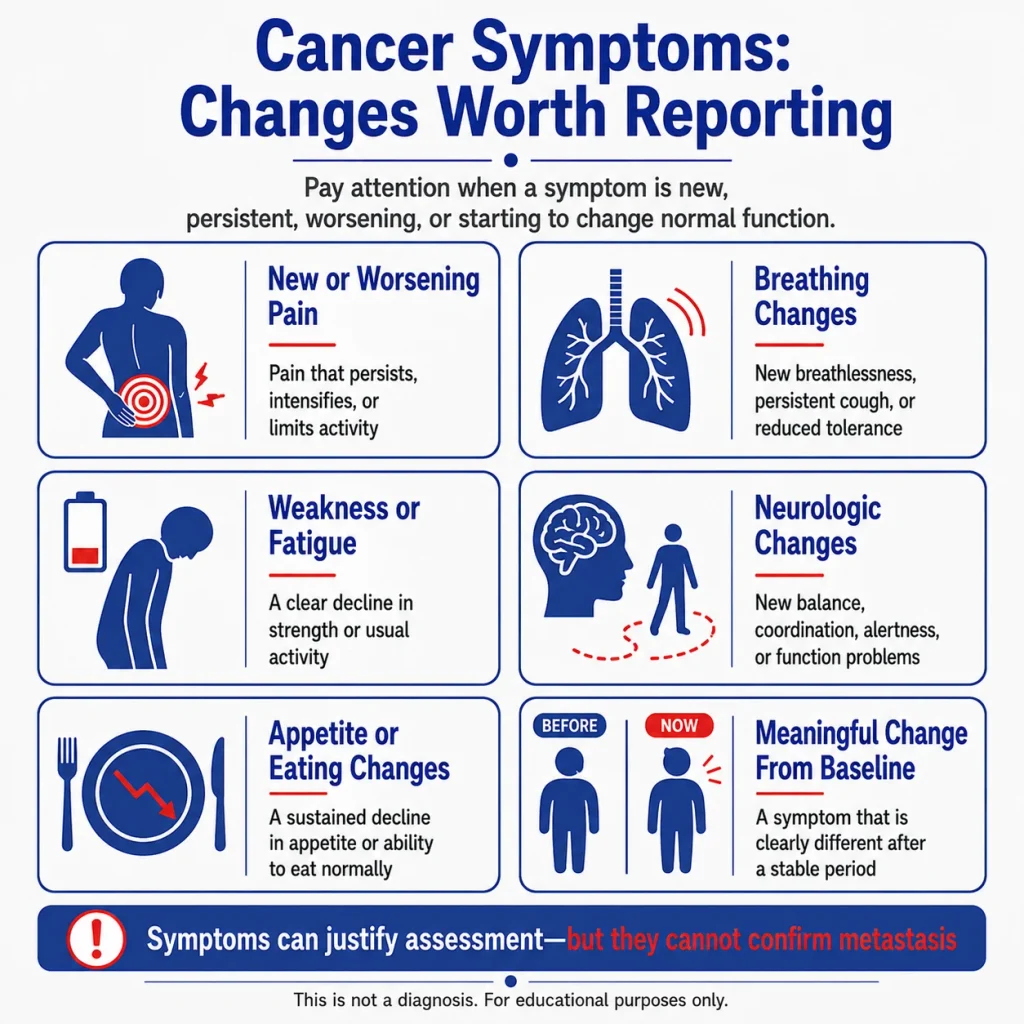
Concern rises when a symptom is new for that person, keeps returning or does not settle, becomes progressively more intense, or begins to interfere with walking, breathing, eating, sleeping, thinking, or normal daily activity. A meaningful change after a period of otherwise stable cancer care also deserves attention.
At the same time, many possible cancer symptoms are not specific to cancer. The NCI notes that symptoms associated with cancer can also be caused by other problems, including illnesses, injuries, and noncancerous conditions. In a person receiving cancer treatment, treatment effects can add another layer of possibilities. That is why the safest approach is to assess the change in context rather than label it as metastasis based on a symptom list.
Symptom Patterns That May Need Prompt Evaluation
New or progressively worsening pain
Persistent focal pain, substantial new back pain, or bone-type pain that is clearly different from the person’s usual pattern deserves reassessment, especially when it is getting worse or limiting normal activity. Cancer involving bone can cause pain or weaken bone, but muscle strain, arthritis, fractures, kidney problems, and other conditions can produce similar symptoms.
The urgency changes if back pain comes with new weakness, numbness, trouble walking, or loss of bladder or bowel control. The NCI definition of spinal cord compression notes that pressure on the spinal cord can cause pain, weakness, loss of feeling, paralysis, and bowel or bladder incontinence. That combination warrants emergency evaluation rather than waiting for a routine oncology appointment.
New breathing or chest symptoms
New or worsening shortness of breath, a cough that is not settling, or a clear decline in breathing tolerance should be assessed. In people with cancer, the NCI describes many possible causes of shortness of breath, including tumor-related effects, fluid around the lungs or heart, chest infection, blood clots, anemia, treatment-related lung problems, heart problems, and other conditions.
Because the cause cannot be sorted out reliably from symptoms alone, the severity and speed of change matter. Mild, stable respiratory changes can often start with prompt contact with the cancer-care team. Severe or rapidly worsening difficulty breathing is an emergency concern. Post Oak ER also provides patient guidance on breathing changes that may warrant ER evaluation.
New neurologic or functional changes
New weakness, balance problems, confusion, unusual drowsiness, a new seizure, or sudden loss of coordination or function deserves careful attention. Cancer progression can affect neurologic function, but stroke, infection, medication effects, metabolic abnormalities, dehydration, and treatment toxicity can produce neurologic changes as well.
The NCI guidance on seizures in people with brain or spine tumors describes symptoms such as confusion, jerking movements, one-sided tingling, and loss of consciousness, and it emphasizes having an emergency plan for severe, worsening, prolonged, or repeated seizures. A sudden or major neurologic change should be evaluated for the acute problem rather than waiting for cancer restaging.
When Symptoms Should Be Reported Promptly to the Cancer-Care Team
For a patient who is stable and not experiencing emergency warning signs, a meaningful change often belongs first in timely communication with the oncology team or other clinician directing cancer care. Examples include:
– A new symptom that persists rather than resolving.
– An existing symptom that is gradually becoming more frequent or more intense.
– New pain that is affecting activity or sleep but remains controlled and is not accompanied by emergency neurologic symptoms.
– Increasing fatigue, weakness, appetite change, or decline in the ability to manage normal daily tasks.
– A new symptom that appears after a period of otherwise stable cancer care or after a treatment change.
The American Cancer Society explains that symptoms of advanced or metastatic cancer do not always mean the cancer has spread and that evaluation may involve clinical assessment, imaging, blood tests, or other testing depending on the situation. Reporting a stable change gives the cancer-care team a chance to decide whether the patient needs an earlier visit, treatment-related evaluation, imaging, laboratory testing, or another next step.
Symptoms That May Require Emergency Evaluation
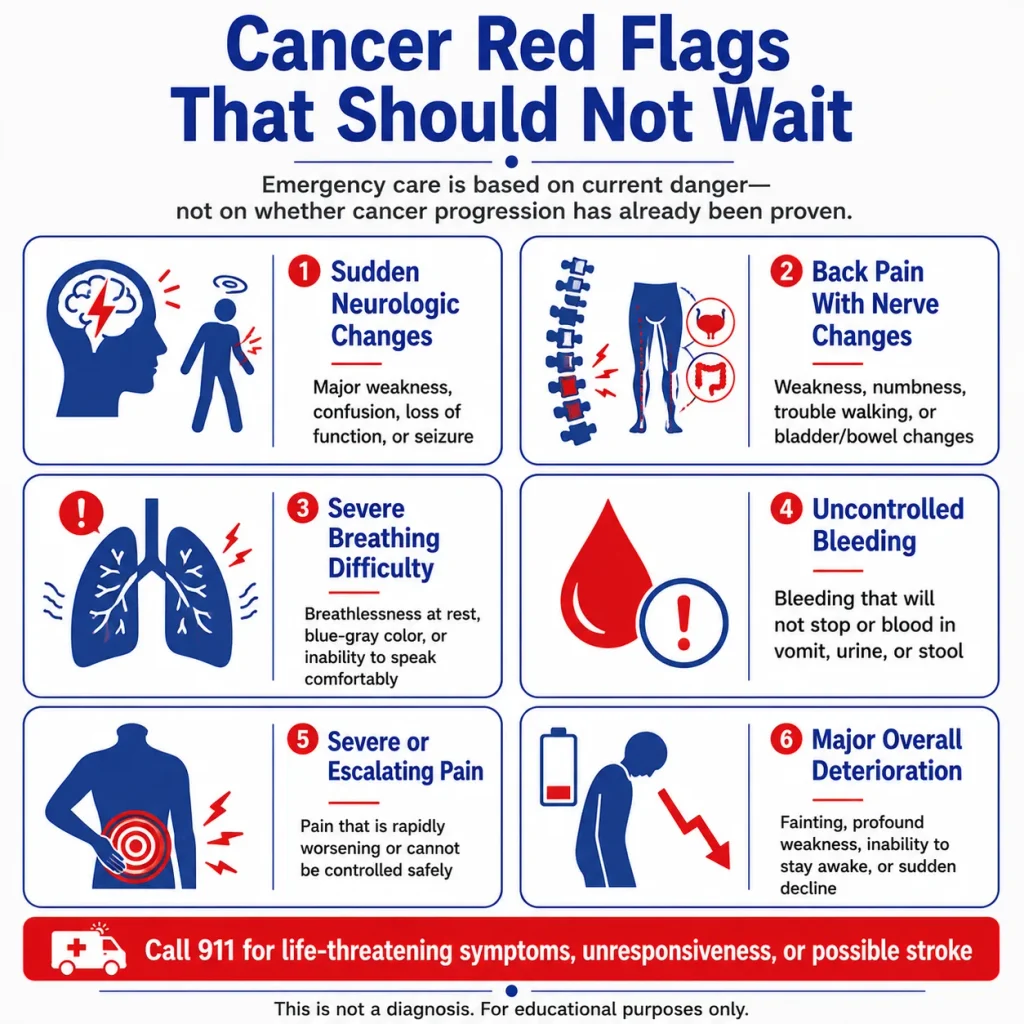
The ER decision is based on current danger, not on whether cancer progression has already been proven. A serious complication may be related to the cancer, a treatment effect, an infection, a blood clot, bleeding, dehydration, or a separate medical emergency. What matters first is identifying and stabilizing the acute problem.
Sudden or severe neurologic changes
Emergency evaluation is appropriate for a first or major seizure, new major weakness, inability to walk or use a limb normally, significant new confusion, a sudden loss of function, or rapidly worsening neurologic symptoms. Severe back pain plus new weakness, numbness, difficulty walking, or bowel or bladder changes is another emergency pattern because spinal cord compression is one possible cause.
If a person is unresponsive, has signs of a possible stroke, has a prolonged seizure, or otherwise appears to have a life-threatening neurologic emergency, call 911 rather than trying to drive.
Serious breathing problems
Severe shortness of breath at rest, rapidly increasing work of breathing, inability to speak comfortably because of breathlessness, blue or gray discoloration, collapse, or chest pain with major breathing difficulty should be treated as an emergency. These symptoms can reflect cancer-related disease, treatment complications, infection, a blood clot, heart or lung problems, or another urgent condition.
Severe pain, bleeding, or rapid systemic decline
Uncontrolled or rapidly escalating pain, significant bleeding that does not stop, vomiting or coughing blood, heavy bleeding with dizziness or fainting, profound weakness, repeated fainting, inability to stay awake normally, or an abrupt change in which the person becomes seriously unwell can require emergency evaluation.
Bleeding deserves particular care because cancer treatment itself can affect blood counts. The NCI guidance on bleeding and bruising during cancer treatment identifies bleeding that does not stop and blood in vomit, urine, or stool among problems that should be reported. For patients deciding whether bleeding requires emergency care, Post Oak ER provides additional guidance on when to visit the ER for bleeding.
What Emergency Evaluation Can – and Cannot – Determine
Emergency clinicians begin with the symptom that is dangerous or changing now. Evaluation may include vital signs, oxygen level, neurologic or respiratory assessment, the location and severity of pain, the amount and source of bleeding, hydration status, medication and treatment history, and a focused physical exam.
Testing depends on the presentation. Blood counts, chemistry testing, or other laboratory studies may help identify anemia, infection, dehydration, electrolyte problems, kidney issues, or treatment-related complications. Imaging such as CT, X-ray, or ultrasound may be appropriate when clinicians need to evaluate a neurologic problem, breathing concern, severe pain, bleeding, injury, or another urgent question.
An emergency evaluation can identify and stabilize serious complications, reveal findings that need hospital-level care or specialist input, and sometimes point to a cause other than cancer progression. It is not the same as complete oncology restaging. Determining whether cancer has progressed may require comparison with prior imaging, specialized scans, pathology information, and an oncology assessment that integrates the person’s full cancer history.
Emergency Evaluation for Houston Patients With Cancer
For Houston-area patients with cancer, Post Oak ER provides 24/7 emergency care in Houston for sudden illness and serious symptoms. When a patient develops a major neurologic change, serious breathing difficulty, uncontrolled bleeding, fainting, severe or rapidly escalating pain, or major overall deterioration, the emergency team can assess the immediate problem and determine what testing is appropriate. Post Oak ER lists CT, X-ray, and ultrasound imaging as part of physician-guided emergency evaluation and provides on-site laboratory testing. These services are for urgent assessment and stabilization; new but stable symptoms should still be reported promptly to the patient’s oncology or medical team.
Frequently Asked Questions
1. What symptoms can suggest that cancer has spread?
Possible patterns include new or progressively worsening pain, new breathing problems, neurologic changes, marked fatigue or weakness, or another symptom that is clearly changing function. Metastatic cancer can also cause no noticeable symptoms for a time, and the exact pattern depends on where disease is located. Symptoms alone cannot confirm that cancer has spread.
2. Can cancer spread without causing noticeable symptoms?
Yes. Metastatic cancer does not always produce obvious symptoms. Routine oncology follow-up, imaging, laboratory testing, and other surveillance may identify changes that a person cannot feel, which is one reason scheduled cancer follow-up remains important even during periods of stability.
3. Does new bone or back pain mean cancer has metastasized?
No. Bone and back pain have many common noncancer causes, so pain by itself does not prove metastasis. In someone with cancer, new, persistent, or worsening pain should be reported; severe back pain with new weakness, numbness, walking difficulty, or bowel or bladder changes requires emergency evaluation because spinal cord compression is one possible cause.
4. Can metastatic cancer symptoms appear or worsen suddenly?
Some symptoms can become noticeable or deteriorate quickly when an acute complication develops, but sudden change does not prove that the cancer itself suddenly spread. A seizure, severe breathing problem, major weakness, uncontrolled bleeding, fainting, or abrupt systemic decline should be treated according to its severity and evaluated urgently.
5. How fast can cancer spread to other parts of the body?
There is no single timeline. The American Cancer Society explains that how and where cancer spreads depends on the cancer type and its biology, among other factors. Symptoms cannot measure the speed of spread; oncology evaluation and appropriate testing are needed to determine whether disease has changed.
6. When should someone with cancer go to the ER for new symptoms?
Go to the ER for sudden or severe neurologic changes, serious breathing difficulty, uncontrolled bleeding, severe or rapidly escalating pain, fainting, or major acute deterioration. Call 911 for symptoms that appear life-threatening, including severe breathing compromise, unresponsiveness, or possible stroke. If a symptom is new but stable, contact the cancer-care team promptly rather than assuming at home that it means metastasis.