
A new bleeding pattern can be unsettling, especially when it happens after menopause or outside the timing you expect. Endometrial cancer begins in the lining of the uterus and is the most common type of uterine cancer, according to MedlinePlus. Abnormal vaginal bleeding is an important warning sign, but it is not a diagnosis: many noncancerous conditions can cause the same symptom.
The practical question is not whether you can identify the cause from the blood itself. It is whether the pattern is unusual enough to need medical evaluation and whether the bleeding, pain, dizziness, or weakness is severe enough that waiting would be unsafe.
Abnormal Bleeding Is the Warning Sign to Pay Attention To
For endometrial cancer, abnormal vaginal bleeding is the symptom patients most often notice. The American Cancer Society describes changes such as bleeding between periods, a change in usual periods, or bleeding after menopause. Spotting and unusual discharge can also be relevant.
What matters is the change from your baseline. Bleeding that is new for your age, menstrual pattern, or menopausal status deserves an explanation when it is unexplained, persistent, or recurring. At the same time, the National Cancer Institute emphasizes that these symptoms can be caused by endometrial cancer or by other conditions. Symptoms alone cannot tell you which one is responsible.
What Bleeding Changes May Need Evaluation
Bleeding after menopause
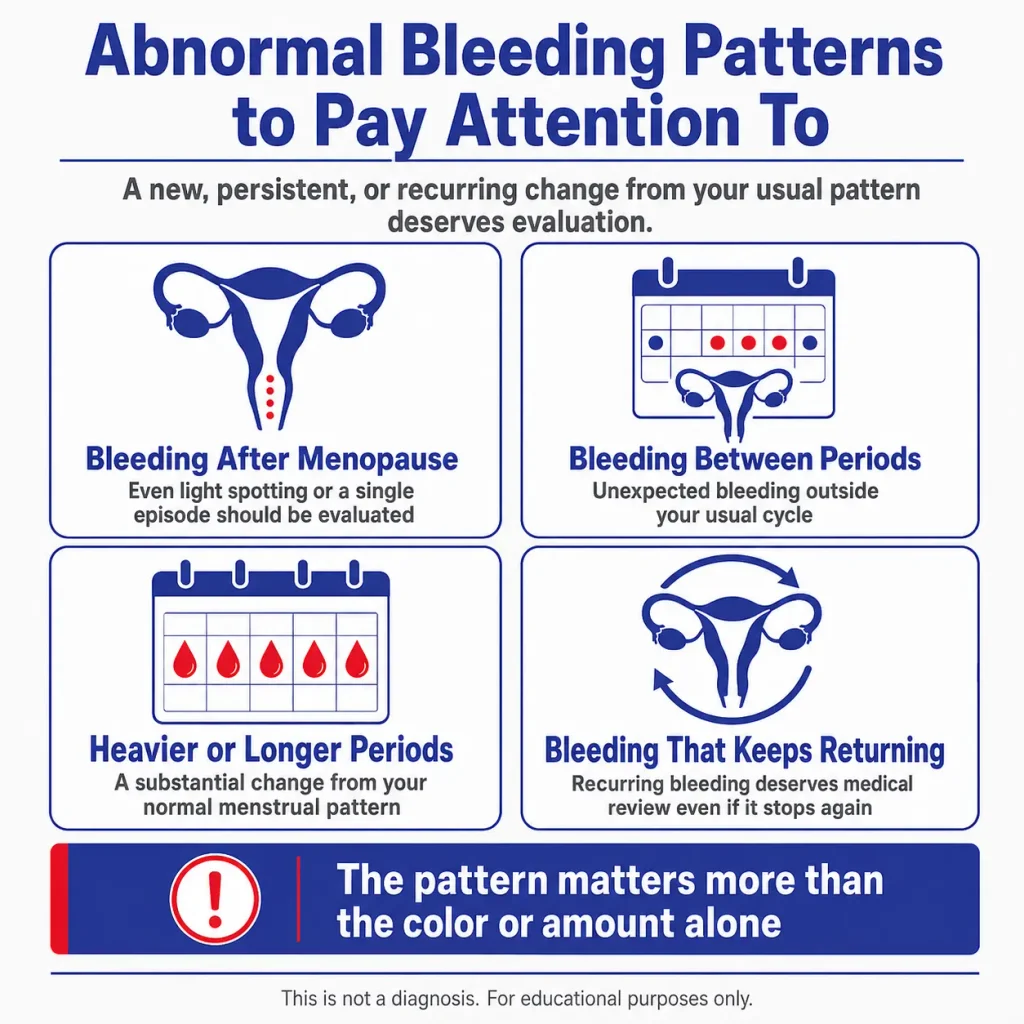
Any new vaginal bleeding after menopause should be evaluated, even if it is only light spotting or happens once. The Society of Gynecologic Oncology notes that postmenopausal bleeding can range from spotting to heavy bleeding and should not be considered normal based on the amount alone.
That does not mean a single episode proves cancer. It means postmenopausal bleeding is a clinically meaningful change that should not be dismissed simply because it stopped or seemed minor.
Bleeding that is unusual for your normal cycle
Before menopause, cycle patterns vary from person to person. A meaningful change may include unexpected bleeding between periods, periods that become substantially heavier or longer than usual, or bleeding that no longer follows your established pattern. ACOG guidance on endometrial cancer specifically includes irregular menstrual bleeding, spotting, and bleeding between periods among symptoms that warrant attention before menopause.
A changed cycle is still much more useful as a reason to get evaluated than as a reason to assume the cause. Age, medications, hormonal patterns, medical history, and other symptoms all affect what clinicians consider next.
Bleeding that keeps returning
Recurrence matters. Bleeding that repeatedly returns after seeming to stop, or a pattern that continues across cycles, deserves medical review rather than repeated watch-and-wait decisions. You do not need to judge cancer risk from whether the blood is bright red, brown, light, or heavy; the persistence and context are more useful clues for deciding that an explanation is needed.
Other Changes That Can Matter Alongside Abnormal Bleeding
This article is intentionally bleeding-led, but accompanying symptoms can add context. Pelvic or lower-abdominal discomfort, pressure, cramping, or unusual vaginal discharge may occur with uterine or endometrial cancer. The MedlinePlus overview of uterine cancer also identifies pelvic pain or pressure and unusual discharge as possible symptoms.
These symptoms are not cancer-specific either. Their importance rises when they are new, persistent, worsening, or occurring together with abnormal bleeding. Severe pain changes the urgency of the situation regardless of whether cancer is ultimately involved.
Why Abnormal Bleeding Needs Evaluation but Does Not Confirm Cancer
Abnormal uterine or vaginal bleeding has a broad range of causes. Hormonal or ovulation changes, noncancerous uterine growths such as polyps, medication effects, infection, and other gynecologic conditions can all alter bleeding. ACOG information on heavy and abnormal periods describes several noncancerous explanations and recommends evaluation when bleeding patterns become abnormal.
That is why the safest takeaway is simple: persistent abnormal bleeding needs an explanation, not an assumption. A clinician can use your age, menopausal status, bleeding history, examination findings, and appropriate tests to narrow the possibilities. The amount or appearance of blood by itself cannot establish endometrial cancer.
When Bleeding or Pain Becomes an Urgent Problem
Cancer concern is not what makes a bleeding episode an emergency. The immediate issue is whether the current bleeding, pain, or change in your condition suggests significant blood loss or another acute problem that needs prompt assessment.
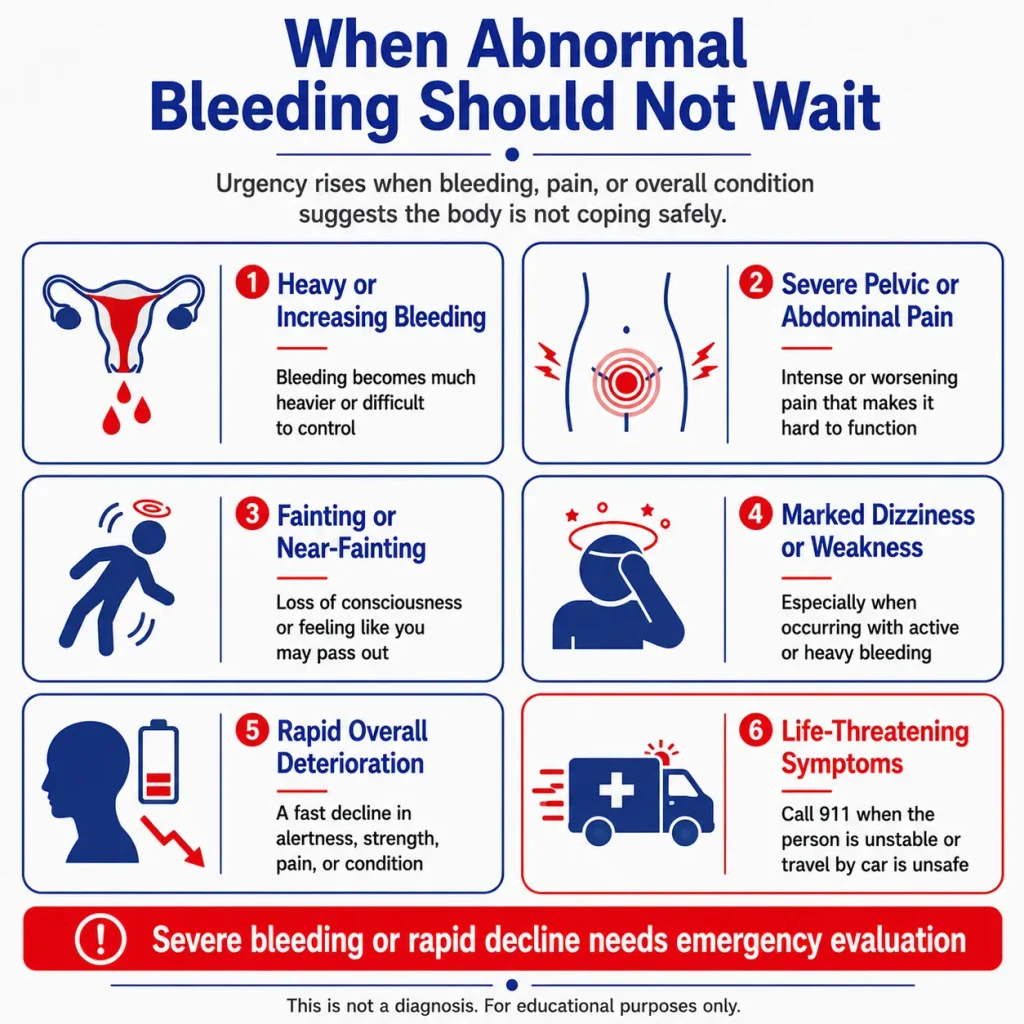
Emergency evaluation becomes more appropriate when any of the following is happening:
– Heavy or rapidly increasing bleeding. Bleeding that is becoming difficult to control or is clearly much heavier than your usual pattern needs more urgent assessment.
– Severe or worsening pelvic or abdominal pain. Pain that is intense, escalating, or making it hard to function should not be treated as routine follow-up. Post Oak ER also outlines ER warning patterns for severe or worsening abdominal pain.
– Fainting or near-fainting. Loss of consciousness or feeling as though you may pass out can signal that your body is not tolerating the situation well.
– Significant dizziness or weakness. These symptoms are more concerning when they occur with active or heavy bleeding. ACOG identifies dizziness or fainting as warning signs that can accompany heavy bleeding.
– Rapid deterioration or feeling seriously unwell. A fast change in alertness, strength, pain, or overall condition is a reason to favor immediate assessment rather than waiting for an office appointment.
If symptoms are life-threatening or it is not safe to travel by car, call 911. If bleeding is persistent but light and you otherwise feel stable, it still deserves timely gynecologic follow-up, but the reason for that visit is to identify the cause rather than to treat the symptom as an emergency by default.
What Medical Evaluation May Help Clarify
Evaluation usually starts with the story of the bleeding: when it began, whether you have gone through menopause, how the pattern differs from normal, whether it has happened before, and what other symptoms or medications are relevant. A clinician may also perform an examination and order tests based on your situation.
For suspected endometrial disease, the American Cancer Society overview of diagnostic testing describes medical history, pelvic examination, ultrasound, and examination of endometrial tissue as parts of the diagnostic process. The key distinction is that imaging or symptoms may raise concern, but confirmation requires appropriate specialist-directed evaluation; an emergency visit is not a substitute for the full cancer diagnostic pathway.
When bleeding is heavy or symptoms are acute, emergency evaluation has a different job. Clinicians can assess vital signs, the degree of blood loss or anemia when relevant, severe pain, fainting, weakness, and other immediate problems. Imaging may be used when the clinical picture calls for it. Post Oak ER provides on-site emergency imaging, including ultrasound, as part of physician-guided emergency evaluation when appropriate.
Persistent but stable abnormal bleeding still needs appropriate gynecologic follow-up even if an emergency assessment finds no immediate threat. The urgent question and the diagnostic question are related, but they are not the same.
Emergency Evaluation for Severe Bleeding or Pelvic Pain in Houston
For Houston-area patients experiencing heavy bleeding, severe pelvic or abdominal pain, fainting, marked weakness, or rapidly worsening symptoms, Post Oak ER provides 24/7 emergency care in Houston for urgent symptom evaluation. Depending on the situation, emergency care may include examination, lab testing, imaging, symptom treatment, stabilization, and determination of whether hospital-level care or further follow-up is needed. Post Oak ER should not be viewed as the place to confirm uterine or endometrial cancer; if abnormal bleeding is persistent but you are otherwise stable, timely gynecologic follow-up remains important rather than waiting indefinitely for the problem to resolve.
Frequently Asked Questions
What abnormal bleeding can be a warning sign of uterine or endometrial cancer?
Bleeding after menopause, bleeding between periods, and a substantial change from your usual menstrual pattern can all be warning signs. These patterns warrant evaluation, but none of them is specific enough to diagnose cancer on its own.
Is bleeding after menopause always a sign of endometrial cancer?
No. Many people with postmenopausal bleeding have a noncancerous cause. Even so, any bleeding or spotting after menopause should be evaluated because endometrial cancer is one important condition clinicians need to rule out.
Can uterine cancer cause bleeding between periods?
Yes. Endometrial cancer can cause bleeding or spotting between menstrual periods. Because hormonal changes and other noncancerous conditions can do the same thing, persistent or recurrent intermenstrual bleeding needs medical evaluation rather than self-diagnosis.
Can endometrial cancer occur without heavy bleeding?
Yes. Bleeding does not have to be heavy to matter. Light spotting, especially after menopause, can still be an abnormal pattern that deserves evaluation.
What other symptoms can occur with abnormal bleeding in uterine cancer?
Pelvic or lower-abdominal pain, pressure, cramping, or unusual vaginal discharge can occur alongside abnormal bleeding. These symptoms also have many noncancer causes, so the pattern and medical evaluation matter more than any single symptom.
When does abnormal vaginal bleeding require emergency care?
Emergency care is more appropriate when bleeding is heavy or rapidly increasing, or when it occurs with severe or worsening pelvic or abdominal pain, fainting or near-fainting, marked dizziness or weakness, or rapid overall deterioration. If you are stable and the bleeding is persistent but not severe, arrange timely gynecologic follow-up to determine the cause.