

A headache can be unsettling when it is new, keeps returning, or no longer behaves like your usual headaches. The concern rises further when the change is accompanied by weakness, numbness, speech or vision problems, confusion, trouble walking, a seizure, or repeated vomiting. These patterns can occur with brain tumors, but they can also occur with stroke, migraine, infection, bleeding, medication effects, and other neurologic conditions.
The most useful question is not, “Does this headache prove I have brain cancer?” Symptoms alone cannot do that. Instead, pay attention to whether the pattern is new or progressive and whether neurologic function is changing. The American Cancer Society notes that brain-tumor symptoms vary with tumor location and growth rate, and that the same symptoms can have other causes.
A New or Progressive Headache Pattern Deserves Attention
There is no single “brain tumor headache” that can be recognized at home. Some people with brain tumors have headaches, while others do not. What matters clinically is a change from baseline: a headache that is new for you, becoming more frequent, steadily more intense, lasting longer, or appearing with symptoms you have not experienced before.
Official National Cancer Institute patient guidance lists headache among possible brain-tumor symptoms along with seizures, vision or speech problems, frequent nausea or vomiting, balance difficulty, weakness, changes in behavior or concentration, and unusual sleepiness. That list is useful as context, not as a diagnostic checklist.
A familiar headache that resolves in its usual way is a different situation from a headache that has changed character over days or weeks. If you need a broader review of headache emergencies that is not specific to cancer, Post Oak ER has a separate guide on when a headache may need ER evaluation. This article stays focused on tumor-related concern: progression plus neurologic change.
Neurologic Symptoms Change the Picture
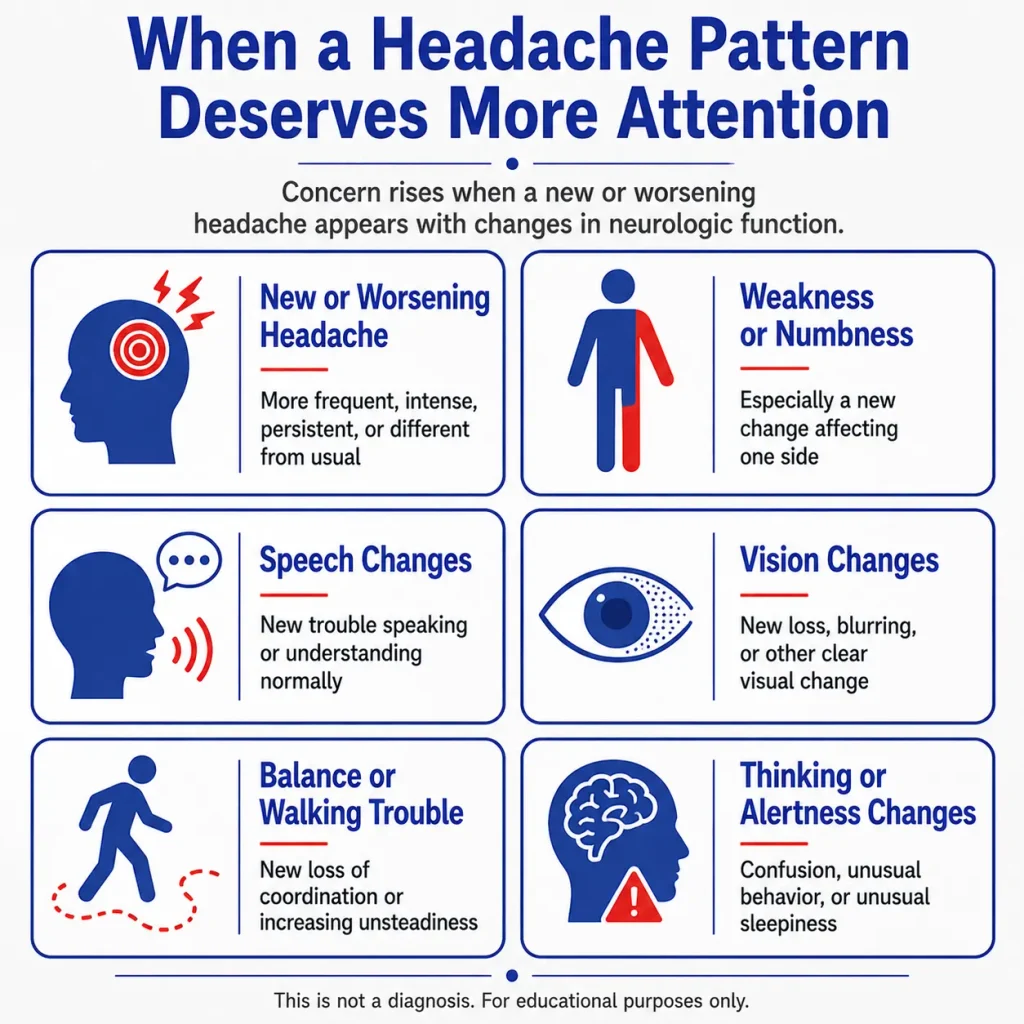
The brain controls movement, sensation, language, vision, balance, behavior, memory, and alertness. A problem affecting brain tissue can therefore show up as more than pain. MedlinePlus lists brain-tumor symptoms such as trouble talking, hearing, or seeing; problems with balance or walking; thinking or memory changes; weakness or sleepiness; mood or behavior changes; and seizures.
The pattern becomes more concerning when a new headache occurs together with a new neurologic change. Examples include one-sided weakness or numbness, a new speech problem, new loss of coordination, a clear change in vision, confusion that is unusual for the person, or a first seizure. The symptom combination does not tell you the cause, but it does lower the threshold for prompt evaluation.
Symptoms Can Raise Concern Without Diagnosing a Brain Tumor
Searches for “brain tumor symptoms” or “signs of brain cancer” often lead to long lists that overlap with many other disorders. That overlap is real. Headache, nausea, dizziness, weakness, visual changes, and confusion are not specific to tumors. Even a symptom that appears on a cancer website cannot establish the diagnosis in an individual person.
The MedlinePlus review of primary adult brain tumors explains that symptoms depend on factors such as tumor size, location, and brain swelling, and that some tumors cause slowly developing symptoms. It also advises medical evaluation for new, persistent headaches and emergency care for certain sudden neurologic changes.
Migraine, stroke, bleeding in or around the brain, infection, and other conditions can produce overlapping symptoms. The point is not to decide which diagnosis fits best from an online list. It is to recognize when the pattern has changed enough to justify evaluation and when the change is acute enough that the cause must be investigated urgently.
Persistent Changes vs Rapid Neurologic Deterioration
Patterns That Need Prompt Medical Evaluation
A slowly evolving pattern is not automatically an ER emergency, but it should not be managed indefinitely with repeated self-treatment. Arrange timely medical evaluation if a new headache keeps recurring, a prior headache pattern is steadily changing, or subtle neurologic symptoms are persisting or progressing. Examples include increasing balance difficulty, repeated episodes of weakness or numbness, new cognitive changes, or vision or speech symptoms that are not resolving as expected.
A clinician can review the timeline, medications, medical history, cancer history when relevant, and neurologic findings. The decision about testing should follow the clinical picture rather than the presence of headache alone.
Changes That Move the Situation Toward Emergency Care
Sudden onset or rapid neurologic worsening is different. A person who abruptly develops one-sided weakness, facial drooping, trouble speaking, major confusion, loss of coordination, a seizure, or a severe headache with acute neurologic symptoms needs emergency assessment. Some of these are also classic stroke patterns, and waiting to see whether they pass can delay time-sensitive care.
Brain and Neurologic Red Flags That Should Not Wait
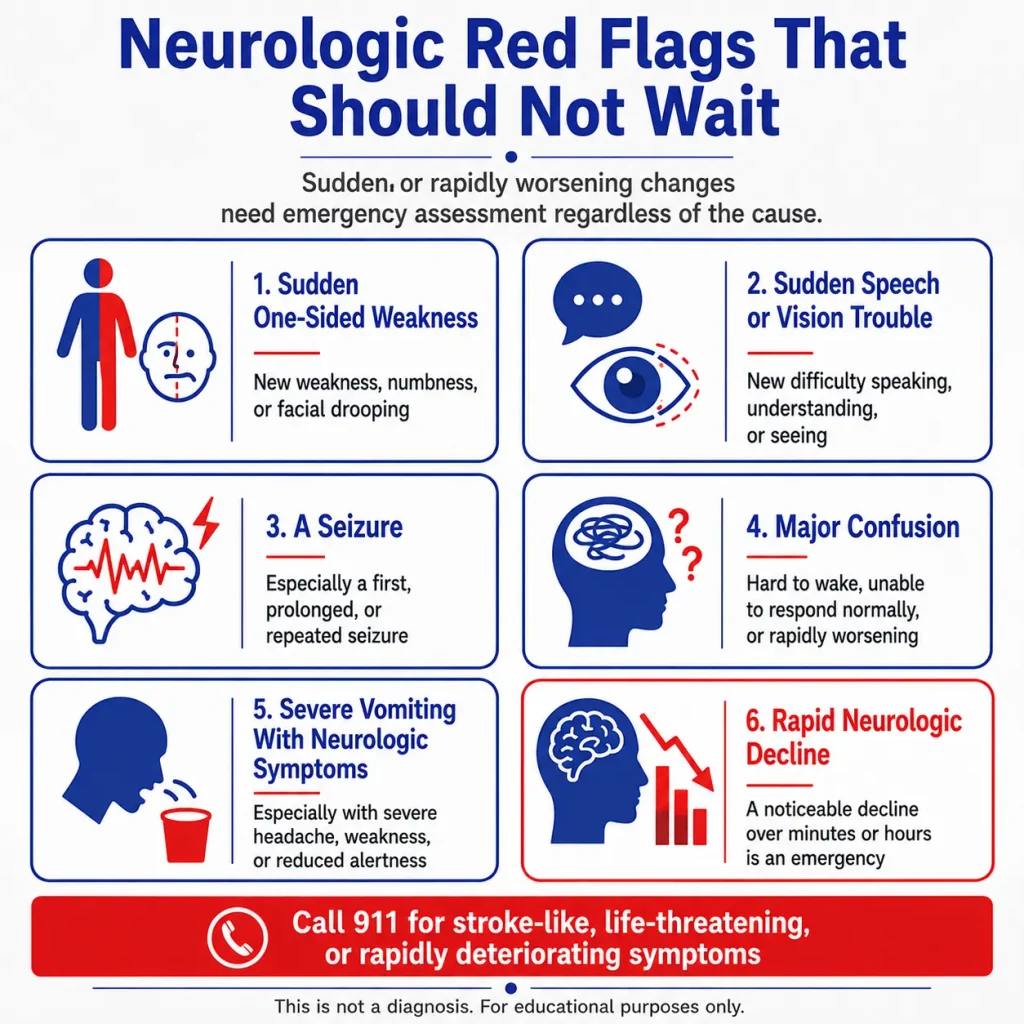
Go to an emergency department now – and call 911 for stroke-like, life-threatening, or rapidly deteriorating symptoms – when headache or brain-tumor concern is accompanied by:
– Sudden focal neurologic deficits: new weakness or numbness on one side, facial drooping, new trouble speaking or understanding, or abrupt loss of coordination or vision. The CDC stroke warning signs emphasize that sudden one-sided weakness, confusion, speech difficulty, vision problems, walking difficulty, or severe unexplained headache require immediate action.
– A seizure: especially a first seizure, a prolonged seizure, repeated seizures without recovery, or a seizure followed by failure to return to normal awareness. MedlinePlus seizure guidance identifies these as reasons to call emergency services.
– New or significant confusion: particularly if the person is difficult to wake, cannot follow simple conversation, is behaving markedly differently, or is getting worse over a short period.
– Severe or repeated vomiting with neurologic symptoms: vomiting becomes more concerning when it occurs with severe headache, weakness, confusion, visual changes, a seizure, or reduced alertness.
– Rapidly worsening neurologic symptoms: a noticeable decline over minutes or hours should be treated as an emergency even if no one knows whether a tumor, stroke, bleeding, infection, or another condition is responsible.
If the new symptoms resemble stroke – for example, facial drooping, one-sided weakness, or sudden speech difficulty – do not drive yourself. Call 911. Post Oak ER also has a focused overview of stroke symptoms that require emergency action, but the immediate priority is activating emergency care, not deciding whether cancer is the explanation.
What Evaluation May Help Clarify
Evaluation starts with the clinical story and a neurologic examination. Clinicians may check strength, sensation, reflexes, coordination, balance, vision, speech, alertness, and other functions. The American Cancer Society overview of brain-tumor diagnosis describes the neurologic exam and imaging as key parts of investigating suspected brain tumors.
Imaging is selected according to the situation. CT can be especially useful when a rapid assessment is needed, while MRI can provide more detailed soft-tissue evaluation in many brain-tumor workups. RadiologyInfo explains the roles of CT and MRI in brain-tumor evaluation. An imaging abnormality may lead to further testing or specialist assessment; it does not mean that symptoms alone have diagnosed brain cancer.
If imaging identifies a concerning mass, additional diagnostic steps may be needed to determine exactly what it is. Depending on the finding and the patient, this can include specialist evaluation and sometimes biopsy. The ER role is to assess the acute neurologic problem, identify immediate danger, stabilize serious symptoms, and determine the appropriate next level of care or follow-up.
Emergency Evaluation at Post Oak ER in Houston
For Houston-area patients, Post Oak ER is open 24/7 for emergency evaluation when a headache is accompanied by sudden focal neurologic changes, seizure, significant confusion, severe vomiting with neurologic symptoms, or rapidly worsening neurologic function. The facility provides physician-guided emergency assessment and on-site CT imaging when clinically appropriate. Persistent but stable symptom patterns still need appropriate medical follow-up, while stroke-like symptoms or other life-threatening changes should prompt a 911 call.
Frequently Asked Questions
What headache patterns can occur with a brain tumor?
Brain-tumor headaches do not follow one reliable pattern. A headache is more concerning when it is new, becomes progressively more frequent or severe, or occurs with neurologic changes such as weakness, speech problems, confusion, balance difficulty, vision changes, or seizure.
Can a brain tumor cause headaches without other symptoms?
Yes, a brain tumor can present with headache, but headache alone is common and usually has a non-tumor cause. A new or progressively changing headache still deserves medical evaluation if it persists, especially when it is unlike your usual pattern.
What neurologic symptoms can occur with a brain tumor?
Possible symptoms include new weakness or numbness, speech or vision changes, balance or walking problems, changes in thinking or behavior, unusual sleepiness, and seizures. Which symptoms occur depends in part on where a problem affects the brain.
Does a headache with vomiting mean you have a brain tumor?
No. Headache with vomiting can occur for many reasons and does not diagnose a brain tumor. It needs more urgent assessment when vomiting is severe or repeated and is paired with new neurologic symptoms, reduced alertness, or rapidly worsening headache.
Can brain tumor symptoms develop gradually?
Yes. Some symptoms develop gradually and worsen over time, while others can appear suddenly. A slow pattern of persistent change warrants medical evaluation; sudden or rapidly worsening neurologic deficits require emergency care.
When should headache and neurologic symptoms be evaluated in the ER?
Use the ER for sudden focal weakness or numbness, facial drooping, new speech or vision problems, a seizure, major confusion, severe vomiting with neurologic symptoms, or rapid neurologic decline. Call 911 for suspected stroke or other life-threatening neurologic changes.