
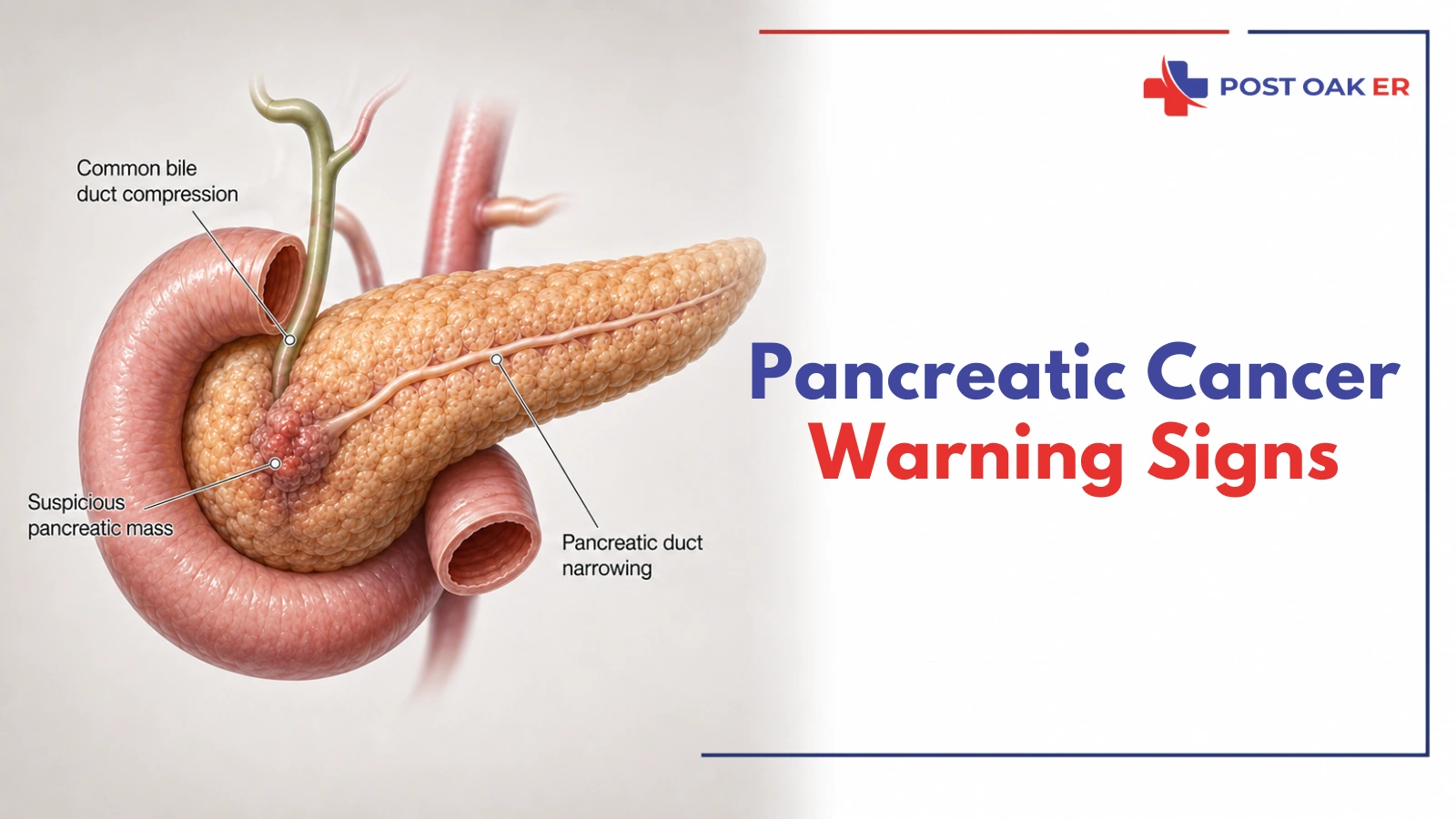
Upper-abdominal and back pain are common, and one episode does not point to pancreatic cancer. Concern rises when discomfort keeps returning, does not resolve, or clearly worsens – especially with weight loss, jaundice, appetite changes, unusual stool or urine changes, or a broader decline in how you feel.
The National Cancer Institute lists upper- or middle-abdominal and back pain among possible pancreatic cancer symptoms, but it also emphasizes that these findings overlap with many other illnesses. The goal is not to identify cancer from pain alone. It is to recognize when a symptom pattern deserves medical evaluation and when the severity of what is happening now makes emergency care more appropriate.
When Abdominal or Back Pain Becomes More Than an Everyday Symptom
A pulled muscle, indigestion, gallbladder disease, kidney problems, ulcers, and many other conditions can cause abdominal or back discomfort. Pain can also occur with pancreatic cancer, but location is not diagnostic. More useful questions are how long the symptom has lasted, whether it is recurring or progressing, and what else is changing at the same time.
Pancreatic cancer can be difficult to recognize early. MedlinePlus notes that symptoms are often vague or absent at first, so an isolated sensation cannot reliably identify the disease. A persistent pattern, however, deserves a clinician’s assessment rather than repeated self-testing or trying to match your pain to an online diagram.
How Pancreatic Cancer-Related Pain May Present
Upper-abdominal discomfort or pain
Pancreatic cancer may cause upper- or middle-abdominal discomfort or pain, but no single sensation confirms a pancreatic tumor. American Cancer Society guidance on pancreatic cancer symptoms specifically cautions that belly pain is more often caused by something other than pancreatic cancer.
Persistence changes the decision. Pain that lasts, repeatedly returns without a clear explanation, or becomes progressively harder to ignore should be evaluated even when it is not severe enough for the ER.
Pain that seems to reach or spread into the back
Abdominal and back symptoms can occur together in pancreatic disease because a tumor may affect nearby structures or nerves. But back pain is extremely common, and its presence does not make cancer the most likely explanation.
The pattern carries more weight than the map of the pain. Back discomfort that persists or progresses with upper-abdominal symptoms, unexplained weight loss, jaundice, or appetite changes deserves follow-up. Sudden, severe, or rapidly worsening pain shifts the priority toward ruling out an acute problem.
Warning Signs That Matter Alongside the Pain
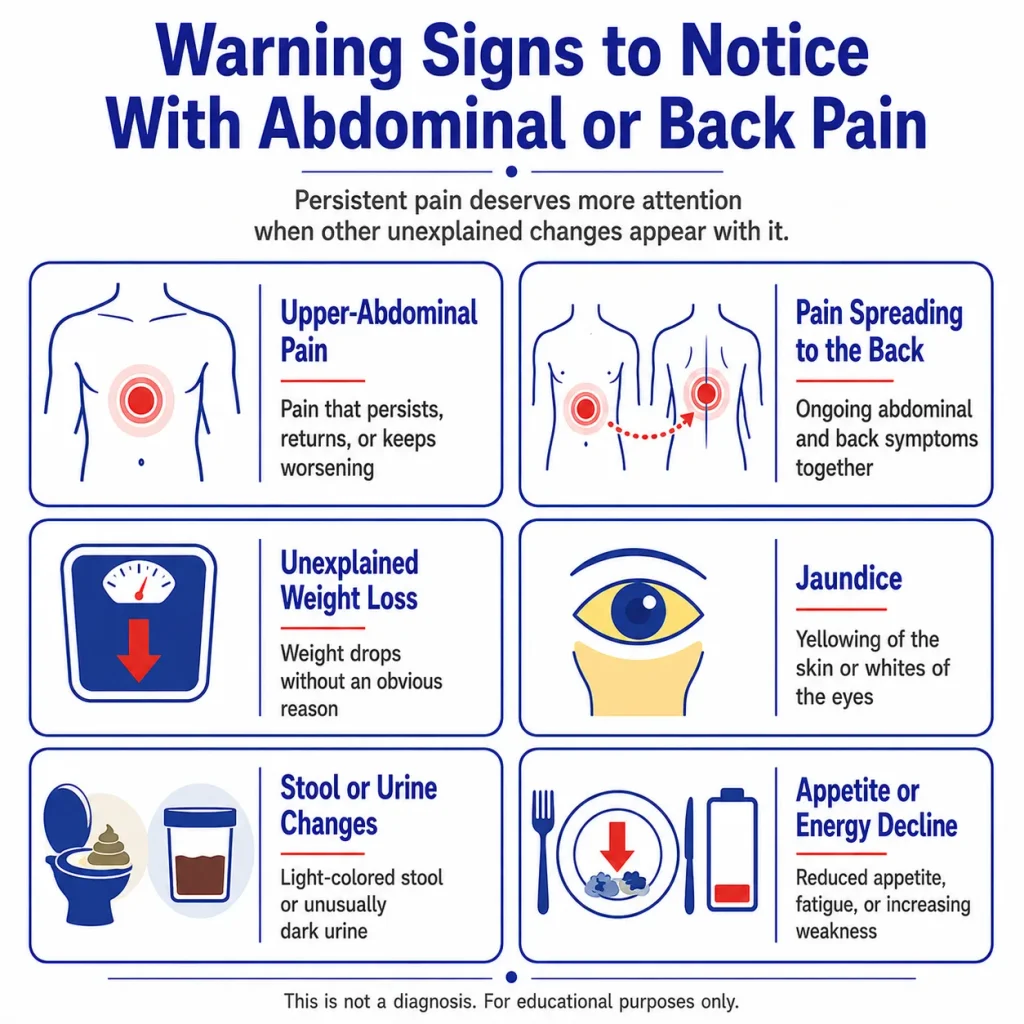
Certain accompanying changes make persistent abdominal or back symptoms more concerning. None proves pancreatic cancer, but they strengthen the case for evaluation.
Unexplained weight or appetite changes. Unintentional weight loss or a sustained drop in appetite matters more when it occurs with ongoing pain.
Jaundice. Yellowing of the skin or whites of the eyes needs medical assessment. Pancreatic cancer can cause jaundice, but gallstones, liver disease, and other conditions can as well.
Stool or urine changes. Light-colored stools and dark urine can accompany jaundice. They are not specific to cancer, but they matter when paired with persistent upper-abdominal symptoms.
Persistent nausea or digestive change. Ongoing nausea, vomiting, or difficulty tolerating food adds context. Repeated vomiting is more urgent when you cannot keep fluids down or develop dehydration.
Increasing weakness or overall decline. Fatigue and weakness are nonspecific, but a clear decline with weight loss, jaundice, pain, or reduced intake is a reason to arrange evaluation.
What “Early Pancreatic Cancer Symptoms” Can – and Cannot – Tell You
Searches such as “early signs of pancreatic cancer” or “my first symptoms of pancreatic cancer” can suggest there should be a recognizable first symptom. There is no dependable sequence: some people have no noticeable symptoms early, while others develop vague changes that fit many conditions.
The NCI describes pancreatic cancer as difficult to diagnose early because early disease may not produce noticeable symptoms and, when symptoms appear, they resemble those of many other illnesses. NCI research also notes that there is not currently a general screening test that reliably catches pancreatic cancer before symptoms in the overall population. That is why symptom persistence and clinical evaluation matter more than trying to identify a particular “first” sign.
Symptoms can justify testing, but they cannot establish that cancer is present or determine its stage. Those questions require medical evaluation and, when appropriate, imaging and tissue diagnosis.
Persistent Symptoms vs an Acute Emergency
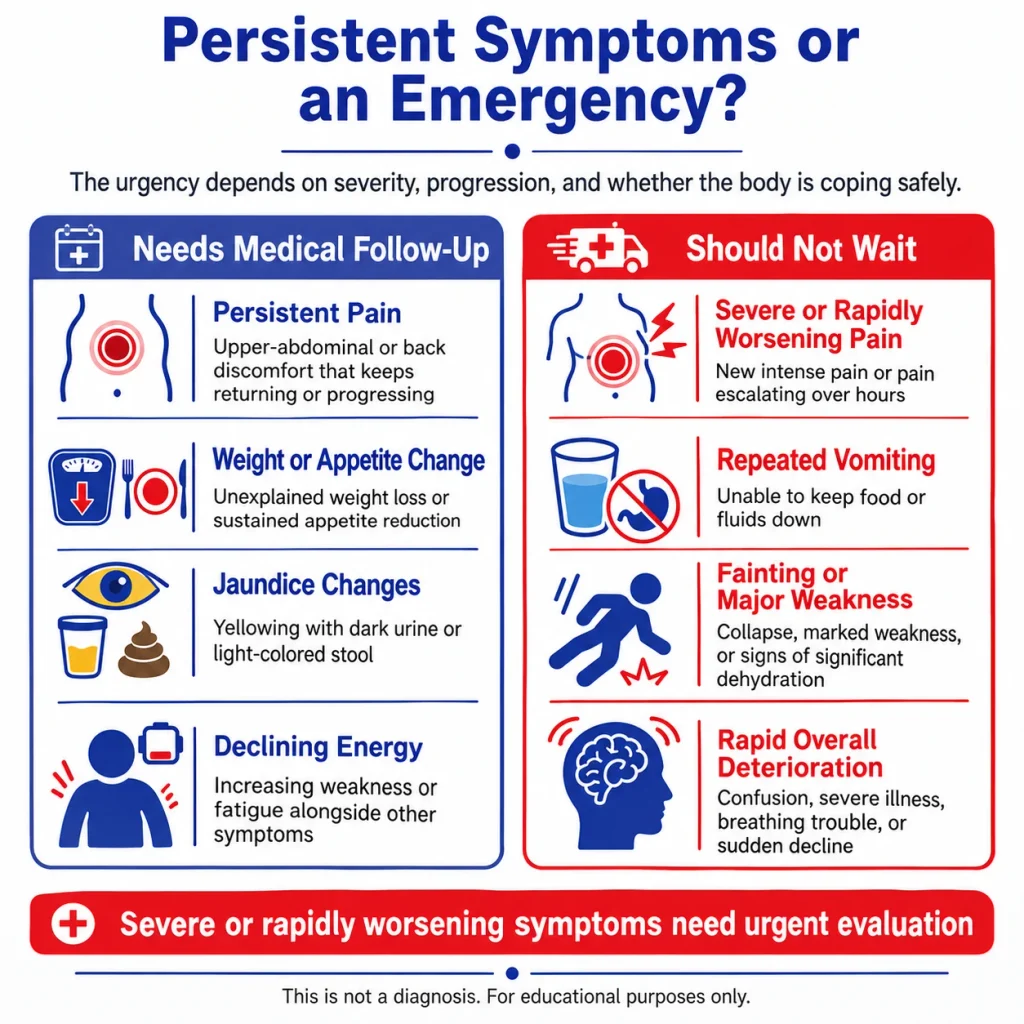
Symptoms that need medical follow-up
If you are otherwise stable, persistent or progressively changing upper-abdominal or back symptoms usually need timely medical follow-up rather than an automatic ER visit, especially with weight loss, jaundice, appetite changes, unusual stool or urine color, or declining energy.
A clinician can review the timeline, examine you, and decide what testing is appropriate. Pain does not have to become an emergency before it deserves evaluation.
Symptoms that should not wait
Emergency evaluation is more appropriate when the problem is acute, severe, or causing signs your body is not coping well. MedlinePlus emergency guidance for abdominal pain includes sudden sharp pain, severe or worsening pain with nausea or vomiting, inability to keep down food or liquids, and other serious warning signs.
Severe or rapidly worsening pain. New severe pain, marked tenderness, or pain escalating over hours should be evaluated urgently regardless of whether cancer is suspected.
Repeated vomiting or inability to keep fluids down. Ongoing vomiting can lead to dehydration. Post Oak ER also provides guidance on when nausea and vomiting need emergency evaluation.
Fainting, major weakness, or rapid deterioration. MedlinePlus lists fainting, confusion, lack of urination, and rapid heartbeat or breathing as signs of severe dehydration that need immediate medical help.
Severe illness with other acute symptoms. Fever, shortness of breath, chest symptoms, confusion, or sudden severe illness should be assessed as the emergency in front of you, not as a cancer question.
For a broader list of urgent abdominal red flags, Post Oak ER’s abdominal pain emergency guidance explains when severe or worsening abdominal symptoms warrant ER care.
What Evaluation May Help Clarify
Evaluation starts with the symptom timeline and associated findings such as jaundice, weight loss, vomiting, or appetite changes. Blood tests and imaging may then be used to look for a cause.
The American Cancer Society overview of pancreatic cancer testing describes medical history, examination, blood testing, imaging, and biopsy as parts of the diagnostic process. Imaging may include CT, MRI, ultrasound, or endoscopic ultrasound depending on the situation. Blood tests can support the workup, but no single symptom or routine blood test can confirm pancreatic cancer on its own.
Other conditions can overlap. For example, NIDDK notes that pancreatitis can cause upper-abdominal pain that spreads to the back, often with nausea or vomiting. Post Oak ER has a separate pancreatitis guide for that condition; this article does not duplicate its causes, diagnosis, or treatment.
If symptoms are severe, emergency clinicians can assess pain, vomiting, dehydration, and other acute complications and decide whether emergency testing is needed. An ER visit can identify urgent problems and guide next steps, but it does not by itself confirm pancreatic cancer. Stable, persistent symptoms still require appropriate outpatient follow-up to determine the underlying cause.
24/7 Emergency Evaluation for Severe Symptoms in Houston
For Houston-area patients with severe or rapidly worsening abdominal or back pain, repeated vomiting, significant weakness, dehydration, or other acute symptoms, Post Oak ER provides 24/7 emergency evaluation. When clinically appropriate, the facility can use on-site CT, X-ray, and ultrasound as part of emergency imaging evaluation, along with laboratory testing and symptom-focused treatment. Persistent but stable symptoms still need follow-up with the appropriate outpatient clinician to investigate cancer and other possible causes.
Frequently Asked Questions
Can pancreatic cancer cause both abdominal and back pain?
Yes. Pancreatic cancer can cause upper- or middle-abdominal pain and back pain, and some people experience both. The combination is not specific to cancer, so persistence, progression, accompanying symptoms, and clinical evaluation matter more than pain location alone.
Where is abdominal pain from pancreatic cancer usually felt?
It may be felt in the upper or middle abdomen and can sometimes extend into the back. There is no single pain location or sensation that reliably identifies pancreatic cancer, so ongoing or worsening symptoms should be evaluated rather than self-diagnosed by location.
Can back pain be an early sign of pancreatic cancer?
It can occur, but back pain alone is far more often related to other causes. Concern rises when pain is persistent or progressive and appears with changes such as jaundice, unexplained weight loss, reduced appetite, or upper-abdominal discomfort.
What are some of the early warning signs of pancreatic cancer?
Early pancreatic cancer may cause no noticeable symptoms. When symptoms do occur, possible warning signs include upper-abdominal or back pain, jaundice, dark urine or light-colored stools, unexplained weight loss, appetite loss, and fatigue; these findings can also come from non-cancer conditions.
Can pancreatic cancer symptoms come and go at first?
Some symptoms may be intermittent or subtle, but there is no reliable on-and-off pattern that identifies pancreatic cancer. Recurrent symptoms that keep returning, evolve over time, or appear with other concerning changes are worth discussing with a clinician.
When should abdominal or back pain be evaluated in the ER?
Use the ER for severe, sudden, or rapidly worsening pain; repeated vomiting or inability to keep fluids down; fainting; marked weakness; confusion; or rapid overall deterioration. Persistent but stable pain without emergency features still warrants timely medical follow-up to determine the cause.