
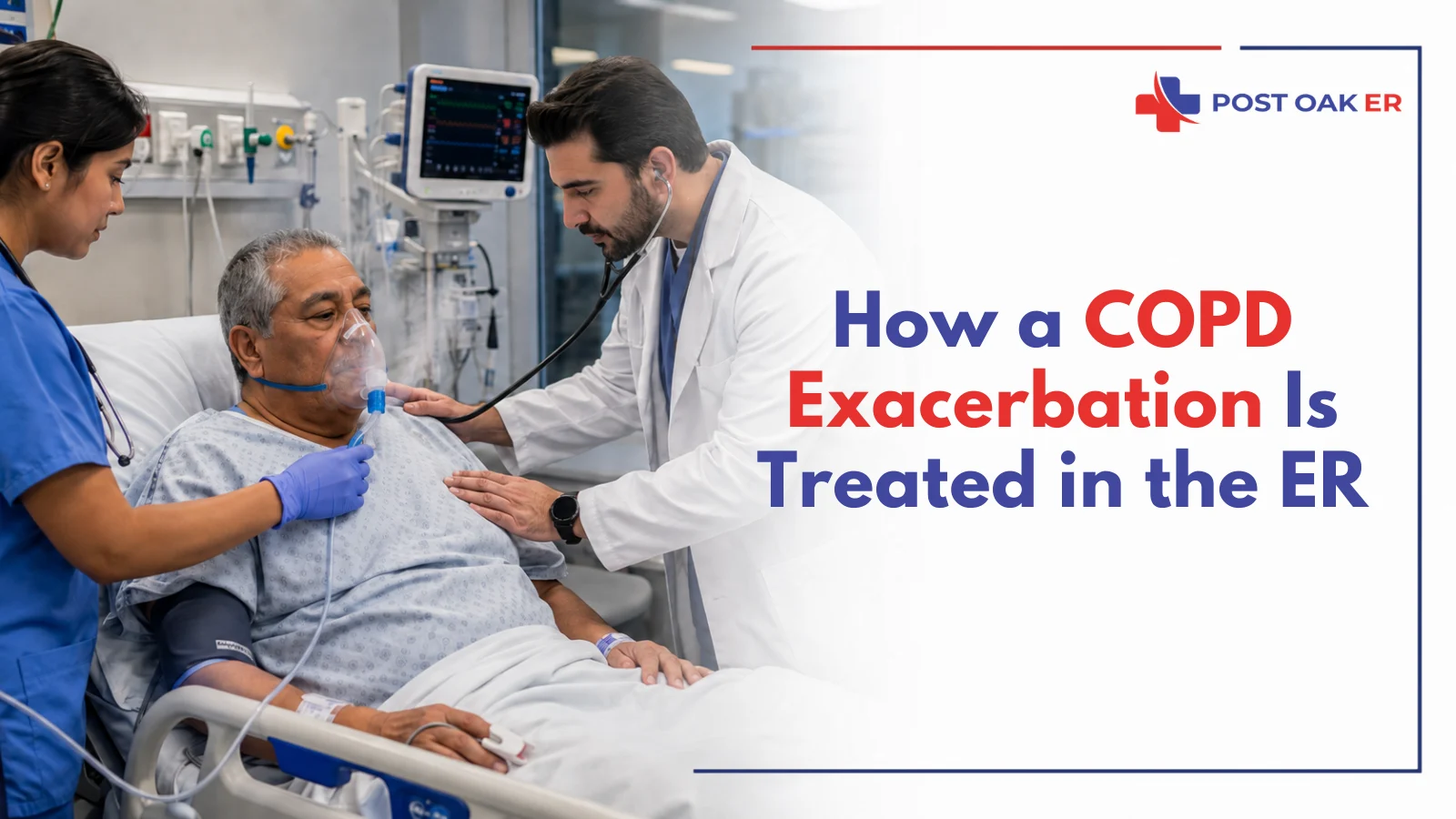
When a COPD flare can no longer be managed safely at home, an ER visit can feel uncertain. Emergency care has two connected goals: support breathing now and look for the problem causing or worsening the change. Those steps often happen together, and the exact evaluation depends on how ill the patient appears.
A flare needs emergency evaluation when breathlessness is severe or rapidly worsening, the person cannot speak normally, becomes confused or unusually drowsy, develops concerning chest symptoms, or does not improve with the prescribed rescue plan. The National Heart, Lung, and Blood Institute’s COPD emergency guidance advises calling 911 for serious warning signs such as difficulty catching a breath or talking, blue or gray lips or nails, reduced alertness, or treatment that is not working.
What Happens First When You Arrive at the ER?
The first priority is to determine how severely breathing is affected and whether immediate stabilization is needed. The team may check vital signs and oxygen saturation while observing breathing rate, visible effort, ability to speak, skin color, and alertness. A lung and heart examination helps identify wheezing, reduced air movement, abnormal breath sounds, an irregular heartbeat, or signs that another condition may be involved.
Clinicians will also ask what the patient’s usual COPD symptoms are, what changed, which medications and home oxygen have been prescribed, and what happened after the patient followed the rescue plan. When symptoms are serious, treatment does not have to wait until every question or test is complete.
How the ER Evaluates What Is Causing the COPD Flare
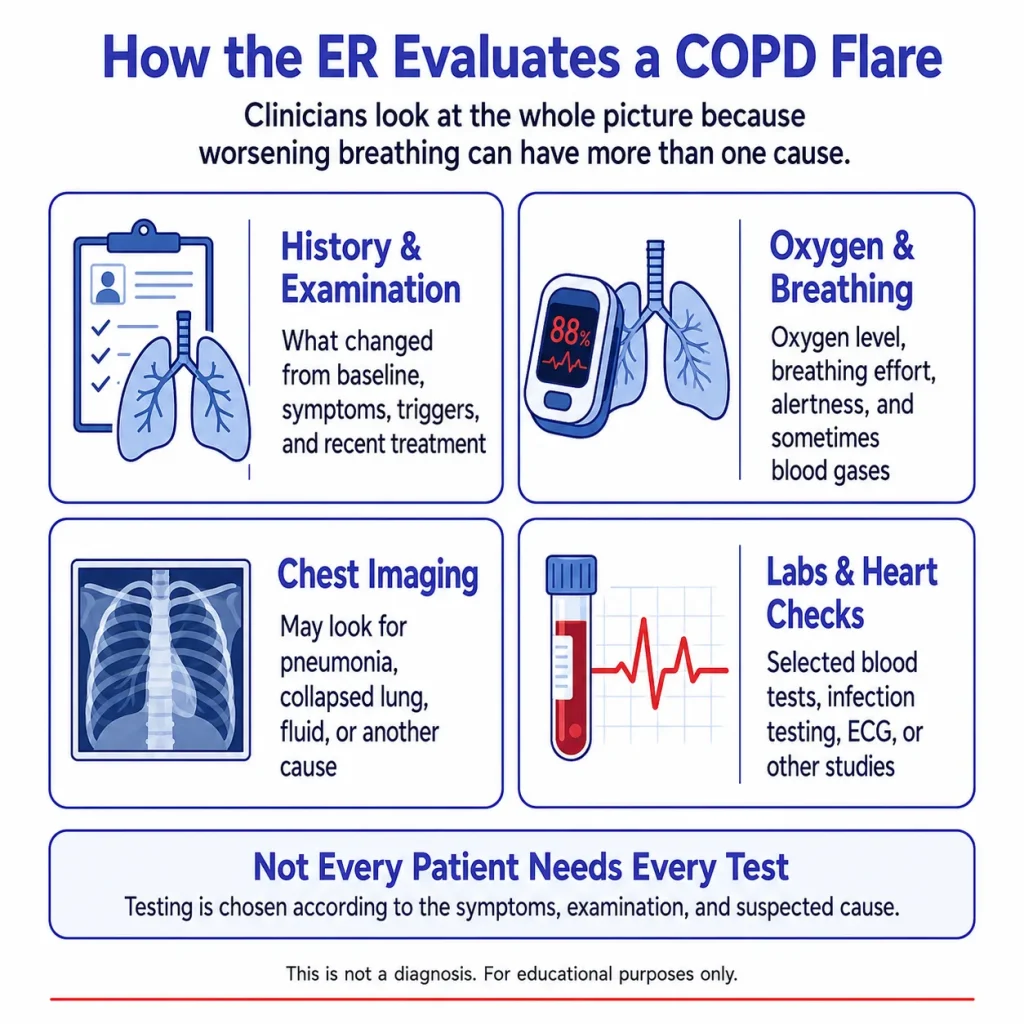
Worsening breathing in someone with COPD is not automatically due to COPD alone. A respiratory infection may trigger an exacerbation, while pneumonia, heart failure, an abnormal heart rhythm, a blood clot, or a collapsed lung can resemble or complicate one. A clinical assessment of acute COPD exacerbations therefore combines the history, physical findings, suspected triggers, severity assessment, and evaluation for other plausible causes.
Medical History and Physical Examination
The team may ask when the change began; whether breathlessness, cough, wheezing, or mucus differs from the person’s baseline; and whether fever, chest discomfort, swelling, illness exposure, smoke, or another irritant preceded it. Recent treatments matter too, including rescue medication, steroids or antibiotics already started, and whether the prescribed plan brought meaningful relief.
Oxygen and Breathing Assessment
Pulse oximetry provides one piece of the picture, but clinicians also judge respiratory effort, alertness, and the patient’s usual oxygen needs. Blood-gas testing may be considered when more information is needed about oxygen, carbon dioxide, acid-base balance, or the severity of respiratory impairment. This is one reason a single oxygen reading does not determine the entire treatment plan.
Chest Imaging
A chest X-ray may be used when it could help identify pneumonia, a collapsed lung, fluid-related changes, or another explanation for the sudden breathing difficulty. CT or other imaging is reserved for situations in which the symptoms, examination, or initial findings justify a closer look. The American College of Radiology and Radiological Society of North America’s COPD imaging overview explains that chest imaging can also reveal conditions that produce symptoms similar to COPD.
Laboratory and Other Testing
Blood counts, chemistry tests, infection testing, an electrocardiogram, heart-related blood tests, or other studies may be selected according to the presentation. A patient with fever and new sputum changes may need a different workup than someone with chest pressure, leg swelling, or sudden one-sided chest pain. No single testing package is appropriate for every COPD flare.
Treatments the ER May Use for a COPD Exacerbation
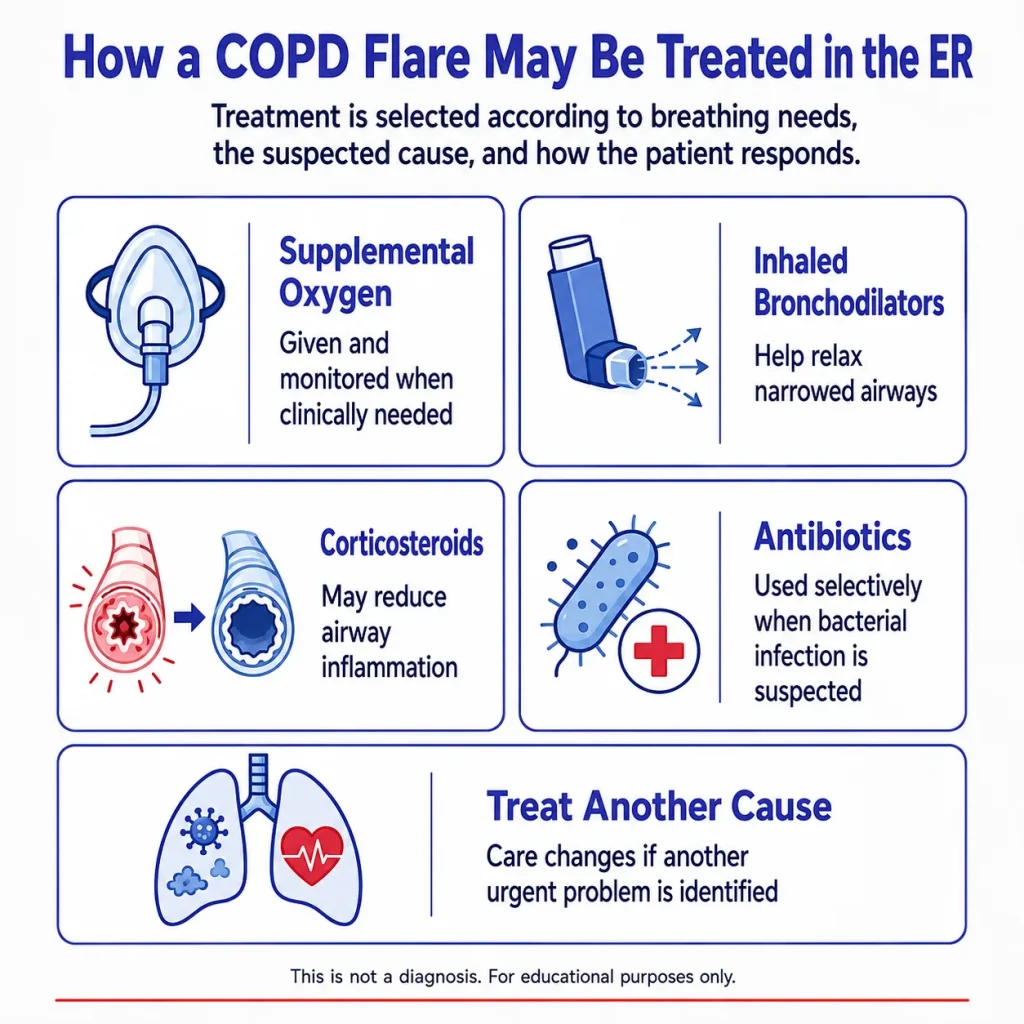
ER treatment is built around what the patient needs at that moment. Clinicians may begin one treatment while continuing to investigate the trigger, then adjust the plan as symptoms, examination findings, and test results change.
Supplemental Oxygen When Appropriate
Supplemental oxygen may be given when the patient’s condition and measurements show that it is needed, with ongoing monitoring to avoid both inadequate and excessive oxygen delivery. The American Lung Association’s COPD treatment guidance notes that oxygen needs are individualized and informed by clinical testing. Patients should not change a prescribed home-oxygen setting on their own unless their clinician-directed plan specifically tells them to do so.
Inhaled Bronchodilator Treatment
Short-acting inhaled bronchodilator medication may be used under medical supervision to relax narrowed airways and reduce breathing difficulty. Depending on the patient’s condition, it may be delivered by an inhaler with a spacer or through a nebulizer. The American Thoracic Society’s patient guide to COPD exacerbations describes bronchodilators as a core treatment for airway constriction during a flare.
Corticosteroids
Systemic corticosteroids may be considered to reduce airway inflammation and support recovery. The route and duration depend on the clinical situation, the ability to take medicine by mouth, possible side effects, and the treatment setting. The joint European Respiratory Society and American Thoracic Society guideline supports corticosteroid use in appropriate exacerbations while emphasizing that guideline recommendations must be applied to the individual patient.
Antibiotics When a Bacterial Infection Is Suspected
Antibiotics are selective, not automatic. Clinicians consider the severity of the flare, changes in sputum, evidence of bacterial infection, imaging findings, prior antibiotic exposure, allergies, and other patient-specific risks. The Agency for Healthcare Research and Quality’s COPD exacerbation guidance distinguishes COPD exacerbations from pneumonia and ties antibiotic decisions to the clinical picture rather than to the COPD diagnosis alone.
Treatment for Another Identified Cause
If testing points to pneumonia, a heart-related condition, a collapsed lung, or another urgent problem, treatment shifts to address that cause as well as the breathing distress. In severe respiratory failure, hospital-level support may include noninvasive ventilation or other advanced measures.
Why COPD Exacerbation Treatment Is Different for Each Patient
Emergency clinicians tailor care to the severity of breathing difficulty, oxygen and ventilation findings, the suspected trigger, the patient’s usual COPD baseline, other medical conditions, concerning symptoms, and the response to initial treatment. The current 2026 GOLD COPD strategy documents provide evidence-based guidance, but the bedside plan still depends on the individual clinical picture. Receiving fewer or different tests does not necessarily mean the problem is being taken less seriously.
Monitoring and Reassessment After Initial Treatment
A COPD emergency visit may involve observation and repeated checks rather than one treatment followed by an immediate decision. The team may reassess breathing effort, oxygen status, alertness, lung sounds, symptoms, and the need for additional medication or respiratory support. Improvement, lack of response, or new findings can each change what happens next.
How the ER Decides What Happens Next
The decision is based on the whole clinical picture, not one symptom, test result, or oxygen reading. Stability over time and response to treatment matter alongside test findings and the patient’s baseline health.
Discharge After Improvement
Discharge may be considered when breathing has improved enough, the patient appears stable, urgent complications have been addressed, and the findings support safe care outside the hospital. Before leaving, the patient should understand medication instructions, warning signs, and the recommended follow-up plan.
Hospital Transfer or Admission
Continued hospital care may be needed when breathing remains unstable, initial treatment does not provide adequate improvement, testing identifies a serious complication, or the patient needs ongoing monitoring or respiratory support. The VA/DoD COPD clinical practice pocket guide lists factors such as accessory-muscle use, rapid breathing, oxygen or carbon-dioxide abnormalities relative to baseline, and failure to respond to initial therapy as considerations rather than rigid admission rules.
Emergency COPD Evaluation at Post Oak ER
Post Oak ER provides 24/7 emergency care in Houston for serious breathing symptoms, including a suspected COPD exacerbation. Our emergency team can assess breathing and oxygen status, provide medically supervised treatment, and use on-site emergency imaging or laboratory testing when clinically appropriate. We also evaluate whether a patient has improved enough to return home or needs transfer for continued hospital care. If someone is in severe respiratory distress, call 911 rather than delaying emergency assistance.
Frequently Asked Questions
What happens first when a COPD exacerbation is treated in the ER?
The team first determines how severely breathing is affected and whether immediate stabilization is needed. Vital signs, oxygen status, breathing effort, alertness, and lung and heart findings may be assessed while treatment begins.
What tests may be performed during a COPD exacerbation?
Testing is chosen for the individual patient. It may include oxygen measurements, blood tests, infection testing, an ECG, blood-gas analysis, or chest imaging when the symptoms and examination make those studies useful.
Will everyone with a COPD flare receive oxygen or nebulizer treatment?
No. Oxygen is used and monitored according to the patient’s needs, and inhaled medicine may be delivered in different ways. The care team selects treatment based on severity, measurements, medical history, and response.
Are steroids and antibiotics always used for a COPD exacerbation?
No. Steroids are considered when their expected benefit fits the clinical situation, while antibiotics are reserved for cases in which bacterial infection is suspected or other criteria support their use. Neither should be assumed for every flare.
How does the ER decide whether a patient can go home or needs hospital care?
Clinicians consider the overall response to treatment, breathing stability, oxygen and ventilation findings, test results, complications, baseline health, and the need for continued monitoring. No single reading determines the decision.
When should a COPD flare be evaluated in the ER?
Emergency evaluation is appropriate for severe or rapidly worsening breathlessness, trouble speaking, confusion or unusual drowsiness, blue or gray lips or nails, concerning chest symptoms, or failure to improve with the prescribed rescue plan. Call 911 for severe respiratory distress.