

If you’ve been told your eGFR is low, it’s normal to feel uneasy—especially if the number showed up in a routine lab panel and nobody explained what it actually means.
Here’s the simple version: eGFR is an estimate of how well your kidneys are filtering blood. A low eGFR can point to kidney disease, but it can also be affected by context, trends over time, and which other tests are done alongside it. That’s why a single number should never be read in isolation.
Educational only. This is not medical advice or a diagnosis.
What is eGFR?
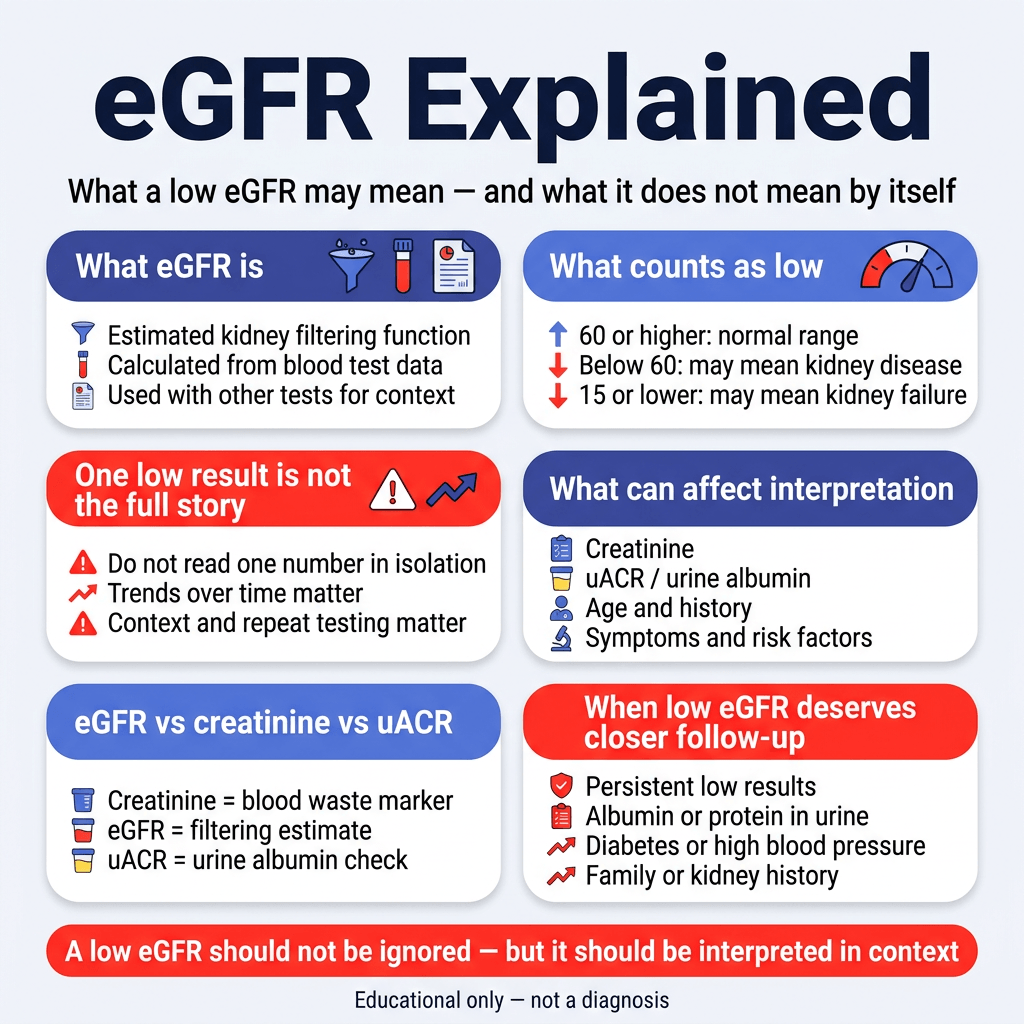
eGFR stands for estimated glomerular filtration rate. It is one of the main ways clinicians estimate how well the kidneys are filtering waste from the blood. NIDDK and the National Kidney Foundation both describe GFR/eGFR as a key measure of kidney function.
Because eGFR is an estimate, it is usually interpreted together with:
- serum creatinine
- urine albumin / uACR
- your age, symptoms, and medical history.
What is a normal eGFR, and what counts as low?
NIDDK’s kidney test explainer states:
- a GFR of 60 or higher is in the normal range
- a GFR below 60 may mean kidney disease
- a GFR of 15 or lower may mean kidney failure.
The National Kidney Foundation also notes that normal GFR varies by age, sex, and body size, and naturally declines with age. That means a “low” eGFR is not interpreted by itself; it is interpreted in context.
Why one low eGFR does not always equal chronic kidney disease
What can cause a low eGFR?
A low eGFR can happen for different reasons.
Chronic kidney disease
NIDDK defines chronic kidney disease as a condition where the kidneys are damaged or have structural problems and cannot filter blood the way they should. NIDDK also identifies diabetes, high blood pressure, heart disease, and family history of kidney disease as key risk factors.
Temporary or short-term factors
A low eGFR result does not always mean permanent kidney damage. Because eGFR is calculated from lab values such as creatinine, it must be interpreted with other tests and clinical context. NIDDK’s evaluation guidance specifically emphasizes urine albumin and persistent eGFR reduction together.
Medication and lab interpretation issues
The National Kidney Foundation notes that patients should ask whether there are factors that may make creatinine—and therefore eGFR—appear higher or lower than expected. That is one reason repeat testing and trend review matter.
eGFR vs creatinine vs uACR: what’s the difference?
This is where many patients get confused.
Creatinine
Creatinine is a waste product measured in the blood. It helps clinicians calculate eGFR, but creatinine alone is not the whole story.
eGFR
eGFR turns that blood information into an estimate of kidney filtering function. NIDDK notes that the currently recommended adult equations are the race-free CKD-EPI equations, and that using both creatinine and cystatin C can improve accuracy in some situations.
uACR (urine albumin-to-creatinine ratio)
NIDDK and CDC both emphasize urine albumin testing alongside blood testing, because urine albumin can catch kidney damage even when eGFR is not severely abnormal yet.
What should you do if your eGFR is low?
A low eGFR is not something to ignore, but it is also not something to panic over without context.
1) Ask whether it needs to be repeated
Because CKD is based on persistent change, repeat testing may be important if this is a new finding. NIDDK’s evaluation guidance emphasizes persistent eGFR reduction rather than one isolated value.
2) Ask for the “full picture”
A smart follow-up includes:
- What is my eGFR trend?
- What is my creatinine?
- Do I have albumin/protein in my urine?
- Do my risk factors include diabetes, high blood pressure, cardiovascular disease, family history, or prior acute kidney injury? CDC specifically highlights those groups for CKD screening.
3) Focus on the biggest kidney-protective levers
The National Kidney Foundation’s low-eGFR guidance highlights practical ways to slow kidney damage, while CDC emphasizes early detection and treatment planning. In real life, the biggest levers often include:
- blood pressure control
- diabetes control
- regular follow-up and repeat labs
- avoiding kidney stressors when advised by your clinician.
Who should pay extra attention to a low eGFR?
- high blood pressure
- diabetes
- cardiovascular disease
- family history of kidney disease
- history of acute kidney injury.
If you fall into one of those groups, a low eGFR deserves a more deliberate follow-up plan rather than a “watch and wait” approach.
Warning symptoms that shouldn’t wait
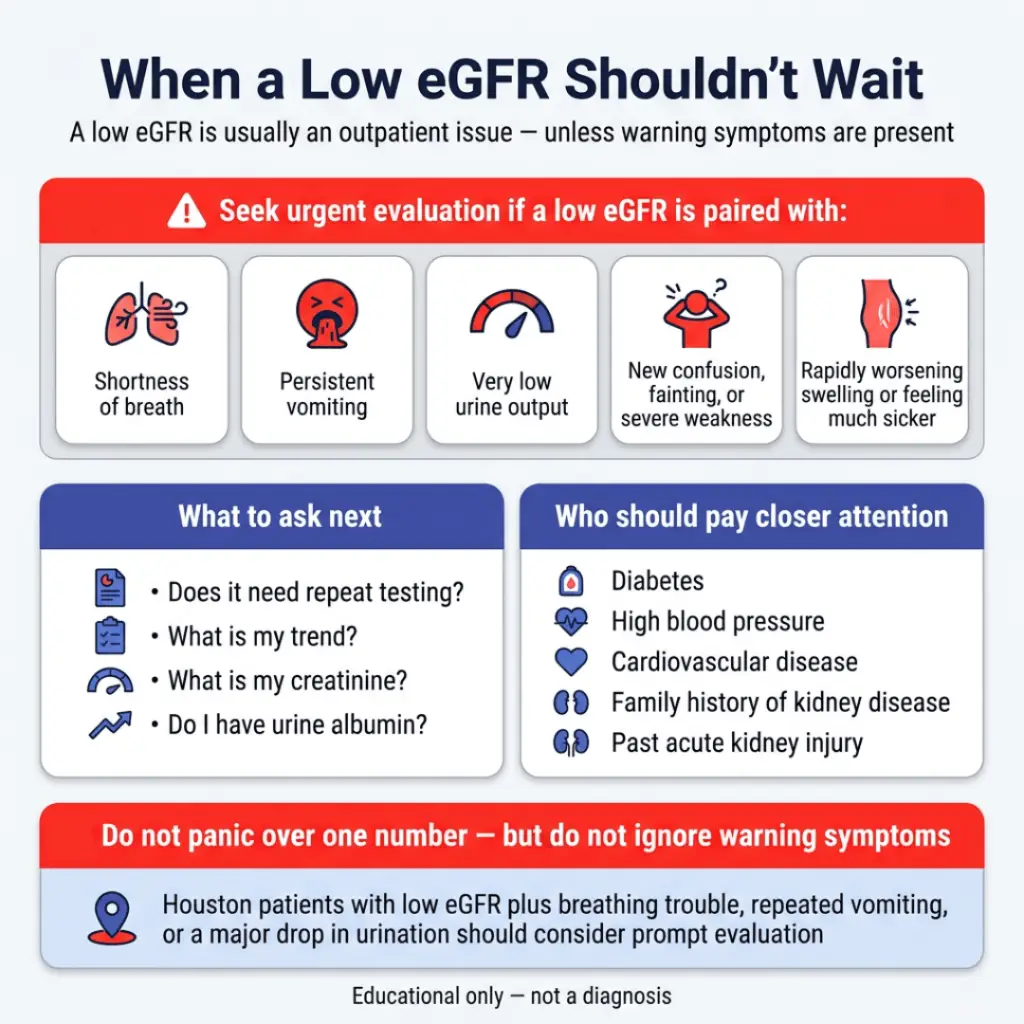
A low eGFR itself is usually an outpatient conversation—but some symptoms should not be managed by watching at home.
Seek urgent evaluation if you have:
- shortness of breath
- persistent vomiting or inability to keep fluids down
- very low urine output
- new confusion, fainting, or severe weakness
- rapidly worsening swelling or feeling suddenly much sicker
These symptoms can reflect worsening kidney function, fluid overload, dehydration, infection, or another urgent problem that needs in-person evaluation. NIDDK and CDC both emphasize using kidney testing to guide timely treatment, not delayed guesswork.
If you’re in Houston and you were told your eGFR is low and now you’re also dealing with warning symptoms that shouldn’t wait—like shortness of breath, repeated vomiting, or a major drop in urination—it’s reasonable to get checked promptly.
Post Oak ER states it is a 24/7 emergency room in Houston’s Post Oak and Galleria area with board-certified physicians, plus on-site labs and imaging, including CT, X-ray, and ultrasound. Their Houston location page also notes convenient access near The Galleria and via major nearby routes.
Frequently Asked Questions
Is a low eGFR always kidney disease?
Not always. NIDDK emphasizes persistent reduction in eGFR, usually along with urine findings, when evaluating CKD.
What eGFR number is considered low?
NIDDK states that below 60 may mean kidney disease, while 15 or lower may mean kidney failure.
Can you improve eGFR?
The National Kidney Foundation’s recent guidance focuses on slowing damage and protecting kidney health rather than promising a quick “fix.” In some cases the number may improve, but the more important goal is preventing further decline and understanding the cause.
What other test should I ask for if my eGFR is low?
Ask about uACR (urine albumin-to-creatinine ratio) and review creatinine and your trend over time. CDC and NIDDK both emphasize urine albumin testing plus blood testing for CKD evaluation.
Should I worry if I feel fine?
You should not ignore it. CDC notes CKD can be caught with simple blood and urine tests even in early stages, when treatment is most effective.