
Key Takeaways
- Low blood pressure (hypotension) can be totally normal for some people—unless it comes with symptoms like dizziness, fainting, confusion, or signs of shock.
- Common causes include dehydration, blood loss, heart rhythm/heart conditions, medication effects, and serious illness (like severe infection or allergic reaction).
- Dizziness can happen with low blood pressure or stroke, but stroke usually brings sudden neurologic changes (face/arm/speech/vision/balance).
- If stroke is suspected: Call 911 for severe symptoms / suspected stroke. The CDC also notes: don’t drive yourself—call an ambulance.
what causes low blood pressure?
Low blood pressure happens when the force of blood against your artery walls is low enough that your brain and other organs may not get the blood flow they need. Mayo Clinic notes it can cause no symptoms at all, or it can lead to dizziness and fainting, and in some situations it can be life-threatening.
In everyday ER terms, the “why” usually falls into a few buckets:
- Not enough fluid in the system (dehydration, vomiting/diarrhea, not drinking enough)
- Not enough blood volume (bleeding—obvious or hidden)
- The heart isn’t pushing effectively (certain rhythm problems, heart failure, heart attack, valve issues)
- Medication effects (especially medicines that treat high blood pressure, plus others)
- Serious body-wide events (severe infection/septic shock, severe allergic reaction/anaphylaxis)
- Positional/nervous-system causes (orthostatic/postural hypotension; neurally mediated hypotension)
When low blood pressure is normal
Some people run low and feel great. Mayo Clinic points out that what’s “low” for one person might be totally OK for another—and low blood pressure may cause no symptoms.
When low blood pressure is a warning sign
Low blood pressure becomes a problem when it’s:
- new for you, or
- tied to symptoms like fainting, confusion, weakness, or signs of shock.
if you have symptoms of extreme low blood pressure or shock, call 911.
Common causes of low blood pressure
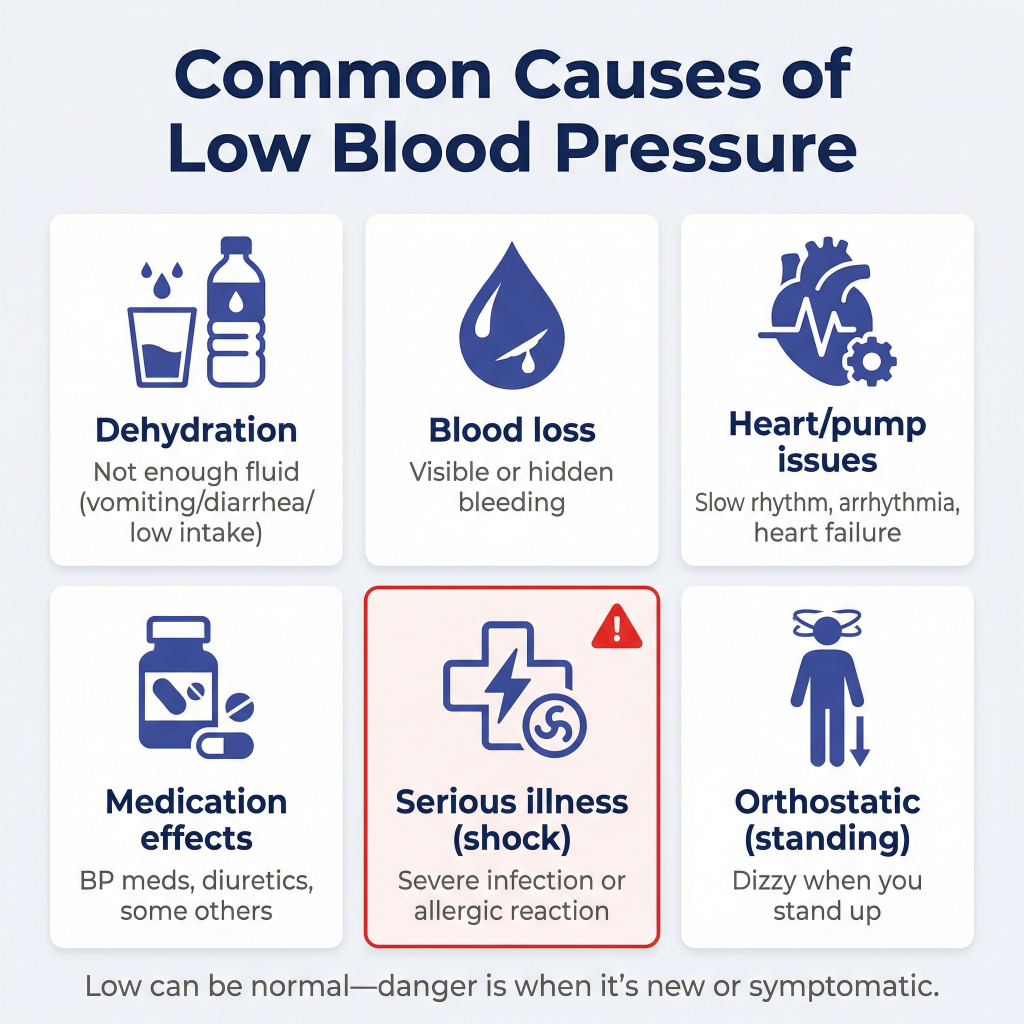
Not enough fluid in the system
If you’re dehydrated—maybe from not drinking enough, vomiting/diarrhea, or simply being run down—blood pressure can dip. MedlinePlus lists dehydration as a cause of low blood pressure.
Mayo Clinic also notes dehydration and other medical conditions can contribute.
What it feels like (often): lightheadedness, fatigue, maybe feeling worse when standing.
Blood loss (obvious or hidden)
Blood loss can drop blood pressure quickly. MedlinePlus Medical Encyclopedia lists sudden loss of blood as a cause of severe hypotension/shock.
This is one of those scenarios where “I’ll sleep it off” can be dangerous—especially if there are signs of significant bleeding or you’re feeling faint/confused.
Heart-related causes
Sometimes the “plumbing” is fine, but the “pump” isn’t pushing well.
Mayo Clinic lists heart conditions like heart attack, heart failure, heart valve disease, and slow heart rate (bradycardia) as possible causes of low blood pressure.
MedlinePlus also points to heart rhythm changes (arrhythmias) and heart failure.
How it shows up: dizziness, weakness, near-fainting, sometimes shortness of breath or chest discomfort (those are “don’t wait” symptoms).
Medication effects
This is one of the most frequent “quiet” causes I see.
MedlinePlus lists categories like diuretics, heart medicines (including those used to treat high blood pressure), some antidepressants, and painkillers as potential contributors.
Mayo Clinic also notes that certain medicines—including those that treat high blood pressure—can cause low blood pressure.
Important compliance note: If you suspect medication is contributing, don’t change or stop meds on your own. Mayo Clinic specifically warns not to change or stop medicine without talking to your healthcare professional.
Hormone/metabolic causes
Mayo Clinic lists endocrine issues like Addison’s disease, low blood sugar (hypoglycemia), and diabetes as conditions that can be associated with low blood pressure.
This doesn’t mean “you have Addison’s” because you felt dizzy once. It means: persistent or recurrent symptoms deserve a real evaluation.
Severe infection or severe allergic reaction
This is the category where low blood pressure can become life-threatening.
Mayo Clinic notes that when infection enters the bloodstream, it can cause septic shock, a life-threatening drop in blood pressure. It also notes anaphylaxis can cause a sudden large BP drop.
MedlinePlus echoes this: severe infection and severe allergic reaction are causes of severe hypotension/shock.
Positional causes: orthostatic (postural) hypotension
If you get dizzy specifically when you stand up, this comes up a lot.
Mayo Clinic defines orthostatic hypotension as a form of low blood pressure that happens when standing after sitting or lying down and can cause dizziness/lightheadedness and fainting.
MedlinePlus describes orthostatic hypotension similarly and notes it often lasts seconds to minutes.
This is common in older adults, and it can be related to dehydration, bed rest, pregnancy, medical conditions, or medications.
Symptoms: what low blood pressure feels like (and what it doesn’t)
Typical low blood pressure symptoms
Mayo Clinic lists symptoms such as:
- blurred/fading vision
- dizziness or lightheadedness
- fainting
- fatigue
- trouble concentrating
- upset stomach
MedlinePlus adds: confusion, nausea/vomiting, sleepiness, weakness.
Here’s the honest “real life” version: people often describe it as washed out, floaty, about to pass out, or my legs feel weak when I stand. That’s very different from classic one-sided neurologic weakness.
Red-flag symptoms that mean you should not wait
Mayo Clinic describes shock symptoms such as confusion (especially in older people), cold clammy skin, pale skin, rapid shallow breathing, and weak rapid pulse—and says to call 911 for extreme low blood pressure or shock symptoms.
Also: if you faint, become confused, have chest pain, severe shortness of breath, or feel like you might collapse—those aren’t “monitor it at home” situations.
Dizziness vs stroke: how to tell the difference in the moment
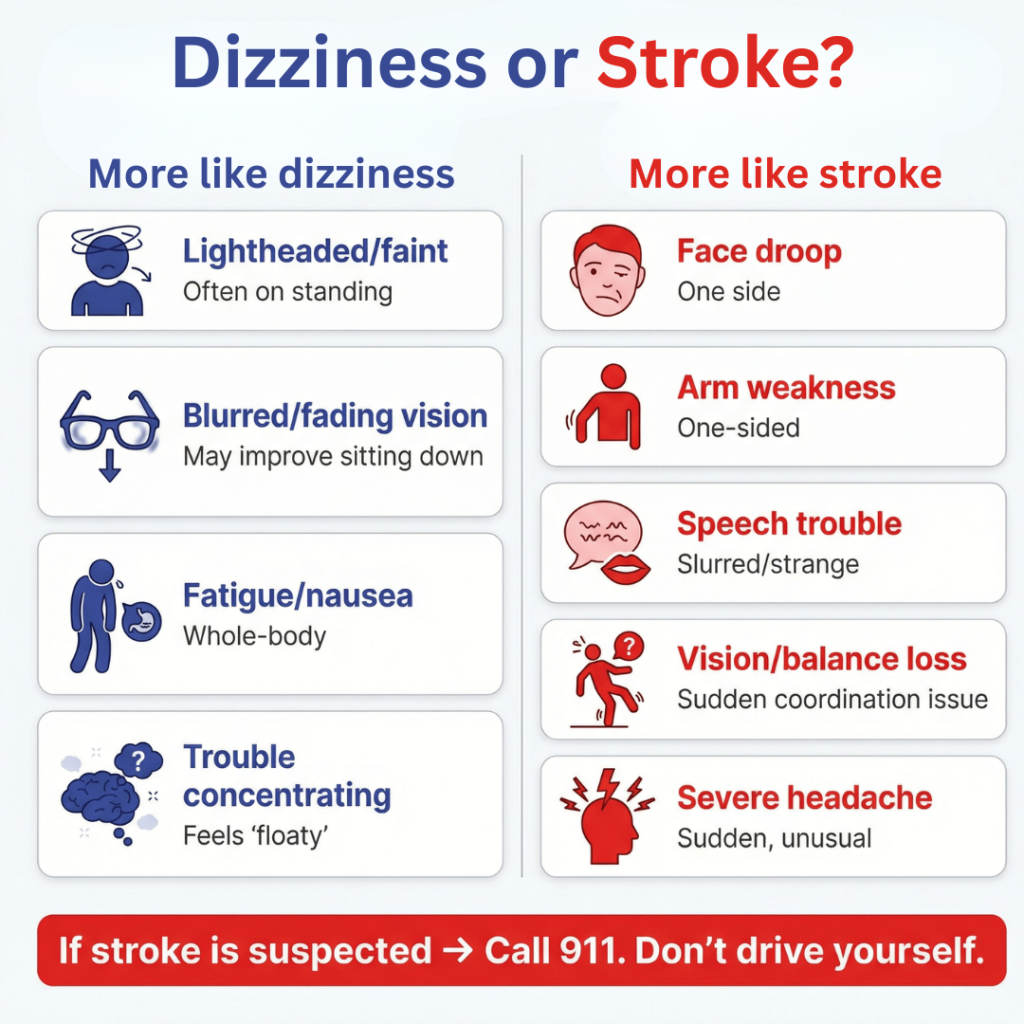
This is the part that protects people.
dizziness can be a symptom of stroke, but not the “I stood up too fast” kind most people mean. The CDC lists stroke signs that can include sudden trouble walking, dizziness, loss of balance, or lack of coordination—and it lists other sudden neurologic symptoms alongside it.
What stroke dizziness tends to look like
Stroke-related dizziness often shows up with one or more of these:
- sudden trouble walking
- loss of balance
- lack of coordination
- plus other neurologic changes (speech, face, arm weakness, vision).
In other words: it’s not just dizziness. It’s dizziness with neurologic “something’s off”—and it tends to be sudden.
The “sudden neurologic deficit” rule
The CDC’s stroke symptom list includes sudden:
- numbness/weakness in face, arm, or leg (especially one side)
- confusion, trouble speaking, difficulty understanding
- trouble seeing
- trouble walking/dizziness/loss of balance
- severe headache with no known cause
If you’re asking yourself:
- Is dizziness a symptom of stroke?
- Can dizziness be a sign of stroke?
- Is lightheadedness a sign of stroke?
Use this rule: If dizziness comes with sudden neurologic changes, treat it like stroke until proven otherwise.
When to call 911
If you suspect stroke—Call 911 for severe symptoms / suspected stroke.
And the CDC adds a detail people skip: Do not drive to the hospital or let someone else drive you. Call 9-1-1 for an ambulance so care can start on the way.
The American Stroke Association reinforces the urgency: it says to call 911 immediately if you observe even one stroke symptom, and notes that on average 1.9 million brain cells die every minute a stroke goes untreated.
Can low blood pressure cause a stroke?
People search this constantly: “can low blood pressure cause a stroke” and “can you have a stroke with low blood pressure.”
Here’s the honest, careful answer:
- Yes, you can have a stroke even if your blood pressure runs low. Stroke is about what’s happening in the brain—blocked blood flow or bleeding—not just the BP reading in that moment.
- Low blood pressure itself is often not the “main cause” of stroke the way uncontrolled high blood pressure is discussed as a major risk factor.
- But extreme low blood pressure can be dangerous because the brain may not get enough oxygenated blood—especially in shock states (severe bleeding, severe infection, anaphylaxis). Mayo Clinic describes these “big drops” as potentially life-threatening and ties them to serious bleeding, serious infection, and allergic reactions.
if you’re fainting, confused, or in shock, that’s an emergency. If you have stroke symptoms, that’s also an emergency. Either way, you don’t wait at home.
What to do right now
If symptoms are happening now
Use two quick filters:
Shock / severe low blood pressure symptoms
If you’re confused, fainting, extremely weak, clammy, or you suspect shock—Mayo Clinic’s guidance is clear: call 911 for extreme low blood pressure or shock symptoms.
If you’re stable but worried
If you’re not having emergency symptoms right now, this is the productive lane:
- Keep a simple log: when you feel dizzy, what you were doing (standing up, after meals, after skipping food), and if you have a home BP reading.
- If you suspect medication effects, do not stop meds on your own—talk with your clinician (Mayo Clinic explicitly cautions against stopping without medical guidance).
- If you’re getting positional dizziness, understand orthostatic hypotension can happen when standing after sitting/lying down; it’s a known pattern and worth evaluation if frequent or causing falls/fainting.
What to expect in an ER evaluation
If someone comes into an ER with dizziness, fainting, or neurologic symptoms, clinicians usually focus on:
- timing (when it started, what triggers it)
- vital signs and safety checks
- whether this looks like a stroke pattern (sudden neurologic deficits) or another cause
- looking for dangerous causes like bleeding, serious infection, abnormal rhythms, or metabolic problems
MedlinePlus notes that providers will examine you to determine the cause, check vital signs frequently, and that hospitalization may be needed depending on severity.
Prevention and risk reduction
Avoid the “swingy” pattern
If your low blood pressure episodes are related to standing up fast, dehydration, or skipped meals, the goal is consistency—regular fluids, regular meals, and taking positional changes slower. (If it’s frequent or severe, get evaluated.)
Stroke safety basics
You don’t need to become a neurologist. You just need to recognize the pattern:
- sudden one-sided weakness/numbness
- sudden speech trouble
- sudden vision trouble
- sudden balance trouble
- sudden severe headache
Then: call 911 immediately.
Also: if stroke symptoms go away after a few minutes, the CDC notes it may have been a TIA (“mini-stroke”) and is still a sign of a serious condition that needs medical help.
When Low Blood Pressure Feels Wrong, Get Checked Right Away
If dizziness, fainting, confusion, chest discomfort, shortness of breath, or sudden weakness is happening now, don’t try to guess whether it’s “just low blood pressure.” Symptoms like these can signal a serious medical emergency, including shock, heart problems, or stroke.
Post Oak ER is open 24/7 for emergency evaluation of sudden dizziness, fainting, severe weakness, and other urgent symptoms.
Go to the ER now if:
- you fainted or almost fainted
- you feel confused, clammy, or severely weak
- you have chest pain or trouble breathing
- you have sudden balance problems, one-sided weakness, speech trouble, or vision changes
Call 911 immediately if stroke is suspected or symptoms are severe. Do not drive yourself.
Frequently Asked Questions
What causes low blood pressure most commonly?
Common causes include dehydration, medication effects, certain heart conditions/rhythm problems, and in severe cases bleeding, infection, or allergic reactions.
When is low blood pressure normal?
When it’s your baseline and you feel well. Mayo Clinic notes low blood pressure may cause no symptoms and what’s “low” for one person may be OK for another.
What low blood pressure symptoms are concerning?
Fainting, confusion, severe weakness, and symptoms of shock are concerning. Mayo Clinic lists shock warning signs and advises calling 911 for extreme low blood pressure or shock symptoms.
Is dizziness a symptom of stroke?
It can be. The CDC includes sudden trouble walking, dizziness, loss of balance, or lack of coordination among stroke signs—especially when sudden and paired with other neurologic symptoms.
What does stroke dizziness feel like compared to low blood pressure faintness?
Low blood pressure dizziness often feels positional (standing up, about to faint). Stroke dizziness is more likely to be sudden and paired with balance/coordination problems and other neurologic deficits (speech, weakness, vision).
Can low blood pressure cause a stroke?
Low blood pressure isn’t a typical “root cause” like chronic high blood pressure is, but extreme low blood pressure in shock states can be life-threatening and can reduce blood flow to organs, including the brain.
Can you have a stroke with low blood pressure?
Yes. The blood pressure number doesn’t rule out stroke. If symptoms suggest stroke, treat it as an emergency.
What are stroke signs I should never ignore?
Sudden face/arm/leg weakness (especially one-sided), sudden confusion or speech trouble, sudden vision loss, sudden trouble walking/balance issues, sudden severe headache. The CDC says to call 911 right away for these symptoms.
When should I call 911 vs go to an urgent care?
If stroke is suspected or symptoms are severe and sudden, call 911—the CDC specifically advises not to drive yourself.