

Key Takeaways
- Sudden one-sided weakness or paralysis is a 911 problem until proven otherwise. The CDC lists sudden numbness/weakness (especially on one side) as a key stroke warning sign.
- In clinical terms, hemiparesis is one-sided weakness and hemiplegia is one-sided paralysis (no movement).
- Symptoms that come and go can still be a TIA (“mini-stroke”) and still need urgent evaluation.
- If stroke is suspected, call 911 immediately—the American Stroke Association notes that, on average, 1.9 million brain cells die every minute a stroke goes untreated.
what is a “paralytic stroke”?
“Paralytic stroke” isn’t a formal medical diagnosis you’ll see on a chart. It’s a real-world phrase people use when stroke symptoms show up as sudden weakness or paralysis, usually on one side of the body.
In the ER, what we care about is the pattern: sudden loss of strength, sudden loss of control, or sudden inability to move—especially when it’s one-sided. That pattern fits the CDC’s stroke warning signs and deserves emergency response.
Weakness vs paralysis
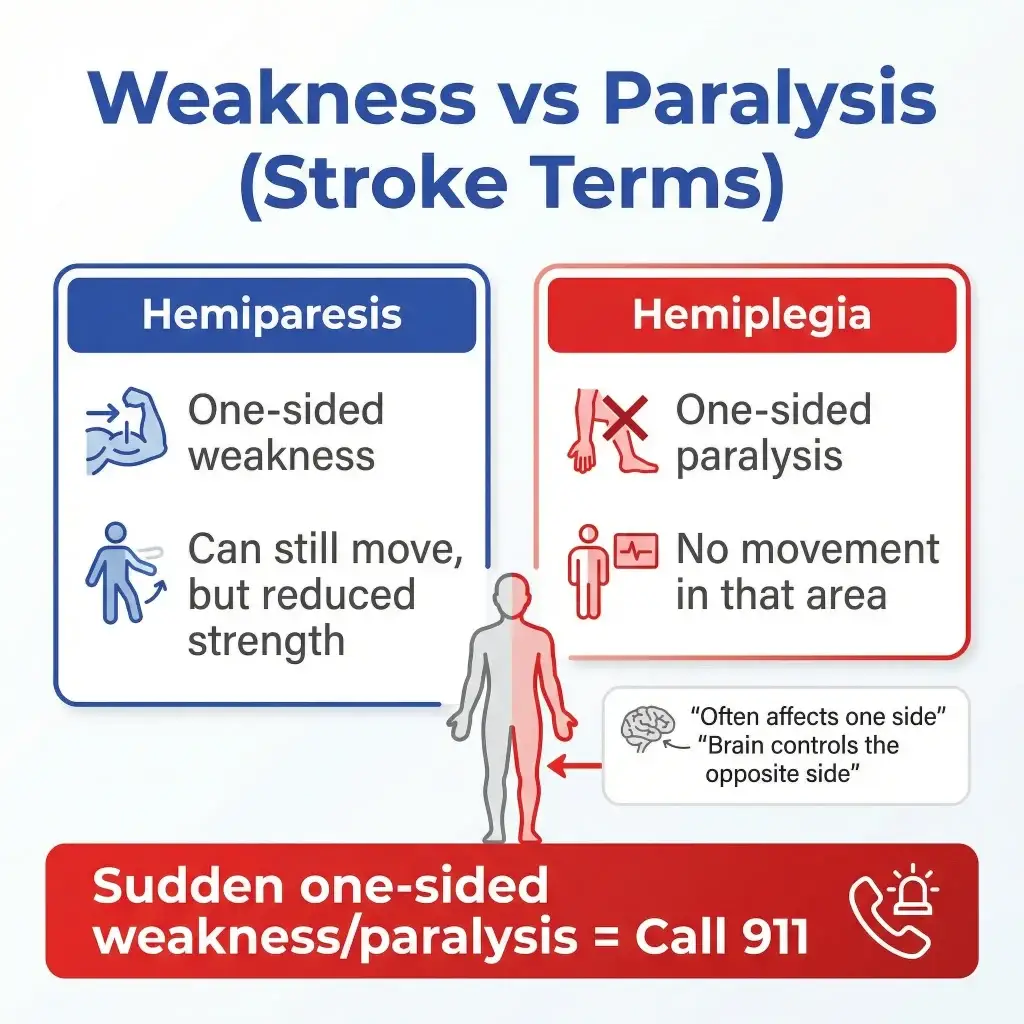
People often use “weak,” “paralyzed,” and “numb” interchangeably. Clinically:
- Hemiparesis = one-sided weakness
- Hemiplegia = one-sided paralysis (you can’t move that part at all)
Both are urgent. Both can be stroke. And if you’re trying to decide which word fits while someone’s face is drooping or their arm won’t lift—don’t. Call 911.
The symptom that matters most: sudden one-sided weakness
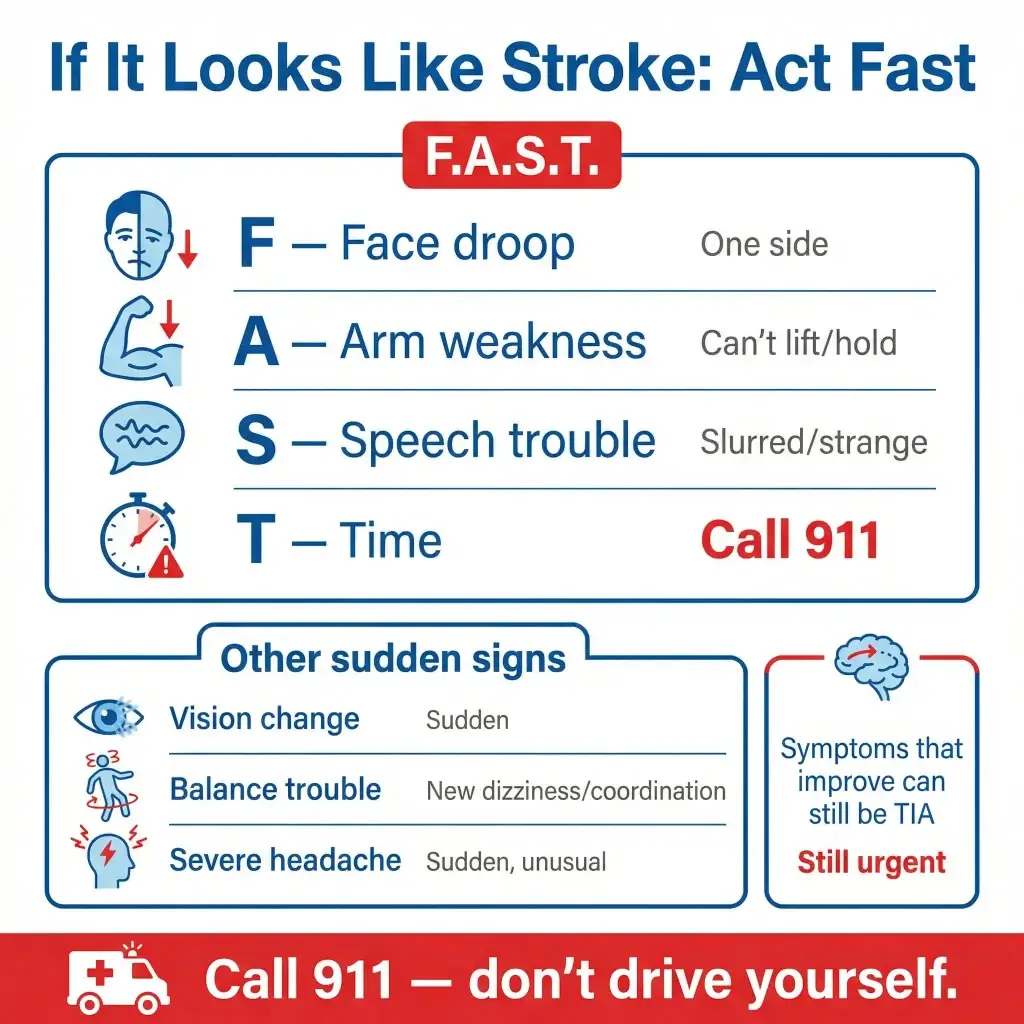
If you remember one thing from this post, let it be this:
Sudden one-sided weakness/paralysis is an emergency.
How it shows up in real life
This is what families describe to me in Houston ER rooms:
- “His arm just dropped like it wasn’t his.”
- “She’s dragging one leg like it won’t listen.”
- “My hand feels useless—I can’t grip.”
- “My face feels weird and I can’t smile right.”
- “I’m trying to talk but the words are coming out wrong.”
Those are not “wait it out” stories.
Symptoms that often ride with paralysis
One-sided weakness is often part of a bigger cluster. The CDC also lists sudden:
- confusion, trouble speaking, or difficulty understanding speech
- trouble seeing in one or both eyes
- trouble walking, dizziness, loss of balance/coordination
- severe headache with no known cause
If the weakness shows up with any of those, the odds that this is “just a pinched nerve” go way down.
When to call 911
If you suspect stroke—Call 911 for severe symptoms / suspected stroke.
Why stroke can cause paralysis
A stroke affects the brain’s ability to send and receive signals. The areas that control movement and strength can be disrupted by:
- a blockage cutting off blood flow (ischemic stroke), or
- bleeding in/around the brain (hemorrhagic stroke)
Either way, the “wiring” between brain and body gets interrupted.
A practical thing that helps people understand the one-sided nature: the brain often controls the opposite side of the body. So a problem in one side of the brain can show up as weakness/paralysis on the other side.
Can paralysis come and go?
Yes—and that can be even more confusing.
A TIA (transient ischemic attack) is often called a “mini-stroke.” NINDS explains it’s a stroke-like event where blood flow is briefly blocked; symptoms happen suddenly and usually resolve within an hour, though they can last up to 24 hours.
If paralysis/weakness came and went, don’t take that as reassurance. Take it as a warning.
“Is this a stroke or something else?”
There are conditions that can mimic stroke symptoms. The point is not for you to diagnose it at home. The point is: if the pattern looks like stroke, treat it like stroke and get urgent care.
Examples clinicians consider (without you needing to sort them out):
- low blood sugar
- seizures (some people have weakness afterward)
- severe migraine variants
- spinal cord emergencies
- certain infections or metabolic problems
If someone suddenly can’t move an arm or leg, you don’t need to know which one it is. You need to get them help.
What to do right now
If it’s happening now
Here’s the clean ER checklist:
- Call 911. (Do not drive yourself.)
- Note the time symptoms started—or the last time the person was normal (“last known well”). This becomes critical information in emergency stroke care.
- Keep the person safe and still. If they’re confused or unsteady, prevent falls.
- Don’t give food or drink if they’re having trouble speaking/swallowing—choking risk is real during neurologic events.
- If the person is on medications, bring a list if you can—without delaying the 911 call.
The American Stroke Association puts it bluntly: call 911 immediately even if you observe one stroke symptom.
If it improved (TIA possibility)
If the weakness/paralysis improved after minutes—or even after an hour—you still need urgent evaluation. NINDS notes TIA symptoms are like stroke symptoms and can resolve, but it’s still a serious warning event.
What to expect in the ER for sudden weakness/paralysis
here’s the typical flow:
What clinicians focus on first
- Time: when symptoms started / last known well
- a focused neurologic exam (strength, speech, facial symmetry, coordination)
- vital signs and immediate threats
- ruling out obvious mimics (for example, checking blood sugar)
Common test categories (high-level)
Depending on the situation, ER teams often use:
- brain imaging to look for bleeding or other urgent causes
- blood tests
- heart rhythm evaluation (some strokes are linked to rhythm problems)
The core idea is speed and clarity: confirm what’s happening and act quickly.
Recovery after stroke paralysis
This is where people search:
- “can you be paralyzed from a stroke”
- “can you recover from a stroke”
- “can you fully recover from a stroke”
- “how long does it take to recover from a stroke”
- “how to recover from a stroke fast/quickly”
- “how to cure stroke paralysis”
Let’s talk about that.
Can you be paralyzed from a stroke?
Yes. Stroke can cause anything from mild weakness to complete one-sided paralysis, depending on what part of the brain is affected and how large the injury is.
But paralysis doesn’t automatically mean “no improvement.” Early days can be dramatic and scary—and then the body and brain start rebuilding pathways.
Is stroke paralysis permanent?
Sometimes it is. Sometimes it isn’t. And sometimes it improves partially.
MedlinePlus notes that recovery is different for each person; problems with moving, thinking, and talking often improve in the first weeks or months after a stroke, and some people continue improving for months or years.
That’s one of the most important truths families need to hear: recovery often isn’t instant, but it also isn’t always “over” after a short window.
“How to cure stroke paralysis” — let’s reframe that
Stroke paralysis usually isn’t something you “cure” like antibiotics curing an infection. It’s more often something you recover from through:
- medical stabilization and prevention of another stroke
- structured rehabilitation (physical, occupational, speech therapy as needed)
- consistent repetition that helps the brain re-learn skills
The CDC notes that stroke care includes rehabilitation to treat side effects after the emergency phase.
How long does it take to recover from a stroke?
This is the question everyone asks—and it’s the one where honesty matters.
MedlinePlus says many problems improve in the first weeks or months, and some people keep improving for months or years.
Johns Hopkins also describes recovery as a process that unfolds across days, weeks, and months, and that different people recover in different ways (sometimes slow and uncertain).
A practical way I explain it:
- The earliest period is often the most intense medically.
- The next stretch is about rebuilding function and independence.
- Progress can continue long-term, but it may slow over time and require persistence.
If you want something more “time-window” specific, NIH Research Matters reported that intensive therapy added to standard rehab produced the greatest improvement when delivered 2–3 months after stroke in the study they summarized.
“Recover fast/quickly” — what actually helps most
there are no magic shortcuts.
What consistently helps most is:
- Getting evaluated quickly when symptoms happen (time matters)
- Taking rehab seriously and early (guided by professionals)
- Preventing a second stroke by managing risk factors with your care team
And just to underline the “time matters” part: the American Stroke Association states that, on average, 1.9 million brain cells die every minute a stroke goes untreated.
That’s why early action isn’t dramatic—it’s practical.
Prevention
Even though this post is about paralysis, the prevention message matters because recurrent stroke can worsen disability.
At a high level, prevention usually focuses on:
- blood pressure control
- diabetes control
- smoking cessation
- cholesterol management
- medication adherence as directed by your clinician
- follow-up care and rehab engagement
This isn’t about blame. It’s about stacking the odds in your favor.
When Sudden Weakness or Paralysis Happens, Act Fast
If someone suddenly has one-sided weakness, paralysis, facial drooping, speech trouble, vision changes, or trouble walking, call 911 immediately. Do not wait to see if it passes, and do not drive yourself if stroke is suspected.
If symptoms were brief, improved, or came and went, it could still be a TIA (mini-stroke) and still needs urgent evaluation.
Post Oak ER is open 24/7 for emergency evaluation of sudden neurologic symptoms. If symptoms are severe or happening right now, call 911 first. If you need immediate medical attention after EMS evaluation or for urgent stroke-like warning signs, come in right away.
Call 911 for severe symptoms. Get emergency care without delay.
Frequently Asked Questions
What is a paralytic stroke?
It’s a common phrase for a stroke that shows up with sudden weakness or paralysis—often one-sided. Clinically, you may hear “hemiparesis” (weakness) or “hemiplegia” (paralysis).
Can you be paralyzed from a stroke?
Yes. Stroke can cause one-sided weakness or paralysis depending on what part of the brain is affected.
What’s the difference between weakness and paralysis in stroke?
Hemiparesis = one-sided weakness.
Hemiplegia = one-sided paralysis (no movement).
If someone suddenly can’t move an arm or leg, what should we do first?
Call 911. The CDC says to call 911 right away for stroke symptoms and not to drive yourself.
Can paralysis come and go (TIA/mini-stroke)?
Yes. NINDS explains TIA symptoms can come on suddenly and resolve (often within an hour), but it’s still serious and needs urgent evaluation.
What are the signs of a stroke I should never ignore?
The CDC lists sudden one-sided weakness/numbness, speech trouble, vision trouble, dizziness/loss of balance, and severe headache with no known cause—and says to call 911 right away.
Is stroke paralysis permanent?
Sometimes, but not always. MedlinePlus notes many problems improve in the first weeks or months, and some people keep improving months or years later.
How long does it take to recover from a stroke?
Recovery varies widely. MedlinePlus notes many improvements happen in the first weeks or months, with possible progress continuing later.
Johns Hopkins describes recovery unfolding over days, weeks, and months, and that it can be slow and uncertain for some people.
Is there a “cure” for stroke paralysis?
It’s usually better to think in terms of recovery and rehabilitation rather than a quick “cure.” Rehab is a core part of stroke care.