
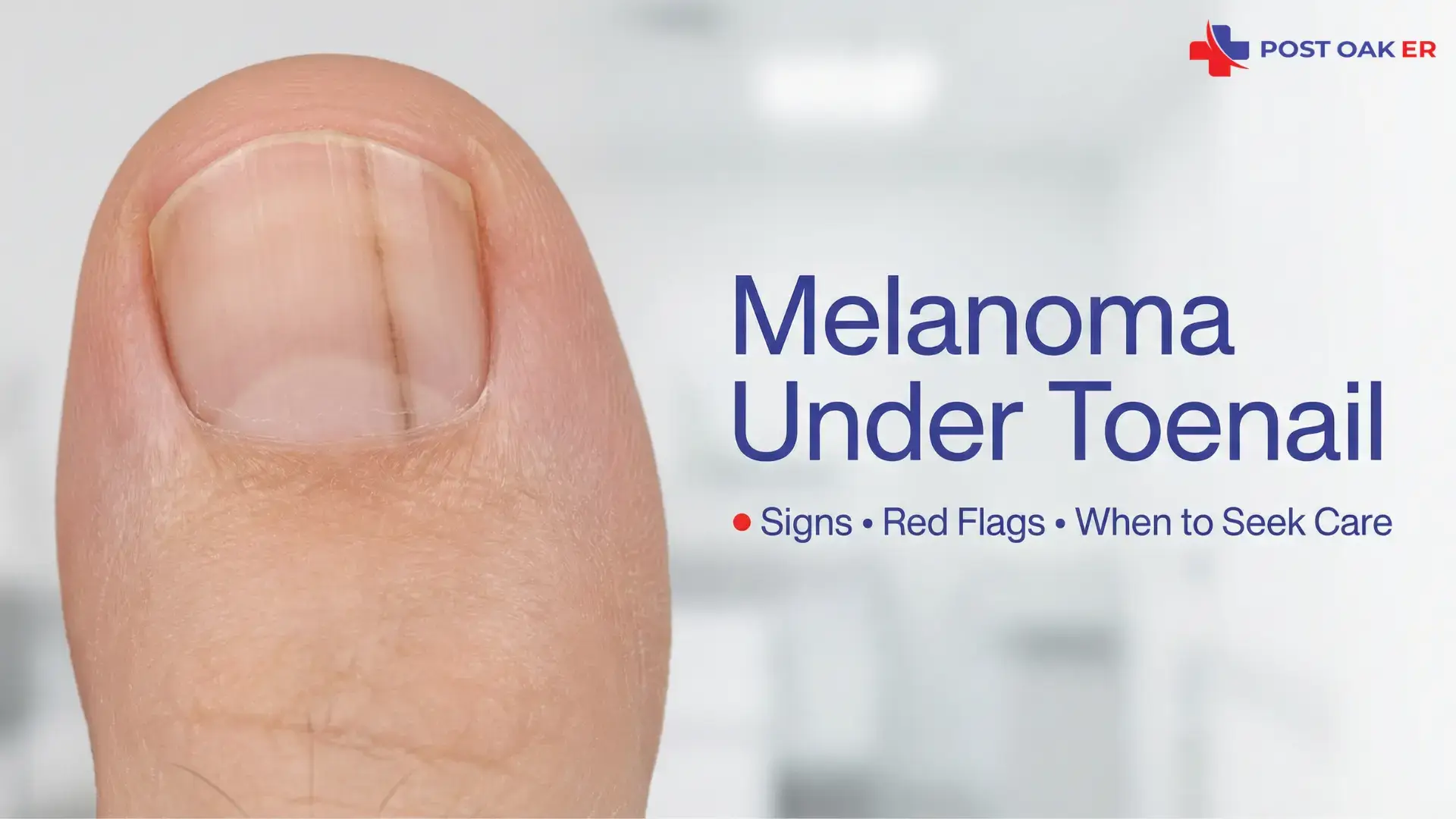
Seeing a dark line under your toenail can stop you in your tracks. Maybe you stubbed your toe. Maybe it’s old blood. Maybe it’s fungus. Or maybe it’s something that needs urgent attention.
Here’s the calm truth: most nail discolorations are not melanoma — but some are, and nail melanoma is often missed early because it can look like a bruise or “just a nail issue.” The goal of this guide is to help you spot red flags, understand what’s more likely vs less likely, and know when to go to the ER right away.
This article is educational and isn’t a substitute for a clinician’s exam. If you’re worried, it’s always okay to get checked.
What this means
“Melanoma under the toenail” (also called subungual melanoma or nail melanoma) is a form of melanoma that starts in the nail unit (often the nail matrix/nail bed). It commonly shows up as a dark brown or black vertical streak that can slowly change over time.
Two important context points:
- Melanoma is rising in Texas. In the Texas Cancer Registry’s Cancer in Texas 2024 report, “incidence rates are rising for melanoma” in both women and men in Texas.
- In Texas overall, the melanoma of the skin incidence rate is 15.4 cases per 100,000 (2018–2022) (age-adjusted).
That statistic is for melanoma broadly (not just nail melanoma). Nail melanoma is rarer, but it matters because it can be overlooked until it’s advanced.
Common signs (early vs later)

Early signs people notice first
A nail melanoma often begins as a single vertical band or streak — brown to black — running from the cuticle area toward the tip of the nail.
You might notice:
- A new dark streak on one toenail (often the big toe).
- A streak that looks like you “drew a line” with a marker (a common description).
- A streak that doesn’t match the rest of your nails (one nail is changing, others look normal).
Signs that are more concerning (progression / red-flag features)
As nail melanoma progresses, you may see changes beyond “just a line”:
- The streak widens over time, especially near the base of the nail.
- The color becomes uneven (patchy/irregular pigment).
- The nail starts to split, crack, deform, or develop dents.
- The nail begins to lift away from the nail bed.
- There’s an ulcer, nodule (bump), or bleeding.
- Pigment extends onto the skin around the nail — called Hutchinson sign (darkening of skin next to the nail/cuticle area).
If a streak is new, changing, widening, irregular, or affecting surrounding skin — don’t watch-and-wait.
“But couldn’t it just be a bruise?”

Yes. A subungual hematoma (blood trapped under the nail) is common, especially after trauma or tight shoes. Cleveland Clinic notes bruising tends to look more like a dark bruise or smudge, often appears quickly after injury, and may grow out as the nail grows.
But here’s the problem: there are times when nail cancer can resemble a hematoma. If you’re unsure, getting it evaluated is the safer move.
Who is more at risk
Anyone can develop melanoma under a toenail. Still, clinicians tend to be more cautious when these factors are present:
- Age: higher risk noted in people over 50 (often cited in the 50–70 range).
- Skin of color: nail melanoma is noted as more common in older individuals and people with skin of color.
- Personal or family history of melanoma.
- Prior nail trauma (history matters, but trauma doesn’t “explain away” a suspicious change).
nail melanoma isn’t always linked to sun exposure the way many other skin cancers are — so even people who are careful with sunscreen can still see a concerning nail change.
What doctors may do next
What happens next depends on your symptoms, your risk factors, and what the nail looks like. Clinicians may:
- Ask about timing, recent trauma, shoes/pressure, and whether the streak is changing.
- Examine the nail and surrounding skin carefully (including looking for Hutchinson sign).
- If the appearance is concerning, discuss next-step evaluation such as dermoscopy or biopsy (often done through dermatology).
- If they suspect infection or another urgent issue, address pain control and urgent stabilization and help coordinate follow-up.
A biopsy (when needed) is how melanoma is confirmed. It’s not something you can diagnose at home by photos or comparisons online.
What you can do today
If you noticed a suspicious streak or nail change, here are safe steps you can take right now:
- Take clear photos (good lighting, same angle) and note the date. This helps track change over weeks.
- Think about timing: Did it show up suddenly after obvious trauma, or has it been slowly changing?
- Don’t try to scrape it out or self-treat aggressively as fungus “just in case.”
- If you wear tight shoes or do high-impact activity, consider easing pressure — but don’t assume that explains the whole picture.
- If there’s any doubt, schedule evaluation promptly (and go to the ER for the red flags above).
Getting checked is not “overreacting.” It’s what smart patients do when something looks off.
When to Go to the ER
Most nail streaks can be evaluated in a clinic or by a dermatologist — but some symptoms should not wait.
Go to the ER now if you have a dark nail streak or nail change plus any of the following:
- Active bleeding from under or around the nail, or a new open sore or ulcer
- A new bump under the nail, especially if it’s growing
- Rapid swelling, spreading redness, pus, or severe pain
- The nail is lifting or detaching, or toe pain makes it hard to walk
- Dark pigment spreading onto the surrounding skin (Hutchinson sign)
- Fever, chills, dizziness, or feeling unwell along with toe or nail symptoms
Urgent does not always mean cancer. It means you need same-day evaluation to check for complications such as infection, serious injury, or a potentially dangerous cause that should not be missed.
If you’re dealing with severe pain, bleeding, swelling, signs of infection, or a rapidly changing nail, come to Post Oak ER for prompt evaluation. Our team can assess urgent toe and nail symptoms, rule out complications, and help you determine the right next steps, including specialist follow-up when needed.
Frequently Asked Questions
What does melanoma under a toenail look like?
Often it looks like a brown or black vertical streak that runs from the base of the nail toward the tip. It may start small and widen over time, and it can be irregular in color.
How can you tell subungual melanoma vs a bruise (subungual hematoma)?
A bruise under the nail (hematoma) usually appears after injury or pressure, can look like a smudge, may be tender, and often shows up quickly (sometimes within hours). Melanoma tends to change more slowly over weeks to months and may present as more of a streak/band.
But they can overlap, and if you’re unsure, it’s best to be evaluated.
Can a black line on a toenail be harmless?
Yes — there are benign causes of nail streaks and pigment. The concern is when the line is new, changing, widening, irregular, or involves surrounding skin. If it’s new or evolving, get it checked.
What is Hutchinson sign, and why does it matter?
Hutchinson sign refers to pigment that spreads from the nail onto the skin around it (near the cuticle or nail fold). It’s considered a warning sign that the pigment change may be more serious.
How fast does subungual melanoma grow?
It typically doesn’t develop overnight. Cleveland Clinic notes it can take several months to grow, and people may notice it, forget about it, and then notice it again weeks later as it changes.
Should I use the ABCDE rule for a nail streak?
The ABCDE rule is a helpful general framework for melanoma warning signs on skin (Asymmetry, Border, Color, Diameter, Evolving).
For nails, the biggest practical takeaway is the E: Evolving part — if it’s changing, widening, becoming irregular, or affecting surrounding skin, get evaluated.