
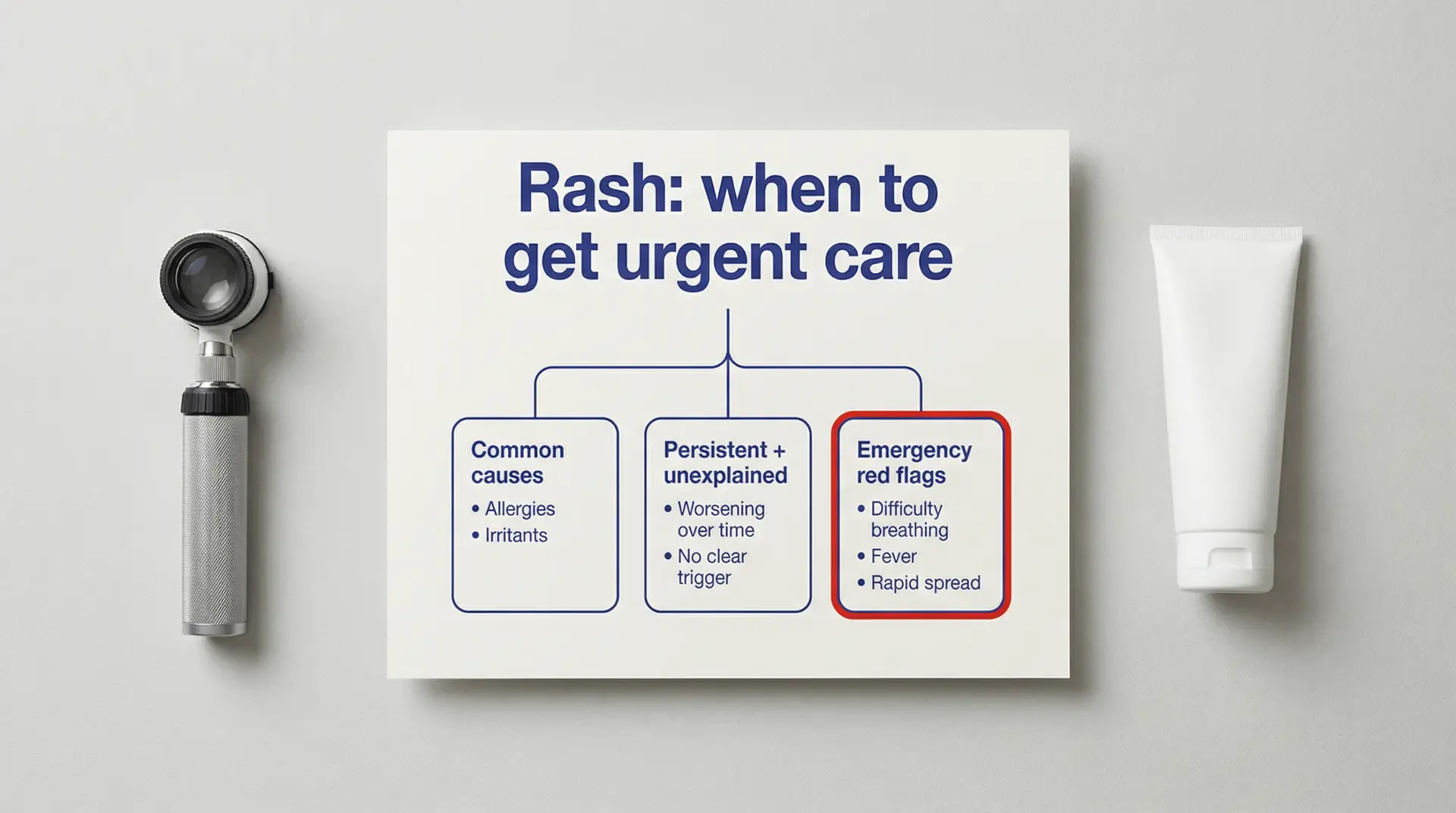
A new rash can be annoying. A rash that won’t go away can be scary—especially if you’ve seen posts online linking “rash + itching” to lymphoma.
Here’s the calm truth: most rashes are not lymphoma. But some lymphomas can involve the skin, and some blood cancers can come with whole-body symptoms that shouldn’t be ignored.
This guide breaks down what “lymphoma rash” usually means, what else to watch for, and when a rash becomes an emergency.
Quick clarity: what “lymphoma rash” usually means
When people say “lymphoma rash,” they’re often talking about cutaneous lymphoma—a type of lymphoma that starts in the skin.
One example is cutaneous T-cell lymphoma (CTCL). CTCL can look like raised or scaly patches, and some people develop an itchy rash that may be widespread.
That said:
- Many common skin conditions (eczema, allergic rashes, psoriasis, fungal infections) can look similar early on.
- Some lymphomas don’t start in the skin at all—but can still cause symptoms like persistent itching (sometimes with or without visible rash).
If your rash is persistent, unexplained, or paired with bigger “whole-body” symptoms, it deserves a medical evaluation.
What can a lymphoma rash look like?
There isn’t one “classic” look. When lymphoma involves the skin, it can show up as:
- Dry, scaly patches
- Raised plaques (thicker areas)
- Itching that doesn’t match what you’re seeing
- New lumps or bumps in the skin
- Color changes that don’t fade like a normal irritation
Mayo Clinic notes CTCL can cause raised, scaly patches and may also include itching and other skin changes.
Key point: a lymphoma-related rash tends to be persistent (weeks to months), unusual for you, and not clearly tied to a trigger (new detergent, known allergy, poison ivy exposure, etc.). That doesn’t mean it is lymphoma—only that it’s worth checking.
Symptoms that matter alongside a rash

If you’re worried about lymphoma, don’t look at the rash alone. Pay attention to the whole picture.
Common lymphoma symptoms can include:
- Swollen lymph nodes (often painless; neck, armpit, groin)
- Fever without a clear infection
- Drenching night sweats
- Unintentional weight loss
- Extreme fatigue
- Chest pressure, cough, or shortness of breath (depending on where lymph nodes are enlarged)
These are described in major clinical/cancer references, including the American Cancer Society.
Some lymphoma symptoms can be serious enough to warrant emergency evaluation, as noted by MD Anderson.
It’s the combination—persistent rash + systemic symptoms—that raises urgency.
why awareness matters
Texas public health has investigated lymphoma patterns locally. In an official assessment focused on an area of East Harris County, the Texas Department of State Health Services reported that lymphoma cancers were “statistically significantly greater than expected” compared with what would be expected based on Texas rates during the study period.
Separately, Texas Cancer Registry reporting shows non-Hodgkin lymphoma is among the cancer sites with the highest number of survivors in Texas, which reflects how common it is as a diagnosis people live with.
This does not mean a rash equals lymphoma. It means lymphoma is common enough that persistent, unexplained symptoms should be taken seriously.
Who is more at risk?
Risk depends on which lymphoma we’re talking about.
Higher-risk patterns for cutaneous lymphoma (CTCL)
Mayo Clinic notes CTCL is more often diagnosed in:
- Older adults
- People assigned male at birth
- Black people (higher reported risk)
Risk factors associated with non-Hodgkin lymphoma (NHL)
The American Cancer Society describes multiple factors that can increase risk, including:
- Weakened immune system (for example from certain medical conditions or immunosuppressing medicines)
- Certain infections linked to specific lymphoma types
- Some autoimmune conditions
- History of certain treatments or exposures (varies by subtype)
Important reality check: Many people diagnosed with lymphoma have no obvious risk factor.
Go to the ER now: rash red flags you should not wait on

A rash can be part of something far more urgent than lymphoma.
Go to the ER immediately if you have a rash plus any of the following:
Breathing/swelling emergency
- Trouble breathing
- Wheezing
- Significant swelling of the lips, tongue, or throat
- Hives with dizziness or fainting
CDC guidance on anaphylaxis highlights serious symptoms such as respiratory distress or significant swelling of the tongue or lips.
Possible severe medication reaction (medical emergency)
- Painful rash that spreads
- Blisters
- Skin peeling
- Sores in the mouth/eyes/genitals
- Often starts with “flu-like” feeling before the rash worsens
Mayo Clinic describes Stevens-Johnson syndrome as a medical emergency that can start with flu-like symptoms followed by a painful rash that spreads and blisters, with skin shedding.
Rash with rapidly worsening infection symptoms
- High fever, confusion, severe headache, stiff neck
- Feeling severely ill “out of proportion” to the rash
- Purple or bruise-like spots that spread quickly
CDC warns meningococcal infections are serious and can become deadly rapidly, with symptoms that can worsen quickly and need immediate attention.
Rash + signs of severe systemic illness
- Very fast heart rate, low blood pressure symptoms (fainting), extreme weakness
- Concern for severe infection
CDC emphasizes: “Sepsis is a medical emergency.”
If you’re torn between ‘wait and see’ and ‘this feels wrong,’ trust your instincts and get evaluated. Need emergency care now? Visit Post Oak ER. We’re open 24/7 for immediate evaluation and treatment.
What doctors may do next
At an ER, the goal is to figure out what’s dangerous today and what needs urgent follow-up.
Depending on your symptoms, clinicians may:
- Ask about timing, triggers, new meds, recent infections, exposures, and travel
- Check your skin closely and examine for swollen lymph nodes
- Evaluate vital signs and hydration status
- Order labs (for example: blood counts and inflammation markers)
- Consider imaging if there are concerning lumps, chest symptoms, or unexplained systemic signs
- If lymphoma is a concern, recommend next-step testing (often through specialists) such as:
- Skin biopsy (for suspected skin lymphoma)
- Lymph node biopsy (if enlarged nodes are present)
An ER visit doesn’t mean you’ll get a cancer diagnosis that day. It means you’ll get triaged appropriately—especially if red flags are present.
What you can do today
If you’re stable and not having emergency symptoms:
- Document it: take clear photos in good light every few days.
- Track the pattern: itch level, spread, fever, night sweats, weight changes, fatigue.
- Note new triggers: new medication, supplement, detergent, food, recent illness.
- Avoid “self-diagnosing” from images online: many rashes look alike.
- Seek timely evaluation if it’s persistent (weeks), worsening, or paired with systemic symptoms like fever/night sweats/weight loss.
Frequently Asked Questions
Can lymphoma cause a rash?
Yes—u003cstrongu003esomeu003c/strongu003e lymphomas can involve the skin (cutaneous lymphomas), and some lymphomas can cause u003cstrongu003epersistent itchingu003c/strongu003e with or without visible rash.u003cbru003eBut most rashes are still caused by non-cancer conditions.
What does a lymphoma rash look like?
It varies, but skin-involving lymphomas may show up as u003cstrongu003eraised or scaly patchesu003c/strongu003e, plaques, or persistent itchy areas.
Can lymphoma cause itching without a rash?
It can. Some people with lymphoma report u003cstrongu003epersistent itchingu003c/strongu003e, and some references list itching among possible lymphoma-related symptoms.u003cbru003eItching alone is not specific to lymphoma.
What symptoms with a rash should worry me most?
u003cstrongu003eTrouble breathing, swelling of the lips/tongue, a painful blistering/peeling rash, or a rapidly worsening feverish illnessu003c/strongu003e are emergency-level concerns.
How common is non-Hodgkin lymphoma?
Nationally, SEER notes u003cstrongu003e~2.0% lifetime risku003c/strongu003e for men and women, and an estimated u003cstrongu003e835,496u003c/strongu003e people living with non-Hodgkin lymphoma in the U.S. (2022 estimate).u003cbru003eThe American Cancer Society estimates u003cstrongu003e79,320 new diagnosesu003c/strongu003e and u003cstrongu003e19,970 deathsu003c/strongu003e from NHL in the U.S. in 2026.
Does a rash mean I have lymphoma?
No. u003cstrongu003eA rash by itself is far more likely to be something commonu003c/strongu003e—but a persistent rash, especially with systemic symptoms, deserves evaluation.