
Quick Summary
- Corns are areas of thickened skin caused by repeated pressure or friction.
- They most often appear on toes or other pressure points on the feet.
- Reducing pressure is the first-line approach.
- Some self-care options are appropriate for certain people.
- People with diabetes, nerve damage, or poor circulation should seek medical care before self-treatment.
Introduction
Corns are localized areas of thickened, hardened skin that develop as a protective response to repeated pressure or friction. They most often appear on the feet and toes, where footwear, walking patterns, or structural factors concentrate stress on the skin.
This article provides a medically grounded overview of what corns are, how they differ from similar conditions, evidence-based care options, and when professional evaluation is recommended. All statements are based only on verified, high-quality medical sources.
What Is a Corn?
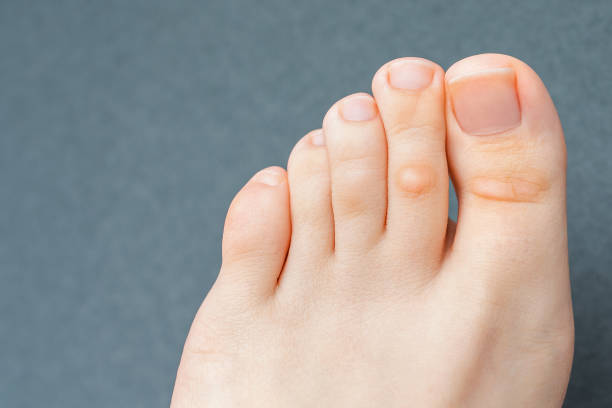
A corn is a small, well-defined area of thickened skin that forms when the skin protects itself against ongoing friction or pressure. Corns commonly develop on the tops or sides of toes, between toes, or on other areas of the foot exposed to repeated rubbing.
Corns often have a firm outer layer and a hard center and may be painful when pressed or when walking.
Corns, Calluses, and Plantar Warts: Key Differences
Comparison Overview
| Feature | Corn | Callus | Plantar Wart |
| Cause | Pressure or friction | Pressure or friction | Viral infection |
| Typical size | Small, defined | Larger, flatter | Variable |
| Pain | Often painful when pressed | Usually not painful | May be painful |
| Location | Toes, between toes | Heels, balls of feet | Soles of feet |
| Viral | No | No | Yes |
- Corns are smaller, deeper, and more clearly defined.
- Calluses are broader areas of thickened skin, usually on weight-bearing surfaces.
- Plantar warts are caused by the human papillomavirus and are not caused by pressure alone.
Types of Corns
Medical sources describe several recognized types:
- Hard corns: Dense, compact areas of thickened skin, usually on the tops or sides of toes.
- Soft corns: Softer, whitish or gray lesions that usually form between toes, where moisture is present.
- Seed corns: Small corns that typically appear on the bottom of the foot. Their exact cause is not fully understood.
What Do Corns Look and Feel Like?
Corns may appear as:
- A raised, hardened bump of skin
- A rough or thickened surface
- A well-defined central area
They may cause tenderness or pain, especially when pressure is applied. Corns can sometimes resemble calluses or plantar warts, which is why evaluation may be helpful if the appearance is uncertain.
Symptoms
Common features of corns include:
- Localized tenderness or pain
- Thick, hardened skin
- Discomfort when walking or wearing shoes
Redness, swelling, drainage, or increasing pain may indicate infection or another condition rather than an uncomplicated corn.
Causes
Corns form due to repeated friction or pressure on the skin. Verified causes include:
- Tight, narrow, or ill-fitting shoes
- High-heeled shoes that increase pressure on the toes
- Wearing shoes without socks
- Repetitive walking or standing
- Structural foot issues that create pressure points
Risk Factors
Risk factors include:
- Foot deformities such as bunions or hammertoes
- Abnormal walking patterns
- Loss of natural cushioning on the feet
- Diabetes, nerve damage, or poor circulation
People with circulation or nerve problems are at higher risk of complications.
How Corns Are Diagnosed
Corns are usually diagnosed through a visual examination by a healthcare professional. Evaluation may include discussion of footwear, walking habits, and foot structure. Testing is typically not required, but other conditions such as plantar warts may be ruled out.
How to Get Rid of a Corn
Reduce Pressure and Friction
- Wear properly fitting shoes with enough room for the toes.
- Use protective pads, padding, or toe separators.
- Cushioned insoles may help redistribute pressure.
Soak and Gently File
- Soak the affected area in warm water to soften thickened skin.
- Gently use a pumice stone or emery board to remove dead skin.
- Avoid removing too much skin, as this can cause bleeding or infection.
Moisturize
- Moisturizing creams can help soften thickened skin over time.
Over-the-Counter Products
- Some corn treatments contain salicylic acid to soften thickened skin.
- These products can injure healthy skin if misused.
- People with diabetes, poor circulation, nerve damage, or delicate skin should not self-treat and should seek professional care instead.
What Not to Do
- Do not cut or shave corns with sharp objects at home.
Treatment by a Clinician
If home care does not relieve symptoms, a healthcare professional may:
- Evaluate footwear, walking patterns, and foot structure
- Recommend customized padding or orthotic inserts
- Consider surgery only when a structural deformity causes repeated corns and conservative care has failed
Possible Complications
Without appropriate care, corns may lead to:
- Skin breakdown or fissures
- Infection
- Open sores or ulcers, particularly in people with diabetes or poor circulation
When to See a Doctor
Seek medical care if:
- A corn becomes very painful or inflamed
- Signs of infection develop, such as redness, swelling, pus, or increasing pain
- An open sore or ulcer appears
- Symptoms persist despite careful home treatment
People with diabetes, nerve damage, or poor circulation should consult a clinician before attempting any self-care.
Prevention
To help prevent corns from returning:
- Choose shoes that fit well and allow room for toes
- Wear socks to reduce friction
- Use protective padding in pressure-prone areas
- Address foot deformities or gait issues if advised
- Inspect feet regularly, especially if you have chronic conditions
Frequently Asked Questions
How do you get rid of a corn on a toe?
Reducing pressure with properly fitting footwear and protective padding is the first step. Soaking and gentle filing may help for people who can safely perform self-care.
How do you get rid of corns on feet?
Corns often improve when the source of pressure or friction is removed. Footwear changes and padding are key measures.
Can you remove a corn with a pumice stone?
Gentle use after soaking can help remove dead skin. Removing too much skin can cause injury or infection.
Do corn pads work?
Protective padding can reduce friction and pressure. Medicated products should be used with caution and are not appropriate for everyone.
Is boric acid safe or recommended for corns?
There is no high-quality evidence supporting this.
Can you freeze off a corn?
There is no high-quality evidence supporting this.
How long does a corn take to heal?
Corns often improve once pressure and friction are removed, but healing time varies. No precise timeframe is established.
Are corns and calluses the same thing?
They are related but different. Corns are smaller and more defined, while calluses are larger and flatter.
APA References List
American Academy of Dermatology Association. (n.d.). How to treat corns and calluses. Retrieved December 25, 2025, from https://www.aad.org/public/everyday-care/injured-skin/burns/treat-corns-calluses
American Diabetes Association. (n.d.). Foot complications. Retrieved December 25, 2025, from https://diabetes.org/about-diabetes/complications/foot-complications
DermNet New Zealand. (n.d.). Corns and calluses (heloma, tyloma). Retrieved December 25, 2025, from https://dermnetnz.org/topics/corn-callus
East Sussex Healthcare NHS Trust. (2022). Corns and callus (Patient information leaflet) [PDF]. https://www.esht.nhs.uk/wp-content/uploads/2022/08/1009.pdf
MedlinePlus. (2025, April 1). Corns and calluses (Medical Encyclopedia). https://medlineplus.gov/ency/article/001232.htm
MedlinePlus. (2023, October 15). Salicylic acid topical (Drug information). https://medlineplus.gov/druginfo/meds/a607072.html
NHS 111 Wales. (n.d.). Corns and calluses. Retrieved December 25, 2025, from https://111.wales.nhs.uk/cornsandcalluses/
StatPearls Publishing. (2023). Corns. In StatPearls [Internet]. National Center for Biotechnology Information. https://www.ncbi.nlm.nih.gov/books/NBK470374/
Cleveland Clinic. (n.d.). Corns and calluses: Symptoms, causes & treatments. Retrieved December 25, 2025, from https://my.clevelandclinic.org/health/diseases/16896-corns-and-calluses