

For someone on hemodialysis, the access site is not just “part of treatment.” It is the lifeline that allows blood to move in and out for dialysis. NIDDK says this directly: your access is your lifeline.
That is why access problems matter so much. If a dialysis access becomes infected, clotted, or narrowed, treatment can be disrupted and the situation can become urgent. NIDDK notes that vascular-access problems are the most common reason someone on hemodialysis needs to go to the hospital, and that any access can become infected or develop poor blood flow or blockage from a clot or scar.
Educational only. This is not medical advice or a diagnosis.
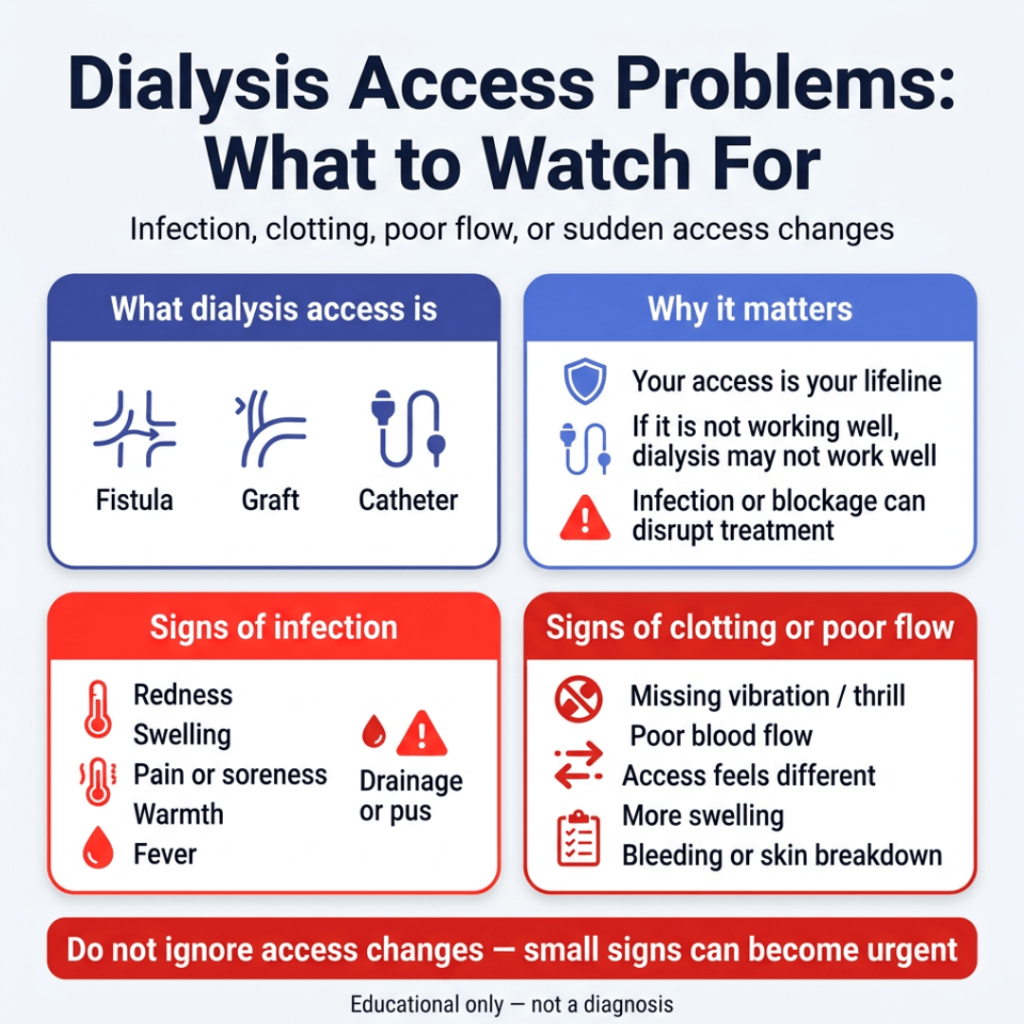
What dialysis access is
Dialysis access is the way clinicians reach the bloodstream for hemodialysis. The National Kidney Foundation explains there are three main types:
- fistula
- graft
- catheter
Fistula
A fistula is usually the preferred access because it tends to have fewer problems over time.
Graft
A graft uses a synthetic tube to connect blood flow for dialysis.
Catheter
A catheter is often used short term or when a fistula/graft is not available.
NKF’s access guide emphasizes that care involves hygiene and checking for problems no matter which type of access you have.
Why access problems matter
If the access is not working well, dialysis may not work well either. NIDDK states that infection, blockage, or poor blood flow in the access can interfere with treatment and may require additional procedures to repair or replace the access.
This is why patients are taught to watch the access closely rather than assume the dialysis center will catch every problem first.
Signs of infection at the access site
MedlinePlus gives a practical list of infection signs to watch for. Signs of infection around a dialysis access include:
- redness
- swelling
- soreness or pain
- warmth
- pus or drainage
- fever
NIDDK also advises patients to check the area for signs of infection, such as warmth or redness.
Why infection needs attention quickly
An access site connects directly to the bloodstream. That is one reason a “small” site infection should never be brushed off casually.
Signs of clotting, blockage, or poor flow
Not every access problem is infection. Sometimes the issue is clotting or poor blood flow.
MedlinePlus notes:
- blood clots may form and block the flow of blood through the access
- grafts and catheters are more likely than fistulas to clot
- blood vessels in the fistula or graft can also become narrow, slowing flow; this is called stenosis.
NIDDK says access problems can include poor blood flow or blockage from a blood clot or scar.
One important sign: the “vibration” is missing
NIDDK states that when blood is flowing well through the access, you can feel a vibration over the area and that you should tell your dialysis center if you cannot feel the vibration.
When access trouble may affect dialysis safety
Access trouble matters because it can affect whether dialysis can be done safely and effectively.
Watch closely if you notice:
- the access feels different than usual
- you cannot feel the vibration
- the arm or access area is more swollen
- there is bleeding or skin breakdown
- dialysis sessions are becoming more difficult or flow seems poor
AKF advises not to wait until the next dialysis session to speak up if something feels unusual.
Day-to-day care that helps prevent problems
A lot of prevention comes down to simple habits.
Keep it clean
NIDDK says to wash the area around your access with soap and warm water every day.
Wash your hands before touching it
MedlinePlus recommends washing your hands with soap and warm water before and after touching your access.
Protect catheters from water exposure
MedlinePlus says if you have a central venous catheter, you should keep the dressing dry at all times, cover it when showering, and avoid baths, swimming, or hot tubs.
Check the access regularly
NKF and NIDDK both emphasize routine checking for access problems.
Warning symptoms that shouldn’t wait
Seek urgent evaluation if you have any of the following:
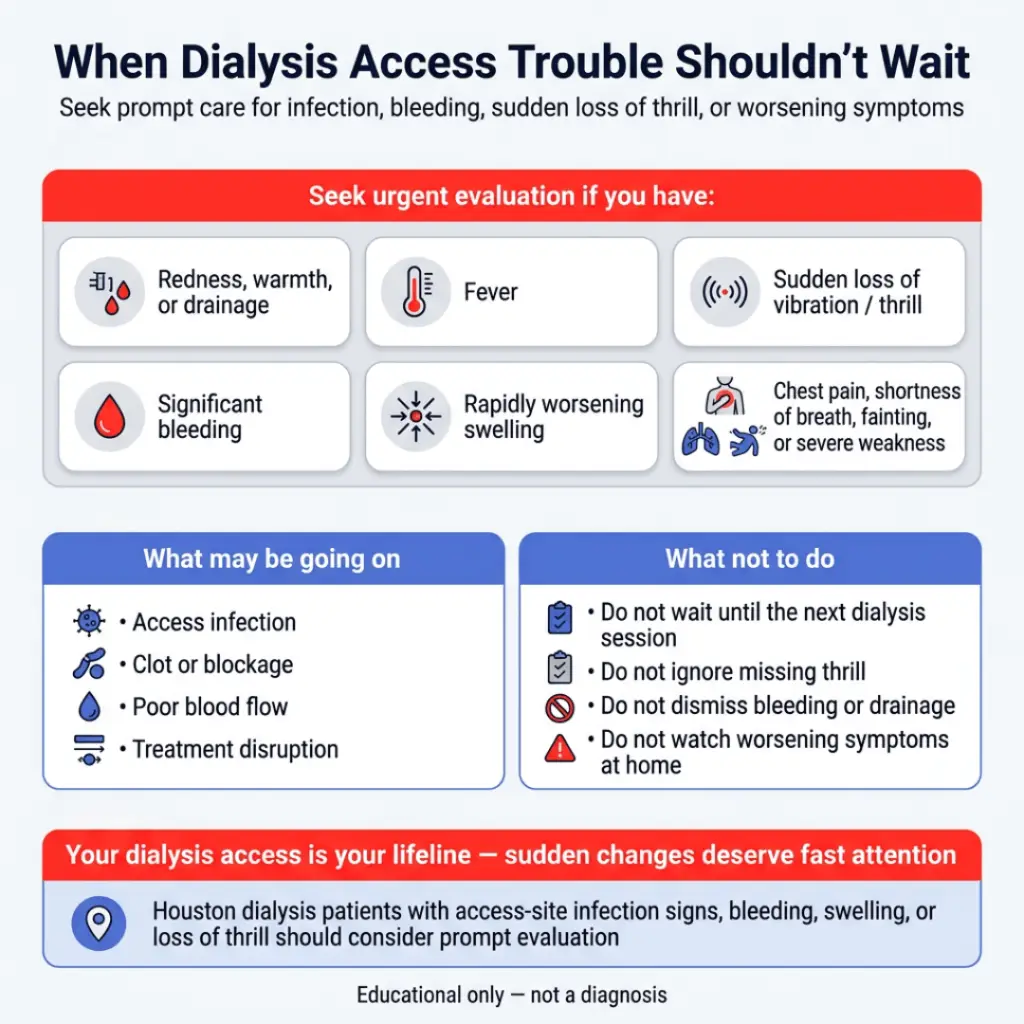
- redness, swelling, warmth, drainage, or fever around the access site
- sudden loss of the vibration/thrill
- significant bleeding
- rapidly worsening swelling of the access arm
- severe weakness, fainting, chest pain, or shortness of breath
- you missed dialysis because the access was not working and now you feel significantly worse
MedlinePlus supports urgent attention for infection signs and clot/blockage symptoms, while NIDDK states vascular-access problems are a common reason dialysis patients require hospital care.
If you’re in Houston and you’re worried about a dialysis access infection, clot, or sudden change in your access site—especially if you have fever, drainage, swelling, bleeding, or you can’t feel the vibration anymore—it’s reasonable to get evaluated promptly.
Post Oak ER states it is a 24/7 emergency room in Houston’s Post Oak & Galleria area with board-certified emergency physicians and advanced on-site diagnostics, including laboratory services and imaging such as CT, X-ray, and ultrasound. Their Houston location page also notes easy access near San Felipe, The Galleria, and Uptown Park.
Frequently Asked Questions
What does an infected dialysis access look like?
Common signs include redness, swelling, pain, warmth, pus/drainage, and fever.
What if I can’t feel the fistula vibration anymore?
NIDDK says to let your dialysis center know if you cannot feel the vibration over the access, because it may mean poor blood flow or blockage.
Are grafts and catheters more likely to get infected?
Yes. MedlinePlus states grafts and catheters are more likely than fistulas to become infected.
Can access problems be an emergency?
Yes. Infection, significant bleeding, or sudden loss of access function can become urgent quickly because the access is essential for dialysis. NIDDK states vascular-access problems are the most common reason someone on hemodialysis goes to the hospital.
Should I wait until my next dialysis session to mention it?
No. AKF specifically says don’t wait for your next dialysis session if you notice something unusual with the access.