
Key Takeaways
- With AFib, “dangerous” isn’t just a heart-rate number—it’s a fast/irregular rhythm plus symptoms (or signs you’re not tolerating it).
- AFib raises stroke risk mainly because blood can pool in the atria, form clots, and a clot can travel to the brain (an embolic ischemic stroke).
- Stroke warning signs are sudden: face/arm weakness, speech trouble, vision trouble, balance trouble, severe headache—call 911 right away.
- AFib is common and important: CDC notes AFib is associated with an ~fivefold increased risk of ischemic stroke (after accounting for standard risk factors) and causes about 1 in 7 strokes.
what is a dangerous heart rate with AFib?
Here’s the honest answer:
A dangerous heart rate with AFib is one that your body isn’t tolerating well. That usually shows up as symptoms—chest pain/pressure, severe shortness of breath, fainting/near-fainting, confusion, extreme weakness—or any sign of stroke.
Why I’m careful about giving a one-size-fits-all “dangerous BPM”:
- People have different baselines.
- A smartwatch number can be wrong (or incomplete).
- The same rate can feel very different in different people depending on age, medications, heart function, dehydration, infection, and more.
So in practice, we don’t anchor on one number first. We anchor on stability and symptoms.
What AFib is
Atrial fibrillation (AFib) is an abnormal rhythm where the upper chambers of the heart (the atria) don’t contract in a coordinated way. Blood doesn’t move as smoothly from atria to ventricles, and the heartbeat can become irregular and sometimes much faster than normal.
Two important details from major references:
- Some people have AFib and don’t feel symptoms at all.
- Others feel a mix of: rapid/irregular heartbeat, fluttering, dizziness/lightheadedness, shortness of breath, weakness, fatigue, faintness/confusion, sweating—and sometimes chest pain or pressure (which should be treated as an emergency).
AFib vs “my heart is racing”
Plenty of things can make your heart beat faster: stress, caffeine, dehydration, fever, pain, exercise.
AFib is different because it’s typically:
- irregular (not just fast)
- can happen at rest
- can come with symptoms like lightheadedness, shortness of breath, weakness, or chest discomfort
What makes AFib “dangerous” in the moment
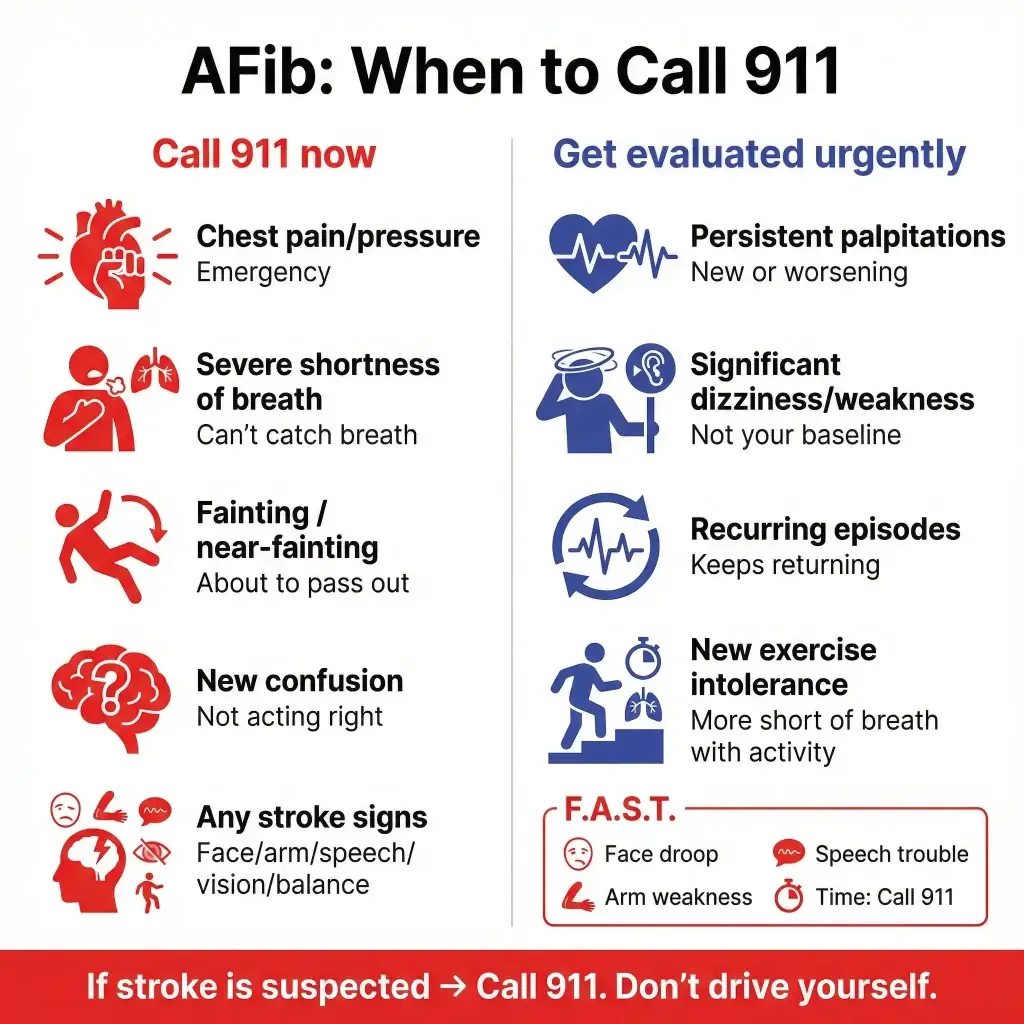
In the ER, the question isn’t “Is your heart rate high?” as much as:
Are you stable, and is your body getting what it needs (oxygenated blood flow)?
“Call 911 now” symptoms (don’t negotiate with these)
If any of these are happening with AFib symptoms, call 911:
- Chest pain or pressure (AHA calls this a medical emergency—call 911).
- Severe shortness of breath.
- Fainting or “I feel like I’m about to pass out.”
- New confusion or you can’t stay awake. (AHA lists “faintness or confusion” among AFib symptoms; confusion with any severe symptoms should be treated urgently.)
- Any stroke symptoms (face droop, arm weakness, speech trouble, sudden vision/balance problems, severe sudden headache).
“Get evaluated urgently” symptoms
These don’t always require an ambulance, but they should not be ignored—especially if they’re new for you:
- Persistent palpitations with significant dizziness or weakness
- New shortness of breath or worsening exercise tolerance
- Symptoms that keep returning (“episodes”)
AFib can occur in episodes (paroxysmal), last longer than a week (persistent), or be long-standing/permanent—so recurring symptoms are worth medical attention.
AFib and stroke: what actually raises the risk
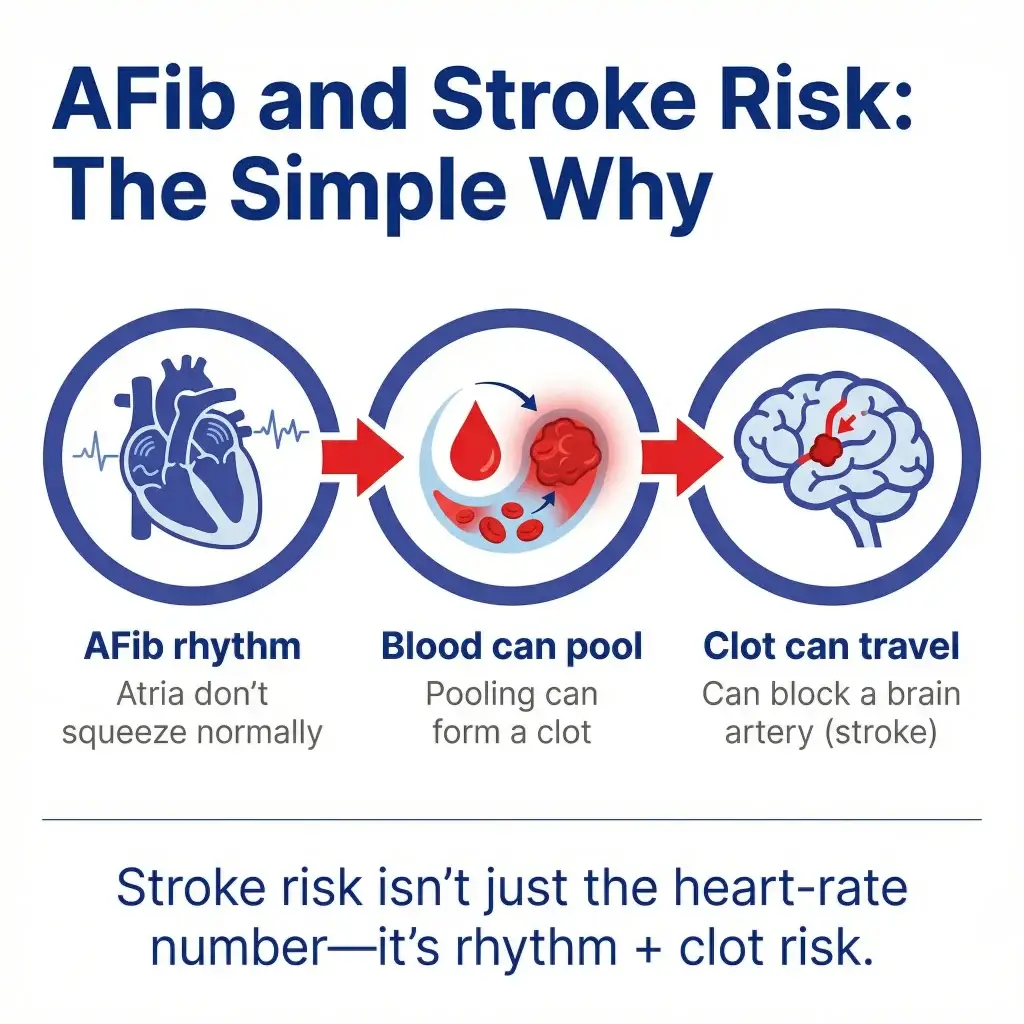
A lot of people assume the stroke risk comes from “fast heart rate.” That’s not the core mechanism.
The core mechanism is clot formation.
When the atria quiver/contract irregularly, blood may not be squeezed forward efficiently. Blood can pool, clot risk increases, and a clot can be pumped out to the brain and block an artery—an embolism causing an ischemic stroke.
The American Stroke Association describes it plainly: blood pools, pooled blood can clot, and a clot can travel to the brain and cause stroke.
How much does AFib raise stroke risk?
CDC’s summary is blunt and useful:
- After accounting for standard risk factors, AFib is associated with an approximately fivefold increased risk of ischemic stroke.
- AFib causes about 1 in 7 strokes.
So even if your heart rate doesn’t feel “crazy” today, AFib can still matter—because the stroke risk is about rhythm and clotting, not just how fast you feel your pulse.
Can a Fast Heart Rate Cause a Stroke?
A very fast heart rate can make you feel very unwell and can sometimes be dangerous. It may cause low blood pressure, chest pain, shortness of breath, dizziness, or fainting.
But in AFib, the main stroke risk usually does not come from the heart beating fast. The bigger problem is that blood can collect in the heart, form a clot, and that clot can travel to the brain and cause a stroke.
Stroke symptoms you should never ignore
When AFib and stroke meet, time matters. And the first battle is recognition.
CDC lists these stroke warning signs (in men and women) as sudden:
- numbness/weakness in face, arm, or leg—especially one side
- confusion, trouble speaking, or difficulty understanding
- trouble seeing in one or both eyes
- trouble walking, dizziness, loss of balance/coordination
- severe headache with no known cause
…and says: Call 9-1-1 right away if you see any of these.
The American Stroke Association also emphasizes: stroke is an emergency; call 911 immediately and note the time symptoms first appear.
And if you want the “why” behind the urgency, ASA states: on average, 1.9 million brain cells die every minute a stroke goes untreated.
TIA (mini-stroke): symptoms that go away still count
A common trap is, “It passed, so I’m okay.”
What you should do right now
Here’s the clean, practical plan:
If severe symptoms or stroke symptoms are happening now
- Call 911.
- Note the time symptoms started (or last known well).
- Don’t drive yourself if you’re faint, confused, or having neurologic symptoms.
- Don’t delay because you’re trying to “confirm” it’s AFib or stroke—treat the pattern.
If you feel palpitations but you’re stable
This is where a calm, same-day plan helps:
- If this is new, recurrent, or worsening, contact your clinician promptly for evaluation.
- If it escalates into chest pain, severe shortness of breath, fainting/near-fainting, confusion, or stroke symptoms—upgrade to emergency response.
What to expect in the ER for AFib with a rapid/irregular heart rate
Here’s what usually happens in the ER:
First priorities
- Check vital signs and stability (blood pressure, oxygen level, mental status).
- Get an ECG to document the rhythm (AFib vs another arrhythmia).
- Look for triggers (dehydration, infection/fever, thyroid issues, stimulant use, medication changes, etc.).
If stroke symptoms are present
The focus shifts immediately to stroke evaluation and time-critical decision making. That’s why the “last known well” time matters so much.
What you can do to lower stroke risk with AFib
This is not a DIY-medication section, but it is a clarity section.
CDC notes AFib treatment often includes:
- medicines to control rhythm/rate
- blood-thinning medicine to prevent clots and reduce stroke risk
- procedures/surgery in some cases
- lifestyle changes to manage risk factors
And the risk factors list matters because AFib rarely shows up alone. CDC lists common risk factors including age, high blood pressure, obesity, diabetes, heart failure, ischemic heart disease, kidney disease, smoking, and more.
So the “big picture” is usually:
- manage AFib with your care team
- address risk factors (blood pressure, diabetes, smoking, sleep, weight, alcohol)
- treat stroke warning signs as emergencies—no waiting
When AFib Symptoms Feel Serious, Don’t Wait
If you have chest pain, severe shortness of breath, fainting/near-fainting, confusion, or any signs of stroke, treat it like an emergency. Fast or irregular heart rhythms with AFib can become dangerous quickly, and stroke symptoms should never be ignored.
Come to Post Oak ER for emergency evaluation, 24/7.
If you think you may be having a stroke or your symptoms are severe, call 911 immediately.
Frequently Asked Questions
What is a dangerous heart rate with AFib?
Dangerous usually means the rate/rhythm plus symptoms (chest pain, severe shortness of breath, fainting/near-fainting, confusion) or any stroke symptoms.
Is a fast heart rate in AFib always dangerous?
Not always—but it’s never something to ignore long-term. Some people tolerate episodes; others become unstable quickly. The safer approach is symptom-based: if you have severe symptoms, treat it as an emergency.
What symptoms with AFib mean I should call 911 right now?
Chest pain/pressure, severe shortness of breath, fainting/near-fainting, or any stroke symptoms.
Can AFib cause a stroke?
Yes. AFib can allow blood to pool, form clots, and clots can travel to the brain and block blood flow (ischemic stroke).
Why does AFib increase the risk of stroke?
Because irregular atrial contraction can reduce forward flow, promote pooling, and increase clot formation risk; a clot can embolize to the brain.
Does AFib increase stroke risk even if I feel fine?
Yes. CDC notes some people have AFib without symptoms, and AFib is still associated with markedly higher ischemic stroke risk.
What type of stroke is caused by atrial fibrillation?
Commonly an embolic ischemic stroke (a clot travels and blocks a brain artery).
What are the signs of a stroke I should never ignore?
Sudden face/arm weakness (often one-sided), speech trouble, vision trouble, balance trouble, or severe headache—call 911 right away.
If symptoms come and go, could it still be a TIA (mini-stroke)?
Yes. CDC says TIAs are “warning strokes,” are medical emergencies, and early on you can’t reliably tell TIA vs major stroke—call 911.
What should I expect in the ER for AFib with a rapid heart rate?
Typically: quick stability check, ECG confirmation, evaluation for triggers, and stroke evaluation if neurologic symptoms are present.