

A lot of people use the word UTI to describe any urinary infection, but there is an important difference between a bladder infection and a kidney infection. A bladder infection usually stays in the lower urinary tract. A kidney infection happens when infection travels higher and involves one or both kidneys, and it can become much more serious.
The simplest way to think about it is this:
Bladder infection usually causes burning, urgency, frequency, and lower abdominal pressure.
Kidney infection is more likely to cause fever, chills, back or side pain, nausea, or vomiting.
That difference matters because a kidney infection is the kind of problem you do not want to “wait out” at home.
Educational only. This is not medical advice or a diagnosis.
What is a bladder infection?
A bladder infection is a type of urinary tract infection caused most often by bacteria that enter the bladder and multiply. NIDDK describes it as a common form of UTI in adults.
Common bladder infection symptoms
CDC lists bladder infection symptoms such as:
- pain or burning while urinating
- frequent urination
- feeling like you need to urinate even when the bladder is empty
- bloody urine
- pressure or cramping in the groin or lower abdomen.
NIDDK also highlights burning with urination and frequent urges as typical bladder infection symptoms.
What is a kidney infection?
A kidney infection is also a UTI, but it is an infection that reaches the kidney. Mayo Clinic states that a urinary tract infection that travels to the kidneys can be dangerous and needs prompt treatment.
Common kidney infection symptoms
CDC lists kidney infection symptoms such as:
- fever
- chills
- lower back pain or pain in the side of your back
- nausea or vomiting.
Mayo Clinic and NIDDK similarly describe kidney infection symptoms that can include back/side pain, fever, nausea, and vomiting.
The easiest way to tell the difference
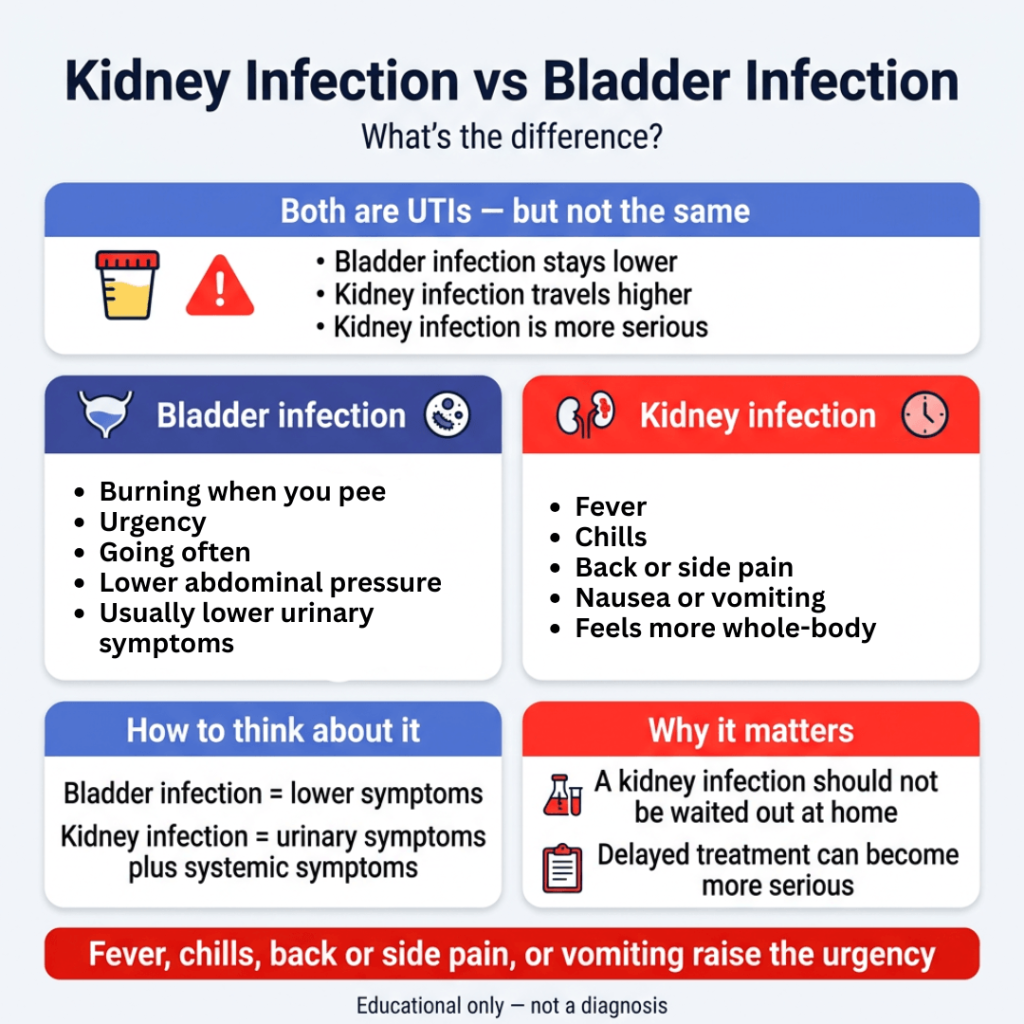
Bladder infection tends to stay “lower”
If the main symptoms are:
- burning with urination
- needing to go often
- urgency
- lower pelvic pressure
it is more consistent with a bladder infection.
Kidney infection tends to feel more “whole-body”
If urinary symptoms are now happening with:
- fever
- chills
- back or side pain
- nausea or vomiting
it is more consistent with a kidney infection, and the urgency goes up.
Why this matters
Mayo Clinic warns that if a kidney infection is not treated properly, it can damage the kidneys or spread to the bloodstream and become dangerous.
Can a bladder infection turn into a kidney infection?
This is one of the biggest reasons not to ignore persistent urinary symptoms—especially if they start changing in character or are joined by fever, vomiting, or flank pain.
Who is more likely to get a bladder infection or kidney infection?
Mayo Clinic notes that women have a higher risk of UTIs than men, partly because of anatomy.
CDC also notes risk factors such as:
- prior UTIs
- recent sexual activity
- pregnancy
- menopause-related changes
- older age
- structural or emptying problems in the urinary tract.
When urine does not flow normally or bacteria are able to linger, the chance of infection—and of infection moving upward—can increase.
How doctors diagnose the difference
NIDDK states that health care professionals use:
- medical history
- physical exam
- and lab tests
- to diagnose a bladder infection.
Urine testing
Urine testing is central. It helps confirm infection and can show what kind of bacteria may be involved. Mayo Clinic notes that urine testing helps identify the bacteria and guide treatment.
Imaging (when needed)
If symptoms are severe, recurrent, or not improving as expected, imaging may be used—especially if there is concern for blockage, stone, or a complicated kidney infection. Mayo Clinic includes imaging in the diagnostic/treatment pathway for more serious kidney infections.
Treatment: why timing matters
Bladder infection treatment
NIDDK states bladder infections are commonly treated with antibiotics.
Kidney infection treatment
Mayo Clinic states that antibiotics are the first line of treatment for kidney infections, and more severe cases may require hospital-level care. It also notes that symptoms often start improving within a few days, but the full antibiotic course must be completed.
The key difference is not just the medicine. It is the risk level if treatment is delayed. A kidney infection is more likely to cause complications than a simple lower UTI.
Warning symptoms that shouldn’t wait
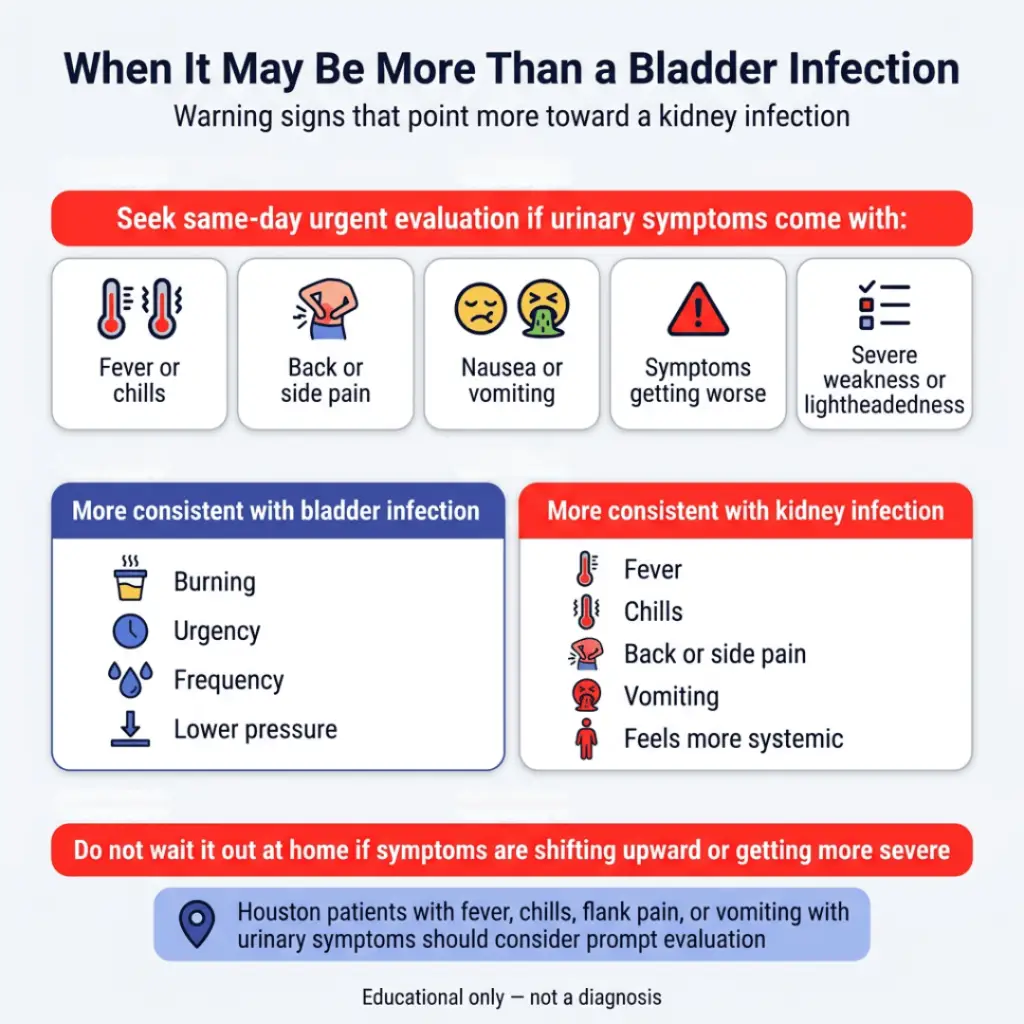
Seek same-day urgent evaluation if you have:
- fever or chills with urinary symptoms
- back or side pain plus burning/frequency
- nausea or vomiting
- symptoms of a UTI that are getting worse instead of better
- severe weakness, lightheadedness, or feeling suddenly much sicker
CDC’s symptom breakdown and Mayo Clinic’s kidney infection guidance both support treating those patterns as higher urgency.
If you’re in Houston and your symptoms seem more like a kidney infection than a simple bladder infection—especially if you have fever, chills, back/side pain, or vomiting—it’s reasonable to get checked promptly.
Post Oak ER states it is a 24/7 emergency room in Houston’s Post Oak and Galleria area with board-certified physicians and on-site labs and imaging. Its Houston location page also notes easy access from nearby areas and that in-house diagnostics help evaluate urgent symptoms quickly.
Frequently Asked Questions
Can a bladder infection turn into a kidney infection?
Yes. NIDDK states that untreated bladder infections can spread to the kidneys.
Does a kidney infection always cause fever?
Fever is a common symptom, but not every person presents exactly the same way. CDC lists fever, chills, back/side pain, and nausea/vomiting as typical kidney infection symptoms.
Do both bladder infections and kidney infections need antibiotics?
Usually, yes. NIDDK and Mayo Clinic both describe antibiotics as the standard starting treatment.
Can I tell the difference at home for sure?
Not always. The symptoms can overlap, and urine testing is often needed—especially if symptoms are worsening or more systemic.
When should I stop waiting and get checked?
If you have fever, chills, flank pain, vomiting, or rapidly worsening symptoms, it should not be delayed.