

Flank pain usually refers to pain on either side of your lower back, between your ribs and pelvis. It can come from something relatively straightforward, like a muscle strain, or from a kidney-related problem such as a kidney stone or kidney infection. Cleveland Clinic lists kidney stones, UTIs, and muscle strains among the common causes.
The reason this symptom matters is simple: some causes can wait for outpatient follow-up, while others should be checked much sooner—especially if you also have fever, vomiting, blood in the urine, or trouble urinating. Mayo Clinic specifically advises same-day medical attention for one-sided side/back pain when it comes with fever, urinary pain, blood in urine, or vomiting.
Educational only. This is not medical advice or a diagnosis.
What flank pain actually means
Flank pain affects the area on either side of your lower back, between the pelvis and ribs. It can be dull or sharp, mild or severe, and it may come on suddenly or build over time. Cleveland Clinic notes that treatment depends entirely on the cause—sometimes rest is enough, and sometimes testing or more urgent care is needed.
A helpful practical rule is this: not all back pain is kidney pain, and not all kidney pain feels the same. Kidney-related pain is often deeper, more one-sided, and more likely to come with urinary or whole-body symptoms. Mayo Clinic notes kidney pain is usually felt on one side and often occurs along with fever or urinary symptoms.
Flank pain from a kidney stone
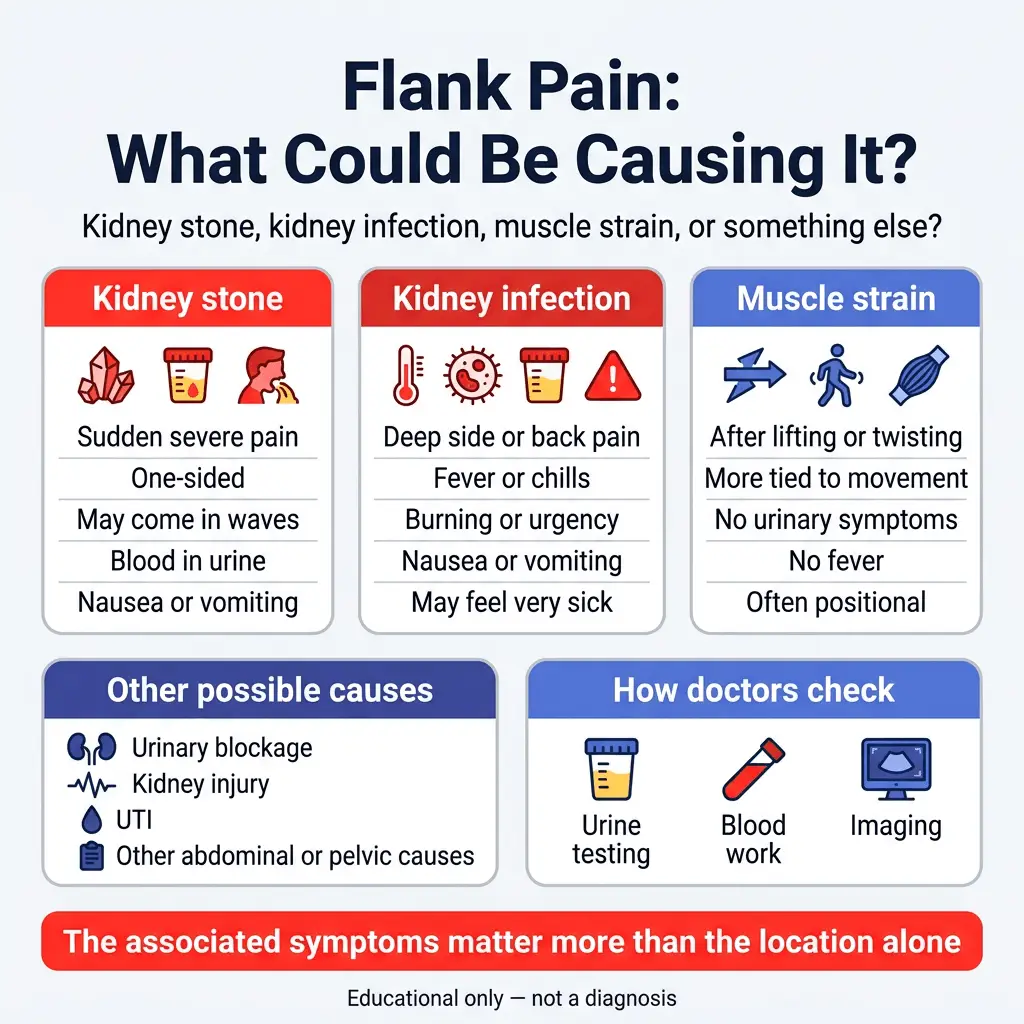
A kidney stone is one of the most common reasons people search for flank pain. NIDDK lists kidney stone symptoms such as sharp pain in the lower back, blood in the urine, nausea and vomiting, urinary urgency, and sometimes fever and chills.
What kidney stone pain usually feels like
Kidney stone pain often:
- starts suddenly
- feels sharp or severe
- happens more on one side
- may radiate toward the lower abdomen or groin
- may come and go in waves as the stone moves
Mayo Clinic and Cleveland Clinic both describe kidney stone pain that can radiate and worsen in waves.
When flank pain points more strongly to a stone
Flank pain is more suspicious for a kidney stone when it comes with:
- blood in the urine
- nausea or vomiting
- frequent urge to urinate
- pain that seems to move lower over time
- sudden severe pain that is hard to sit still through
Flank pain from a kidney infection
A kidney infection is a different problem entirely. It is a urinary tract infection that has moved up into the kidney, and it can make you feel much sicker than a simple bladder infection. Mayo Clinic lists kidney infection symptoms such as fever, chills, back/side pain, nausea/vomiting, painful urination, frequent urination, and blood or cloudy urine.
What kidney infection pain usually feels like
Kidney infection pain is often:
- deep pain in the side or lower back
- paired with fever or chills
- paired with urinary symptoms like burning or urgency
- more likely to make you feel systemically sick
Cleveland Clinic notes that a kidney infection is more likely than a lower UTI to suddenly make you feel sick, cause a fever, or cause pain in your lower back or side.
When flank pain points more strongly to infection
Flank pain becomes more concerning for kidney infection when it comes with:
- fever
- chills
- burning when you pee
- urinary urgency/frequency
- vomiting
- cloudy or bad-smelling urine
Flank pain from a muscle strain
Not all flank pain is coming from the kidneys. Cleveland Clinic includes muscle strains among the common causes of flank pain.
In day-to-day life, muscular pain is often more likely when:
- symptoms started after lifting, twisting, exercise, or awkward movement
- the pain feels more tied to movement or position
- there are no urinary symptoms
- there is no fever, nausea, or vomiting
That does not mean it is “safe by default.” It just means the pattern is different. If the pain is unexplained, persistent, or comes with urinary or whole-body symptoms, it should not be dismissed as “just a strain.” Mayo Clinic’s kidney pain guidance specifically says one-sided side/back pain with urinary symptoms, fever, or vomiting deserves prompt attention.
Other possible causes of flank pain
Flank pain is a symptom—not a diagnosis. Cleveland Clinic notes that several conditions can cause it, ranging from musculoskeletal injuries to urinary causes and other diseases or injuries.
A few patterns clinicians think about include:
- urinary blockage
- kidney injury
- urinary infections
- stone-related pain
- musculoskeletal pain
- other abdominal or pelvic causes
The main point is this: the location alone does not tell the whole story. The associated symptoms often matter more.
How doctors usually evaluate flank pain
When flank pain needs medical evaluation, the workup usually depends on whether the bigger concern is stone, infection, obstruction, or another cause.
Urine testing
Urine testing can be very helpful. NIDDK notes that for kidney stones, urinalysis may show blood, while white blood cells and bacteria may suggest a urinary tract infection.
Blood work
If infection, dehydration, or kidney function problems are possible, blood tests may be used to help assess how serious things are. Cleveland Clinic notes diagnosis depends on the suspected cause and may include testing.
Imaging
If a stone is suspected—or if symptoms are severe or complicated—imaging may be used. NIDDK explains imaging tests can help locate stones and show whether there is a blockage.
Warning symptoms that shouldn’t wait
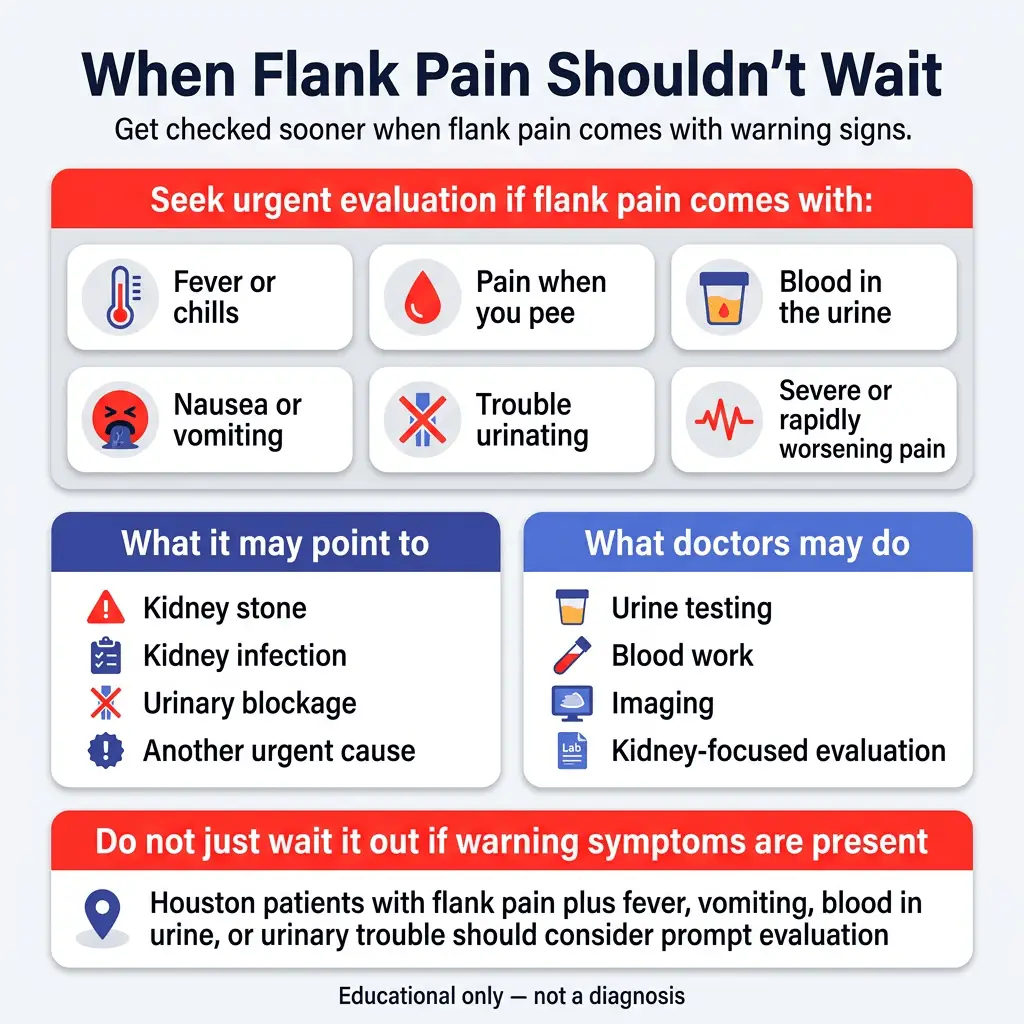
Flank pain should be evaluated urgently if it comes with:
- fever or chills
- pain when you pee
- blood in the urine
- nausea or vomiting
- trouble urinating
- pain that is severe, constant, or rapidly worsening
Mayo Clinic specifically recommends same-day medical attention for one-sided side/back pain when it is paired with fever, urinary pain, blood in urine, or vomiting.
NIDDK also notes that kidney stone symptoms can include vomiting, fever, chills, and inability to urinate, which are not “wait it out” symptoms.
If you’re in Houston and you’re dealing with flank pain plus warning symptoms that shouldn’t wait, it’s reasonable to get checked promptly—especially if you’re worried this could be a kidney stone or kidney infection.
Post Oak ER states it is a 24/7 emergency room in Houston’s Post Oak & Galleria area with board-certified physicians, plus on-site CT, ultrasound, X-ray, and lab services. Their Houston location page notes it is located near The Galleria and Uptown Park, with many patients reaching the facility via Westheimer or Woodway.
Frequently Asked Questions
Where is flank pain located?
Flank pain is felt on either side of the lower back, between the ribs and pelvis.
Is flank pain always kidney-related?
No. Muscle strain is also a common cause. Cleveland Clinic lists kidney stones, UTIs, and muscle strains among the common causes.
What does kidney stone flank pain feel like?
It is often sudden, severe, one-sided, and may come in waves or radiate toward the groin.
What does kidney infection flank pain feel like?
It often comes with fever, chills, urinary symptoms, and nausea/vomiting.
When should I go in for flank pain?
If it comes with fever, blood in urine, vomiting, painful urination, or severe worsening pain, it should not be delayed.