
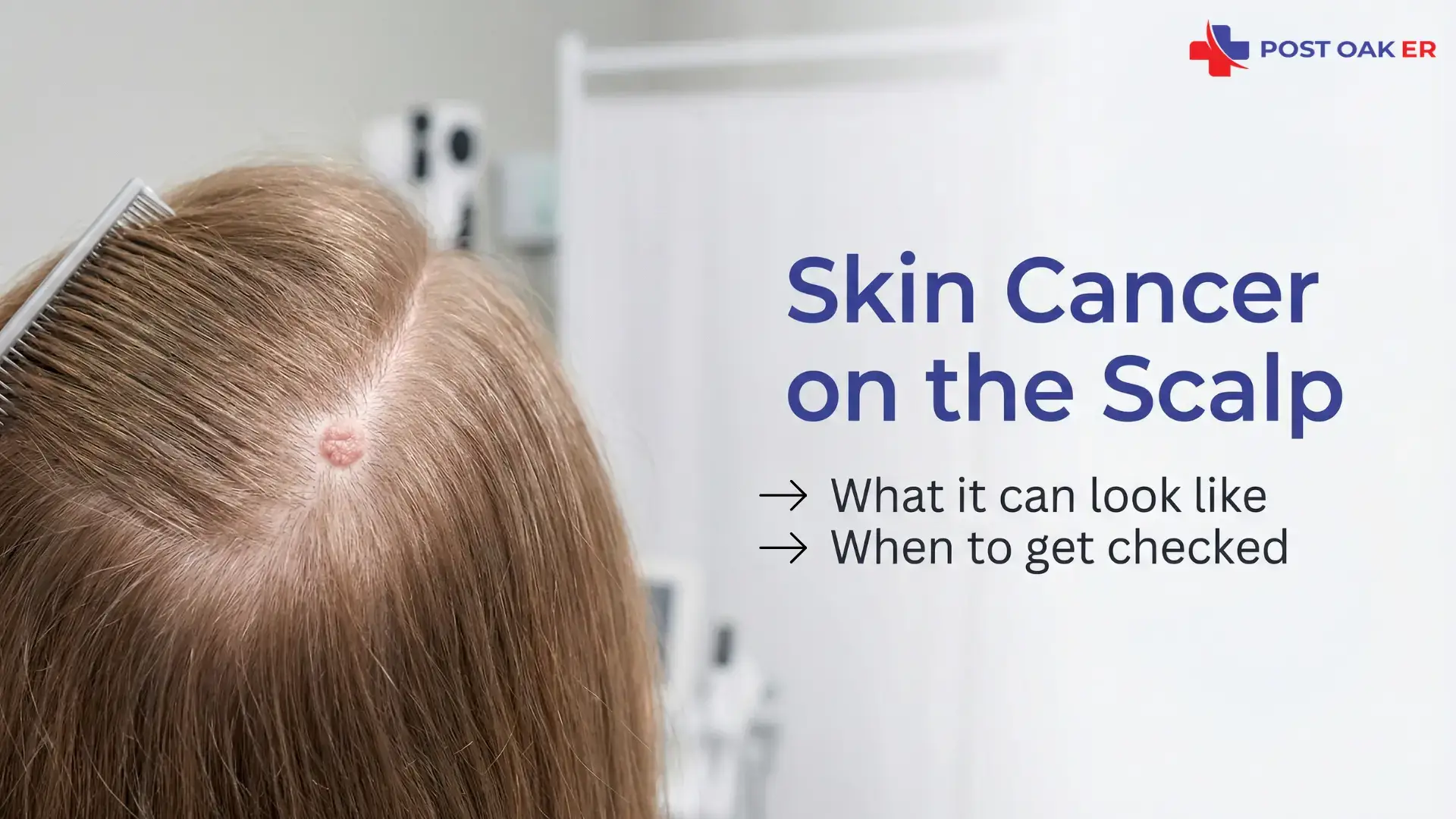
If you found a stubborn spot on your scalp—something that won’t go away, keeps scabbing, or looks “different” than it used to—you’re not alone. Skin cancer on scalp is a real concern because the scalp is easy to miss (it’s covered by hair, hard to see in mirrors, and often ignored during quick self-checks). And at the same time, many scalp changes are not cancer—things like irritation, cysts, psoriasis, seborrheic dermatitis, or folliculitis can look scary but are treatable.
What this means
When people say “skin cancer on the scalp,” they’re usually talking about one of three common categories:
- Basal cell carcinoma (BCC) — often shows up as a non-healing sore or a shiny/pearly bump.
- Squamous cell carcinoma (SCC) — can look like a rough/scaly patch, a thickened bump, or a sore that crusts/bleeds.
- Melanoma — may look like a new or changing mole/spot, sometimes darker, sometimes not.
The tricky part: the scalp is hard to examine, and small changes can hide under hair for months. That’s why “when to get checked” matters as much as “what it looks like.”
How common is melanoma in Texas
Most public cancer registries track melanoma reliably, but non-melanoma skin cancers (like many BCCs/SCCs) aren’t always captured the same way in population-level dashboards. So when you see big, clean numbers, they’re often for melanoma.
In Texas, the age-adjusted incidence rate for melanoma of the skin (all stages, 2018–2022) is 15.4 cases per 100,000 people per year. For comparison, the U.S. rate is 23.1 per 100,000 over the same period.
If you’re looking for Harris County–level numbers, State Cancer Profiles provides county tables you can filter down to your county (including Texas).
And the Texas Department of State Health Services (Texas Cancer Registry) is the statewide home for cancer statistics and reporting.
What skin cancer on the scalp can look like (early vs later)

Early signs
Skin cancer on the scalp doesn’t always come in with dramatic symptoms. Early changes can look like:
- A new spot you don’t remember having
- A mole or mark that’s changing (size, shape, color, texture)
- A rough, scaly patch that feels different when you run your fingers over it
- A spot that becomes itchy or tender for no clear reason
This is where people commonly ask: what does skin cancer on the scalp look like? The honest answer is: it can look like several different things, depending on the type—so the better question is, “Is it new, changing, or not healing?”
Later signs
These are the patterns that deserve faster attention:
- A sore that doesn’t heal
- A spot that crusts, scabs, or reopens
- A lesion that bleeds easily, especially with brushing, washing, or scratching
- A spot that becomes painful or increasingly irritated
People also commonly search: does skin cancer bleed and does skin cancer itch. It can. But bleeding/itching alone doesn’t confirm anything—what matters most is persistence + change.
Melanoma warning pattern (ABCDE + the “ugly duckling” clue)

For melanoma, clinicians often teach a pattern called ABCDE:
- A — Asymmetry: one half doesn’t match the other
- B — Border: edges look irregular, ragged, or blurred
- C — Color: multiple colors or uneven shading
- D — Diameter: often larger than a pencil eraser (but can be smaller)
- E — Evolving: changing over time (this is a big one)
Another helpful concept is the “ugly duckling” sign: a spot that looks noticeably different from the others on your body.
On the scalp, the “E” (evolving) part is especially important—because you may not notice it unless you’re intentionally checking.
Who’s more at risk (scalp-specific and real-life)
Anyone can get skin cancer. But your risk is higher if you have certain factors—many of which show up in everyday life:
Higher-risk profiles
- Lighter natural skin tone, or skin that burns/freckles easily
- Blue/green eyes, blond/red hair
- A history of sunburns or tanning
- A family history of skin cancer
- A personal history of skin cancer
- Older age (risk increases with time and cumulative exposure)
Scalp-specific realities
- Thinning hair or bald spots (more UV exposure directly on scalp skin)
- Outdoor work, sports, or long commutes with sun exposure
- Not wearing a hat consistently
- A “part line” that burns repeatedly
A key point: UV exposure is a major driver of skin cancer risk, whether it’s from the sun or artificial sources like tanning beds.
Go To The ER Now
Most scalp spots are not emergencies, but if you have bleeding that won’t stop with firm pressure, rapid swelling or severe pain, signs of infection such as spreading redness, warmth, drainage, or fever, or symptoms like dizziness, fainting, confusion, chest pain, or shortness of breath, go to Post Oak ER, open 24/7 for urgent evaluation. If you think you’re having a life-threatening emergency, call 911.
What doctors may do next
If a scalp lesion looks suspicious, clinicians typically start with:
- A focused scalp and skin exam (sometimes checking nearby lymph nodes depending on what’s seen)
- A plan for definitive diagnosis if needed—which usually means a biopsy (removing part or all of the spot so it can be examined under a microscope).
- Referral/coordination (often dermatology) depending on how urgent the finding is and what resources are appropriate.
If the issue is clearly infection-driven, the “next steps” may focus on that first. If bleeding is the main issue, the priority is stopping it safely and preventing complications.
What you can do today
Here are practical, safe steps that help without trying to self-diagnose:
- Take a clear photo (use good lighting). If possible, put a small reference next to it (like a clean coin) for size.
- Track changes: write down when you first noticed it and whether it’s changing.
- Don’t pick at it: repeated trauma can cause bleeding/inflammation and make it harder to assess.
- Protect your scalp from UV exposure:
- Wear a hat when you’ll be outside for extended time
- Use sun protection strategies consistently (especially if hair is thinning or you have a visible part line)
- Check your scalp systematically once in a while:
- Use two mirrors, or ask a trusted person to look
- Many people notice scalp changes during haircuts—consider asking your barber/stylist to tell you if they see a spot that looks new or unusual
Not every “weird spot” is cancer. But if it’s new, changing, or not healing, it deserves a real medical look.
Frequently Asked Questions
What does skin cancer on the scalp look like?
It can look like a non-healing sore, a scaly patch, a shiny bump, or a new/changing mole-like spot. The most important pattern isn’t one exact look—it’s change over time or failure to heal.
Can you get skin cancer on your scalp even if you have hair?
Yes. Hair offers some protection, but it doesn’t block all UV exposure—especially along the part line, hairline, or thinning areas.
Does skin cancer itch on the scalp?
Sometimes. Does skin cancer itch? It can—some skin cancers may itch, feel tender, or become painful. But itchiness alone isn’t proof. It’s more concerning when itch happens with a new, changing, or non-healing lesion.
Does skin cancer bleed easily?
It can. Does skin cancer bleed when you brush your hair or scratch? Some suspicious lesions can bleed or crust repeatedly, especially if they’re fragile or irritated. If bleeding is persistent or hard to stop, get evaluated.
Does skin cancer look like a scab?
It can. People often ask does skin cancer look like a scab because some lesions repeatedly scab, crust, and reopen. A scab that “never fully heals” is a reason to get checked—especially if it keeps returning in the same spot.
Does skin cancer cause hair loss?
Sometimes a scalp lesion can disrupt hair growth in a small area—either because of inflammation, scarring, infection, or a growth affecting the skin. Hair loss isn’t automatically cancer, but a new spot with localized hair loss + persistent change should be evaluated.